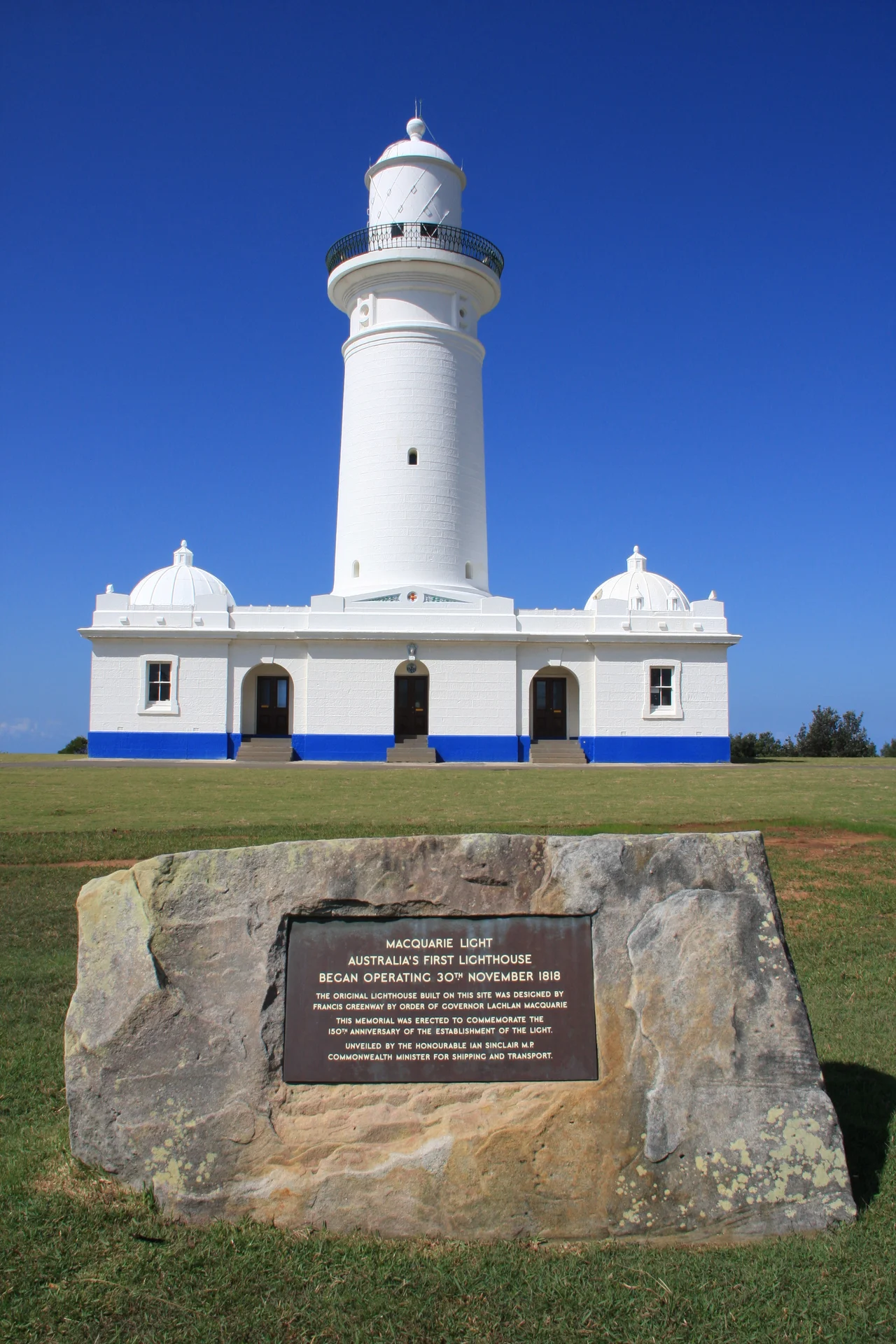

Macquarie Lighthouse
A light has burned on this clifftop for longer than any other in Australia. Stand on Dunbar Head at Vaucluse, on the southern jaw of Sydney Harbour's entrance, and you are looking at the spot where the colony first decided to push back against the dark. Ships had been wrecking themselves on these sandstone cliffs for years. In 1818 a tower rose here to answer them, and in one form or another a beam has swept this stretch of the Tasman Sea ever since. The lighthouse you see today, completed in 1883, is not the original, but it is a deliberate echo of it, raised on almost the same ground.
A Convict's Tower
The first lighthouse was the work of a convict. Francis Greenway had been transported to New South Wales for forgery, yet his talent as an architect was too valuable to waste, and Governor Lachlan Macquarie set him to designing the colony's grandest public works. The foundation stone of the Macquarie Tower was laid on 11 July 1816, and the light was first shown in 1818, making it the earliest lighthouse on the continent. Building it nearly broke everyone involved. The young colony had little quality stone and fewer skilled hands, and Greenway clashed repeatedly with his supervisor over how best to proceed. The local sandstone proved soft and crumbling. Within decades the tower was decaying so badly that iron bands had to be strapped around it to hold it together, and Greenway himself is said to have predicted it would not last.
The Wreck of the Dunbar
The need for a reliable light was written in disaster. On a wild August night in 1857, the immigrant ship Dunbar approached Sydney Heads and, in the storm and confusion, mistook a notch in the cliffs known as The Gap for the harbour entrance. The ship was driven onto the rocks below South Head and broke apart. Of the roughly 122 people aboard, only one survived, a sailor flung onto a ledge where he clung for hours until rescuers hauled him up. The wreck stunned Sydney; many of the dead were colonists returning home to family. Days later, the Catherine Adams was lost on North Head. The tragedies exposed how poorly the harbour mouth was marked, and the following year the Hornby Light was built at the very tip of South Head to make the entrance unmistakable.
The World's Most Powerful Light
By 1878, with Greenway's tower failing, approval came to replace it. The colonial architect James Barnet designed a near-replica, stronger in stone and structure, built between 1881 and 1883 just beside the original. When the old lantern was removed, the first tower was demolished. Barnet's lighthouse was extraordinary for its time. Its giant lens, made by Chance Brothers of Birmingham, threw a beam visible for 25 nautical miles. In clear weather a gas burner sufficed, but in foul weather an electric arc lamp took over, powered by de Méritens magneto generators driven by a Crossley coal-gas engine. On the worst nights a second generator joined in, producing a six-million-candela beam, the most powerful lighthouse light in the world. One of those generators and an arc lamp still survive, displayed at the site.
The Long Watch Ends
For most of its life the lighthouse needed people. Keepers and their families lived in the sandstone quarters Barnet designed, tending the light through every night and every storm, watching for ships and for trouble. During the Second World War the headland bristled with new defences, an observation post and a hidden shaft and tunnel cut into the cliff east of the tower. But technology slowly made the lonely vigil unnecessary. In 1912 the light was converted to a cheaper kerosene mantle; in 1933 it was wired to mains electricity, and the bivalve Fresnel lens it still uses was installed. In 1976 the lighthouse was fully automated, and in 1989 the last lightstation staff packed up and left. After roughly 170 years, no one needed to keep the watch by hand any longer.
Still Burning
The light has not gone out. The Macquarie Lighthouse remains fully operational under the Australian Maritime Safety Authority, its grounds now cared for by the Sydney Harbour Federation Trust and open to visitors. Its silhouette has become a quiet emblem of the city, drawn into the coat of arms of Macquarie University and reduced to a clean line for the logo of Woollahra Council. An archaeological survey carried out in 2006 with the La Perouse Aboriginal Land Council found remnants of a shell midden built into one of the old retaining walls, a reminder that long before any tower, this clifftop edge belonged to the Aboriginal people who gathered and lived along the harbour's mouth. Two centuries on, the beam still sweeps the same dark water it was raised to tame.
From the Air
The Macquarie Lighthouse stands on Dunbar Head at Vaucluse, on the southern side of the entrance to Sydney Harbour, at 33.85°S, 151.29°E, roughly 2 km south of South Head. From the air the white tower is a clear marker on the clifftop, with the Tasman Sea breaking against sandstone cliffs to the east and the harbour mouth and South Head just to the north. The dramatic notch of The Gap lies nearby. Best viewed from 1,000–1,500 feet; the coastline here is exposed and winds off the Tasman can be brisk. The nearest major airport is Sydney Kingsford Smith (YSSY / SYD), about 11 km southwest; Bankstown (YSBK) lies further inland. The harbour entrance sits beneath controlled airspace serving YSSY.
Nearby Stories
- Royal National Park 28 km away
- Jervis Bay 107 km away
- Hive shipwreck 149 km away
- Apsley Falls 283 km away
- Smoky Cape Lighthouse 316 km away
- South West Rocks Pilot Station Complex 346 km away
- Roxy Theatre and Peters Greek Cafe Complex 413 km away
- 2003 Fiordland Earthquake 1774 km away