
Malecón Simón Bolívar
By the late 1980s, parts of Guayaquil's old Malecón had literally fallen into the Guayas River. The boardwalk that had served as the city's social heart for a century was collapsing into the water, and what remained was dangerous enough that guidebooks warned visitors away. Muggers worked the overgrown foliage. Drug dealers and sex workers controlled certain stretches after dark. Then, in October 1999, the city inaugurated the first section of what it called Malecón 2000, a 2.5-kilometer urban renewal project that would transform the waterfront from a liability into one of South America's most studied examples of successful regeneration. The World Health Organization eventually declared it a healthy public space. Five million people now visit every year.
The Rescue of a Riverfront
The project was initiated during the administration of Mayor Leon Febres-Cordero, a former president of Ecuador, and completed under his successor Jaime Nebot Saadi. The goal was ambitious: reclaim the old boardwalk, rebuild its infrastructure, and use it as an anchor for revitalizing the adjacent commercial districts. The Malecón 2000 Foundation, a private non-profit bringing together the city's public and private institutions, took over administration of the boardwalk. The result is one of the most visited spots in Guayaquil and a template studied by urban planners from Medellin to Manila. The transformation is particularly dramatic because the Malecón's decline had been decades in the making. During the 19th century, it had been the city's primary public space; by the 1980s, it was a place people avoided.
The Clock That Came from England
The Malecón's central section holds the boardwalk's most historic features. La Rotonda, perhaps the most photographed monument in Guayaquil, commemorates the 1822 meeting between Simón Bolívar of Venezuela and José de San Martín of Argentina, the two great liberators of South America whose private conversation here still provokes historical debate. Why San Martín withdrew from the independence campaigns afterward remains one of the continent's enduring mysteries. Nearby stands the Moorish Clock Tower, a pale yellow landmark whose mechanism was purchased in England by Don Manuel Antonio Lizarraga, a Spanish merchant and figure in Ecuadorian independence. The clock was inaugurated in October 1842 and has ticked through nearly two centuries of the city's history.
Three Sections, One River
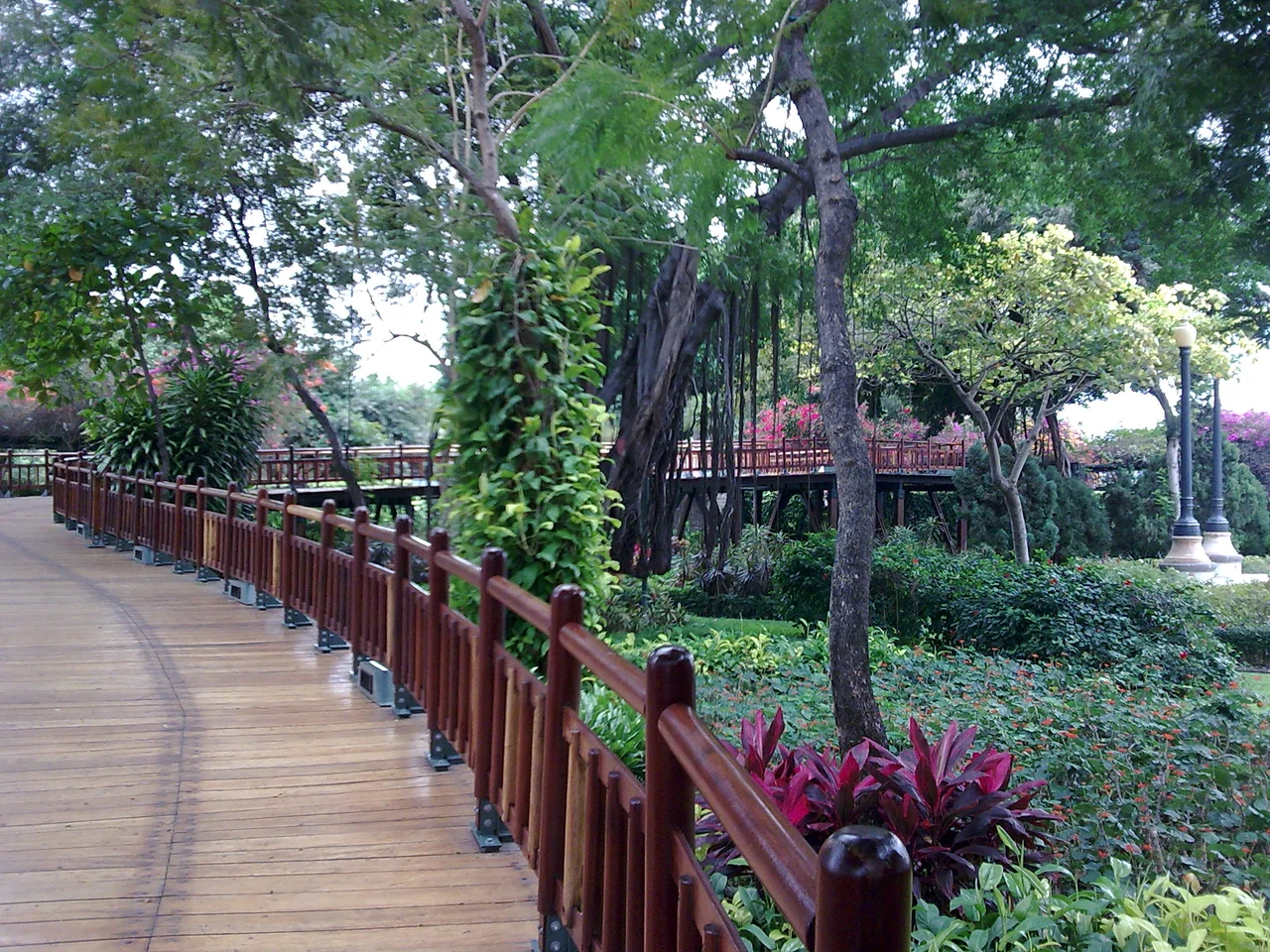
The Malecón divides into three zones with distinct characters. The northern section holds the boardwalk's cultural core: plazas and fountains, an antique Ecuadorian train preserved as public art, a planetarium, an anthropological museum, a contemporary art museum, and the first IMAX theater in South America. The central area, home to the Civic Plaza, concentrates the historical monuments around the Rotonda and the clock tower. The southern section houses the modern Bahia Malecon Shopping Center, built to draw commerce back toward the river. Along the way, the 22,000-square-meter Malecon Gardens preserve Ecuadorian botanical species with an artificial stream and ponds. Boarding docks scattered along the route offer river tours up and down the Guayas.
Monuments and the First Mayor
The boardwalk doubles as an open-air hall of fame for the city's civic figures. Jose Joaquin de Olmedo, a poet who became the first mayor of Guayaquil after independence, stands in bust form near the northern entrance. Carlos Alberto Arroyo del Rio, an Ecuadorian president born in the city, has his own memorial. The statues form a record of civic memory, each one a choice about whose story gets told at the water's edge. Walking the full length of the boardwalk, a visitor moves through approximately two centuries of Guayaquil's self-image: the colonial merchant who funded the clock, the liberators whose 1822 meeting changed the map of South America, the poet-mayor who wrote odes celebrating South American independence, and finally the 21st-century mall anchoring the southern end.
A Model Studied Abroad
What makes the Malecón notable beyond Guayaquil is the scale and success of the urban transformation. The Pan-American Health Organization and the WHO designated it a healthy public space, a formal recognition that rarely attaches to urban redevelopment projects. The Foundation model, which placed administration in the hands of a non-profit rather than a municipal department, is studied as a case in governance. Maintenance has stayed consistent across multiple mayoral administrations because the boardwalk does not depend on any one of them. Visitors who come today find a well-lit, clean, safe public space that serves as the city's de facto living room. A generation of Guayaquileños now associates the Malecón with family Sunday afternoons rather than with the danger of the 1980s.
From the Air
Malecón Simón Bolívar runs along the west bank of the Guayas River at 2.19 degrees south, 79.88 degrees west, in central Guayaquil. The boardwalk extends approximately 2.5 kilometers north to south. Jose Joaquin de Olmedo International Airport (ICAO: SEGU) lies about 5 kilometers north of the Malecon. From altitude the boardwalk appears as a distinct green and gray ribbon along the river, with the IMAX dome and mall visible at the ends. Recommended viewing altitude 2,000 to 5,000 feet for city-scale detail.
Nearby Stories
- Guayas Province 20 km away
- Montañita 29 km away
- Santa Elena, Ecuador 39 km away
- 2023 Guayas earthquake 48 km away
- El Cajas National Park 50 km away
- Santiago de Bolivar 57 km away
- Alausí Canton 67 km away
- Department of Tumbes 158 km away