
Maltby Street Market
On a Saturday morning the narrow yard fills with the smell of bone broth, sourdough, smoked salmon, and Spanish chorizo crisping on a grill. The arches overhead were built in 1836 for steam trains heading toward Greenwich - the first elevated railway anywhere in the world - and they still rumble overhead at regular intervals. Beneath them, on what was once a ropewalk where workers braided rigging for the sailing ships of the London Docks, thirty or so food traders set out their stalls each weekend. Maltby Street Market exists because a handful of stallholders got themselves thrown out of Borough Market in 2011 and decided to take their customers with them.
Where Sailors and Tanners Worked
Bermondsey was a working district long before it became a foodie one. Sitting on the south bank just upstream of the Pool of London, the area served the merchant marine for centuries - tanneries, rope walks, vinegar factories, leather warehouses, biscuit bakeries, breweries. The buried River Neckinger passes a few yards from the southern end of the market walk, remembered now only in the name of Millstream Road. Maltby Street itself was once the site of a ropewalk belonging to Robert Rich; the name has carried over to the market yard, which the salvage company LASSCO still uses to store reclaimed floorboards on weekdays. Within half a mile lie Bevington's Neckinger Mills, the 1814 Sarsons vinegar factory, the 1909 Leathersellers' College, the Hepburn and Gale tannery, and the Anchor Brewery beside Tower Bridge - the granite-and-yellow-stock-brick bones of an industrial empire that has, mostly, slipped into history.
The First Elevated Railway
The railway arches that run the length of the market were built between 1836 and 1839 for the London and Greenwich Railway, the first steam railway in the capital and the earliest elevated railway in the world. The decision to elevate the entire line on a brick viaduct - some 878 arches in total - came down to cost: cheaper than tunneling, and it freed the ground beneath for letting. Nearly two centuries later those same arches still carry Southeastern trains from London Bridge to Greenwich, the noise echoing rhythmically through the market below. The viaduct made many of the spaces on Maltby Street possible: workshops, warehouses, eventually antique dealers after Islington's Caledonian Market relocated to Bermondsey Square in 1950, and finally the salvage yards and food stalls of today.
How the Rebellion Started
In 2009 a group of Borough Market traders began renting storage in railway arches around Maltby Street, about a mile from their main pitches. The Monmouth Coffee Company opened its arch on Saturdays to sell coffee, and other producers followed - selling cheese, charcuterie, oysters, terrines - to their fellow traders and curious neighbours. By 2011 the situation had become awkward. Borough Market evicted seven traders for running a competing venue. Those traders responded with a public broadside against what they saw as Borough's slide from a wholesale producers' market into a takeaway food court with poor facilities. Nine of them left for Maltby Street, joined by others. The breakaway market grew. The point of friction never fully resolved, but it gave London a second weekend food market that felt more like the original Borough than Borough itself.
What's on the Stalls
On a typical weekend Maltby Street fits roughly thirty traders along the narrow walk between Tanner Street and Millstream Road, with more set up inside the railway arches that flank the route. The cast rotates - some traders stay for years, others cycle out and new ones cycle in. A French bakery sells cakes and pastries from an oven-side shop throughout the week; three permanent concessions are open Wednesday to Sunday. On Saturdays the hours run from ten to five, on Sundays from eleven to four, with certain stalls trading later into the evening. The crowd is generally local, partly tourist, mostly genuinely interested in what they are eating. The Financial Times has called it one of London's best street-food markets; so have Time Out and the Evening Standard. None of those endorsements changes the fundamental texture of the place, which still smells like grilled bread and feels like a salvage yard borrowed for the weekend.
The Salvage Yard
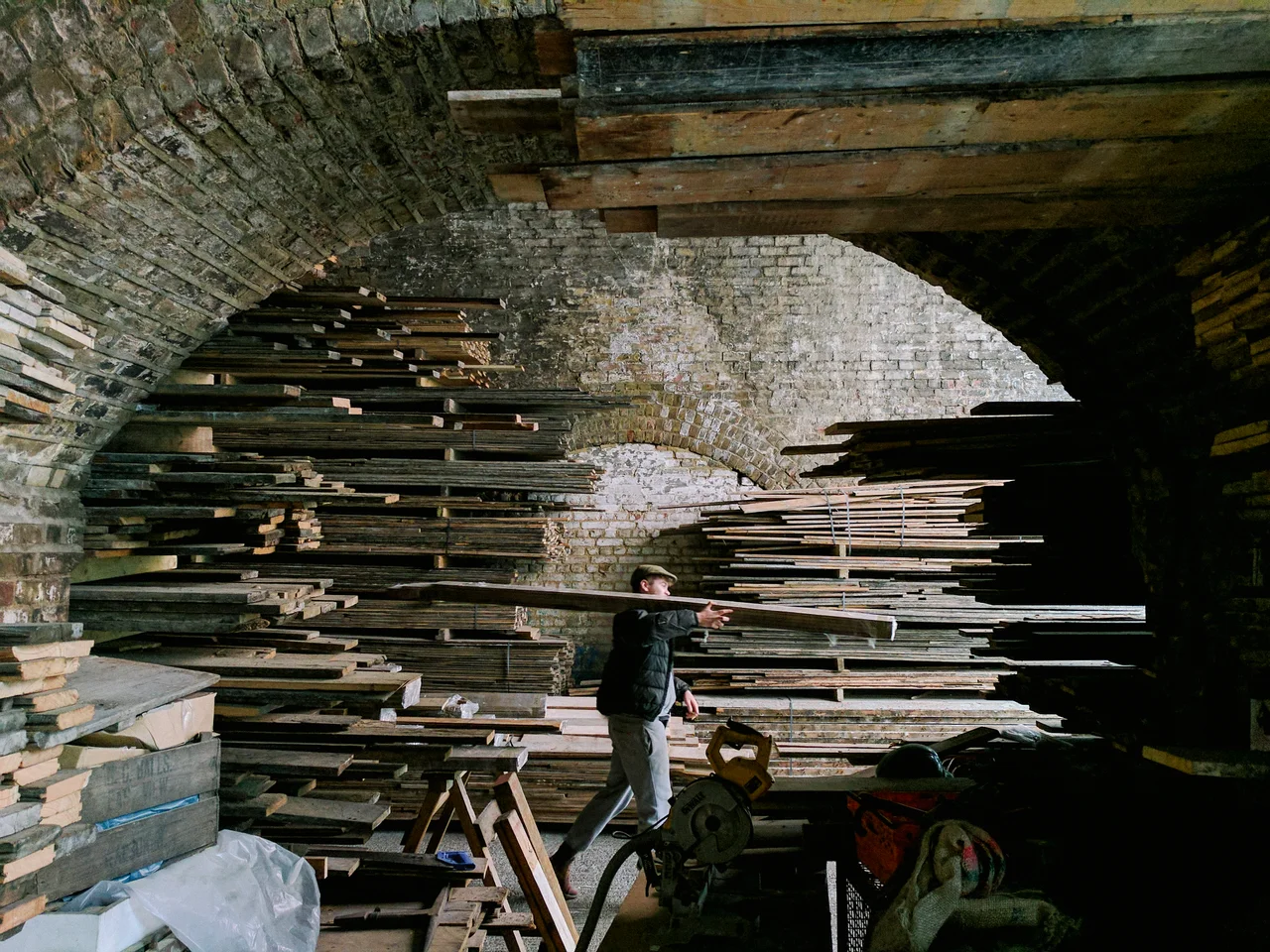
What gives Maltby Street its particular character is the host: LASSCO, the London Architectural Salvage and Supply Company, has occupied the yard for decades, dealing in reclaimed timber, stone, fittings, and architectural fragments. The food market was originally pitched in 2009 as a way to put the yard to use on its quiet weekends. On Friday evenings the firm packs away its machinery and stacks of reclaimed floorboards to make space for the stalls; on Sunday evenings they come back out. The market has never quite shed that improvisational quality. The stalls are temporary. The arches are nearly two hundred years old. The trains keep running overhead.
From the Air
Coordinates 51.4996 N, 0.0762 W in Bermondsey, south London, just southeast of Tower Bridge. From altitude look for the distinctive twin towers of Tower Bridge immediately to the northwest and the long brick spine of the London and Greenwich Railway viaduct running east toward Greenwich. Nearest airport London City (EGLC) about 5 nm east; London Heathrow (EGLL) about 18 nm west. Clear days reveal the Shard rising prominently a short distance west-northwest.
Nearby Stories
- Battle of Britain, Northfleet 1.1 km away
- Bayham Old Abbey 5.4 km away
- Catharine Macaulay 6.4 km away
- Hatfield rail crash 8.8 km away
- Chequers 8.9 km away
- Chelmsford Cathedral 10 km away
- Queen Victoria Hospital 13 km away
- Fishbourne Roman Palace 36 km away