.jpg)
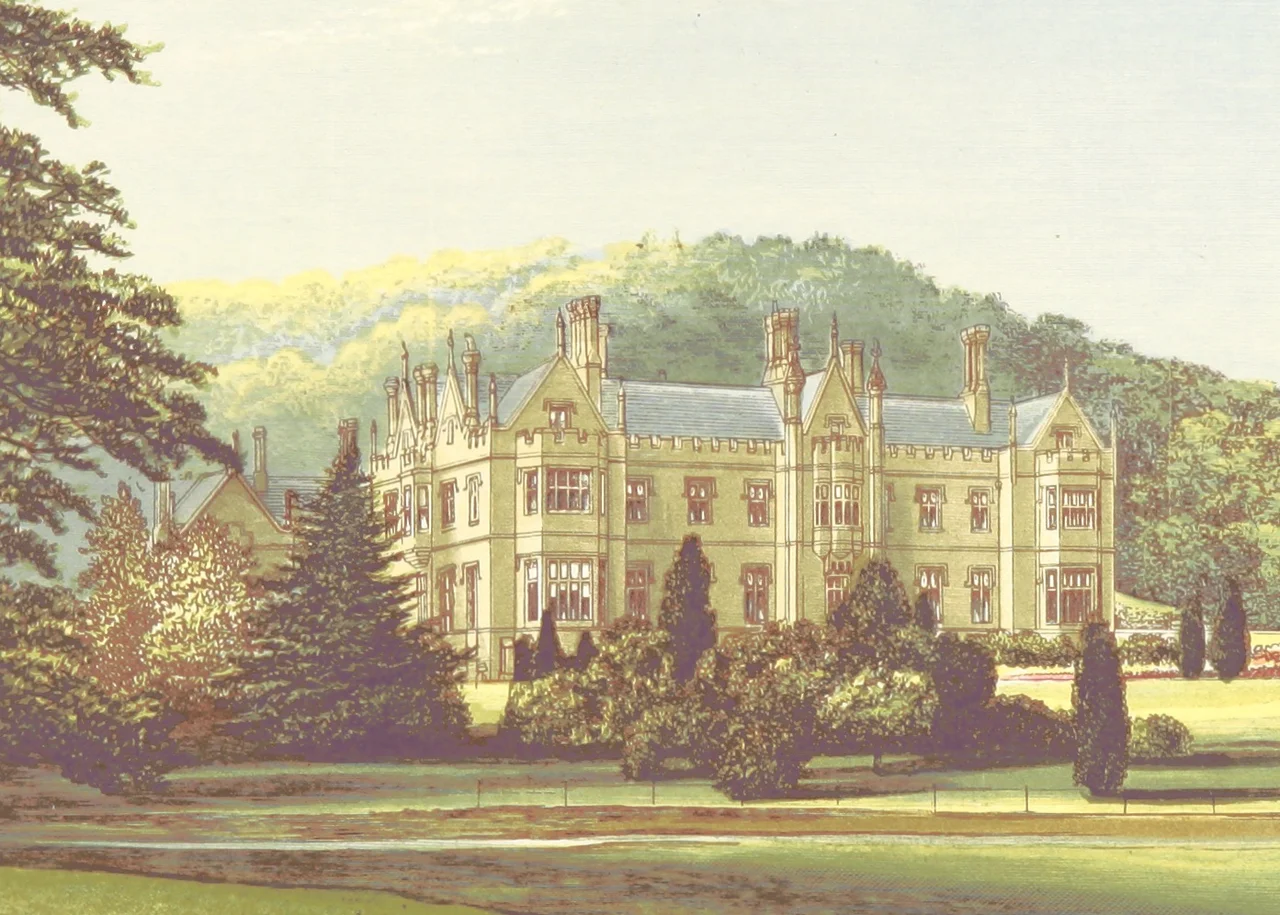
Mamhead House
Anthony Salvin was twenty-six in 1827. He had no major buildings to his name, and the Italianate plans his client had originally commissioned from Charles Fowler had already failed and been abandoned at the footings stage. What he had was a chance. The client, Robert William Newman, was an Exeter merchant who had built his fortune in the Portugal and Newfoundland trade and wanted a country house worthy of his new station. Salvin gave him something Devon had not seen before: a Tudor Revival country house in honey-coloured Bath stone, ornamented with the Newman family motto and the joined initials of Robert and his wife along the decorative skyline above the front door. By the time Mamhead House was finished in 1833, Salvin's reputation was made. He would go on to design Harlaxton Manor and restore the Tower of London and to handle dozens of other commissions across England. None of that would have happened if Newman had not gambled, in 1827, on the unproven young man whose Tudor drawings persuaded him.
Domesday to Newfoundland
The Mamhead estate is recorded in the Domesday Book of 1086 as belonging to Ralph de Pomeroy. It passed through the Carew family and then to the Balls, of whom Thomas Ball (1671 to 1749) was a merchant with an unusual passion: he planted exotic trees on the estate, importing rarities from across the world. His head gardener William Lucombe went on to become Exeter's most famous nurseryman, and the Lucombe oak, a hybrid William grew at Mamhead, still bears his name. The estate was held next by the Earls of Lisburne. In the 1770s, Capability Brown himself laid out new landscaping for the grounds, smoothing the parkland in the soft idealised manner that defined English country estate design for a century. In 1823 the whole property was bought by Robert Newman, the senior partner in Newman & Co. of Exeter, a trading firm whose ships moved Portuguese wines and Newfoundland salt cod across the Atlantic. The old mansion of the Balls had already been demolished. Newman wanted to start from a clean foundation.
Salvin's First Castle
Newman first commissioned Charles Fowler, who proposed an Italianate design. Fowler had got no further than constructing the footings when Newman decided the look was wrong and replaced him with Salvin. The young architect's response was bold. He turned to the recently emerging Tudor Revival style, then a novel architectural approach in England, and proposed a building that would feel ancient even as it was being built. The result, completed between 1827 and 1833, was a country house of warm Bath stone, with mullioned windows, a triple oriel on the east garden front copied from the genuinely Tudor Hengrave Hall in Suffolk, and a gallery staircase based on James Wyatt's external stair at Canterbury Quadrangle in Christ Church, Oxford. Stained glass by Thomas Willement filled the principal windows. Pevsner, two generations later, would suggest that the building took some inspiration from Belsay Castle in Northumberland, which Salvin knew from his North East childhood. Each detail was chosen, each historical reference checked. The house is now Grade I listed.
Statues, Stables, and the Obelisk
Salvin designed more than the house. He laid out three lodges at the park entrances, Dawlish Lodge, Forest Gate, and Basket Lodge, each now Grade II listed. Pevsner described two of them as very pretty examples of Salvin trimmings added to plain eighteenth-century boxes. Historic England considers Dawlish Lodge the most inventive of the three. Around the house, Salvin arranged a series of statues of distinguished British figures, which his biographer Jill Allibone has suggested were modelled on the Temple of British Worthies at Stowe. The statues were scandalously removed and sold in the 1980s, an episode that still stings in architectural histories of the house. On a wooded ridge above the building stands an obelisk, erected in 1742 by Thomas Ball as a navigational guide for shipping in the English Channel. It is older than the present house by more than eighty years, and it still does its old job, visible from out at sea on a clear day. The orangery, the terrace walls, the steps with their decorative urns, the pool with its fountain: all of them survive as a small landscape museum of nineteenth-century country house craftsmanship. The park has its own Grade II* listing.
Wedding Venue, Then For Sale
The Newman family held Mamhead until the 1950s, when Sir Ralph Newman, Robert's great-grandson, sold it to an evangelical society. It became Dawlish College, a school, in the 1960s. In the 1990s it served as the regional headquarters of the Forestry Commission. In the early twenty-first century it returned to private ownership and operated for a time as an events and weddings venue, hosting the second marriage of the singer Peter Andre in 2015. That business went into liquidation, and its owner was disqualified from acting as a company director in 2019. In 2020 the house, with an estate of approximately 164 acres, was put on the market for a guide price of ten million pounds. The future of Mamhead is the future of many great country houses: too large for a single family, too significant to demolish, too quirky for any obvious institutional use. What survives is the house Salvin built when nobody yet knew his name, on land that has been counted in deeds since 1086, looking out across the English Channel from a Devon ridge where Thomas Ball planted his exotic trees three hundred years ago.
From the Air
Mamhead House sits at 50.6197N, 3.5133W on the eastern slope of Haldon, about five miles south of Exeter and three miles inland from Dawlish. From 2,500 to 4,500 feet the house sits high on its ridge with the wooded park around it, the obelisk on the ridge above, and the English Channel opening east beyond Exmouth. Exeter Airport (EGTE) lies about 6 nautical miles to the north and is the natural arrival point. Look for the Haldon ridge running north-south, the Exe estuary just east of the house, and Powderham Castle on the lowland between Mamhead and the river.
Nearby Stories
- Childe's Tomb 5.7 km away
- Coldharbour Mill Working Wool Museum 11 km away
- Montacute Castle 18 km away
- Action of 18 June 1793 18 km away
- Portland Bill 25 km away
- Eddystone Lighthouse 30 km away
- Manor of Orleigh 33 km away
- German Submarine U-672 33 km away