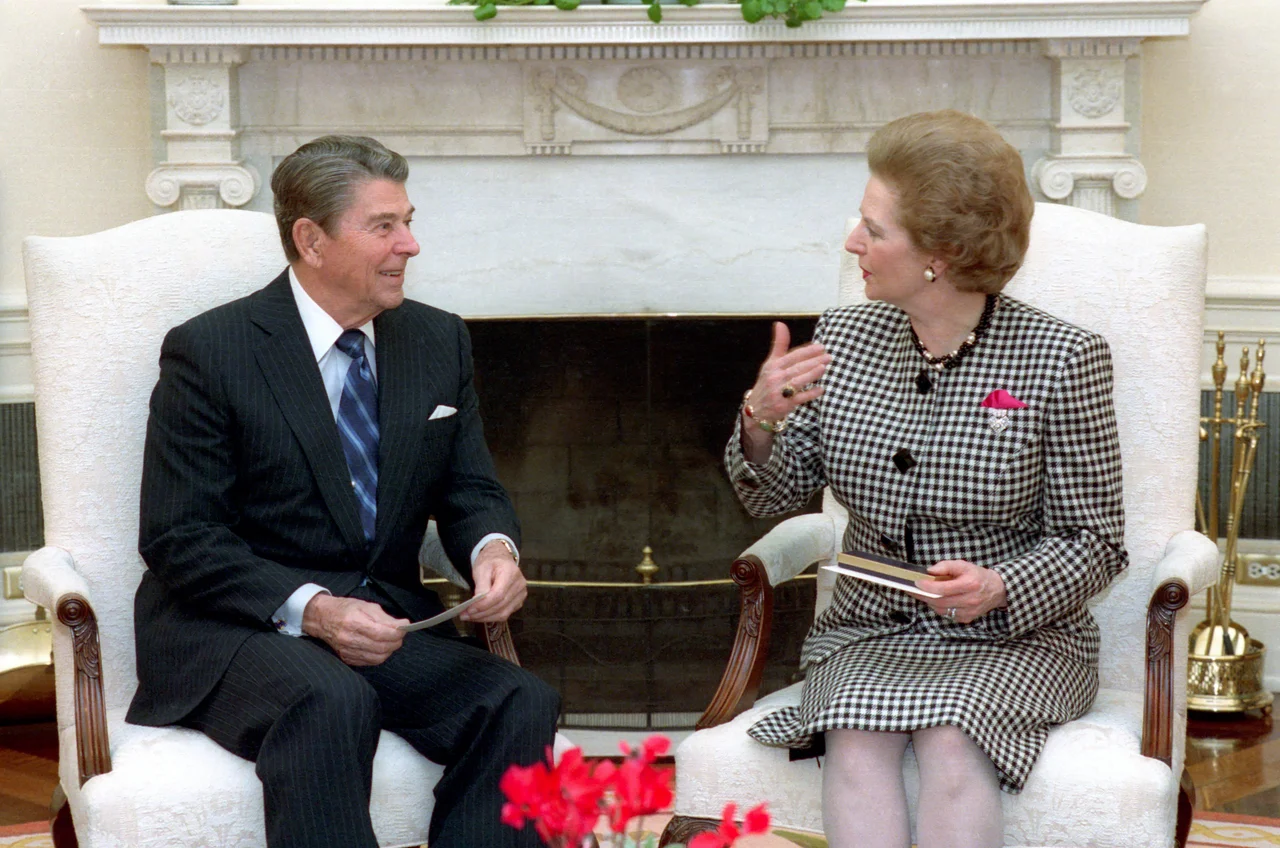

Margaret Thatcher
She grew up over a grocer's shop. Margaret Hilda Roberts was born on 13 October 1925 in Grantham, Lincolnshire, in the flat above Alfred Roberts's combined tobacconist and grocery on North Parade. Alfred was a Methodist lay preacher, an alderman, and eventually mayor of Grantham. The household had no inside toilet and no hot water. By the age of ten, Margaret was running errands for her father, weighing tea, listening to political talk in the shop, and developing the deeply held political instincts - thrift, hard work, hostility to socialism, a faith in markets - that would shape Britain for an entire decade. She would become Britain's first female prime minister, serve the longest continuous tenure of any twentieth-century British leader, and remain, more than a decade after her death, one of the most contested figures in modern British history.
The Grocer's Daughter
The Roberts family were strict Wesleyan Methodists. Margaret attended Finkin Street Methodist Church three times every Sunday. As a child she was already sceptical of certain doctrines - she once calculated that angels would need a six-foot breastbone to support their wings - but she absorbed her father's politics wholesale. Alfred came from a Liberal background but stood as an Independent on Grantham council. He believed in self-reliance, balanced budgets, and the moral duty to work. In 1938, the family briefly sheltered a Jewish teenager fleeing Nazi Germany, with Margaret and her older sister Muriel saving pocket money to help fund the girl's journey. Margaret won a scholarship to Kesteven and Grantham Girls' School, where she was head girl, and during the Second World War she volunteered as an ARP fire-watcher in the town. In October 1943, after another candidate withdrew, she went up to Somerville College, Oxford to read chemistry.
Chemist, Barrister, Backbencher
Thatcher was the only twentieth-century British prime minister with a science degree, and the only one who ever published peer-reviewed research. Her tutor at Somerville was Dorothy Hodgkin, the X-ray crystallographer who later won the Nobel Prize in Chemistry. Her own undergraduate research was on the structure of the antibiotic peptide gramicidin S - a problem that turned out to be too difficult for her timeframe. After graduating she worked first at BX Plastics in Essex and then for J. Lyons in Hammersmith, where she co-authored a 1951 paper on the saponification of glycerol monostearate, possibly used in ice cream emulsification. By then she had also been adopted as Conservative candidate for the safe Labour seat of Dartford. She lost in 1950 and 1951, but reduced the Labour majority both times. In 1951 she married Denis Thatcher, a wealthy businessman; in 1953 their twins Mark and Carol were born; that same year she qualified as a barrister, with Denis funding her studies. She finally entered Parliament in 1959 as MP for Finchley. By 1970 she was Education Secretary under Edward Heath, and earned the nickname "Milk Snatcher" after the policy of ending free school milk for seven-to-eleven-year-olds - a decision she later said she had been forced into by the Treasury and bitterly regretted on political grounds.
Iron Lady
Thatcher won the Conservative leadership in February 1975 after defeating Heath, who had lost two general elections in a row. Four years later, on 4 May 1979, she walked into 10 Downing Street as Britain's first female prime minister, quoting a prayer attributed to St Francis of Assisi: "Where there is discord, may we bring harmony." The eleven and a half years that followed remade Britain. She cut the top rate of income tax from 83 percent to 40 percent. She broke the power of the trade unions, most decisively in the 1984-85 miners' strike, in which a year-long battle with NUM leader Arthur Scargill ended in defeat for the union and the accelerated closure of coal mining as a major British industry - and devastated mining communities across South Wales, Yorkshire, Nottinghamshire, and Durham for generations. She privatised British Gas, British Telecom, British Airways, British Steel, the water and electricity utilities, and sold over a million council houses to their tenants under the Right to Buy scheme. She fought and won the Falklands War in 1982 after Argentina invaded the South Atlantic islands; 255 British and 649 Argentine servicemen died. She survived the IRA bombing of the Grand Hotel in Brighton in October 1984 - a bomb intended to assassinate her and most of her cabinet, which killed five people. She championed Section 28 in 1988, a law banning local authorities from "promoting" homosexuality that became a focal point of LGBTQ rights campaigning for the next fifteen years until its repeal in 2003.
A Contested Legacy
Thatcher's allies argue she rescued a nearly ungovernable country. Britain in the late 1970s was beset by inflation, strikes, balance-of-payment crises, and what Foreign Secretary James Callaghan privately called the possibility of "a breakdown of democracy." Her reforms restored growth, reduced inflation from 18 to 4 percent, and tripled foreign investment. Her partnership with Ronald Reagan and her measured support for Mikhail Gorbachev are credited by many historians with helping end the Cold War. Her critics argue she fractured British society. Unemployment rose to over three million during her first term. Manufacturing collapsed, particularly in the north of England, Scotland, and Wales. The poll tax of 1990 - replacing local property rates with a flat per-person tax - provoked the largest riot in central London in a century and contributed to her own downfall. Inequality widened sharply. Whole communities built around mining or shipbuilding never recovered. Section 28 caused lasting harm to a generation of LGBTQ young people. She was forced from office in November 1990 after her own cabinet, in a series of resignations and confrontations led by Geoffrey Howe and Michael Heseltine, withdrew their support. She wept as she left Downing Street. She died on 8 April 2013 at the Ritz Hotel in Mayfair, aged 87, after a series of strokes. Her ceremonial funeral at St Paul's Cathedral, attended by 2,300 guests including the Queen, drew both crowds in respectful silence and crowds turning their backs. Few British political careers have ended in so divided a public verdict, or so accurate a one - because by then she had remade Britain in ways that would outlast any single judgement of her.
From the Air
This article geolocates to central London at 51.489 degrees north, 0.156 degrees west, in the Belgravia / Chester Square area where Thatcher lived in her later years and died in nearby Mayfair in 2013. The site is in central London restricted airspace; the Houses of Parliament, where she served and led for thirty-three years, are about one mile northeast. Her birthplace in Grantham, Lincolnshire, lies about 95 nautical miles north. Her constituency of Finchley is six miles north of central London. London Heliport (Battersea) is about two miles west. London City Airport (EGLC) lies about nine nautical miles east. Recommended viewing altitude 1,500 to 2,000 feet on prescribed corridors only; this is some of the most restricted airspace in Britain.
Nearby Stories
- Battle of Britain, Northfleet 1.1 km away
- Bayham Old Abbey 5.4 km away
- Catharine Macaulay 6.4 km away
- Hatfield rail crash 8.8 km away
- Chequers 8.9 km away
- Chelmsford Cathedral 10 km away
- Queen Victoria Hospital 13 km away
- Fishbourne Roman Palace 36 km away