
Medinet Habu
Around 1200 BC, a wave of displaced peoples swept out of the Mediterranean and broke against the great powers of the Bronze Age world. Kingdoms that had stood for centuries — the Hittites, the cities of the Levant — collapsed and vanished. Egypt was among the few that held. The story of how it held is carved, in acres of relief, onto the walls of a single temple on the Theban west bank. Medinet Habu is the mortuary temple of Ramesses III, the last great warrior pharaoh, and it was built like what it half-was: a fortress. Behind towering mudbrick walls and a gatehouse modeled on a Syrian stronghold, its sandstone surfaces preserve the most detailed eyewitness account we have of the mysterious invaders the Egyptians called the Sea Peoples — and of the battles that decided whether Egypt would survive them.
A Temple Built Like a Fort
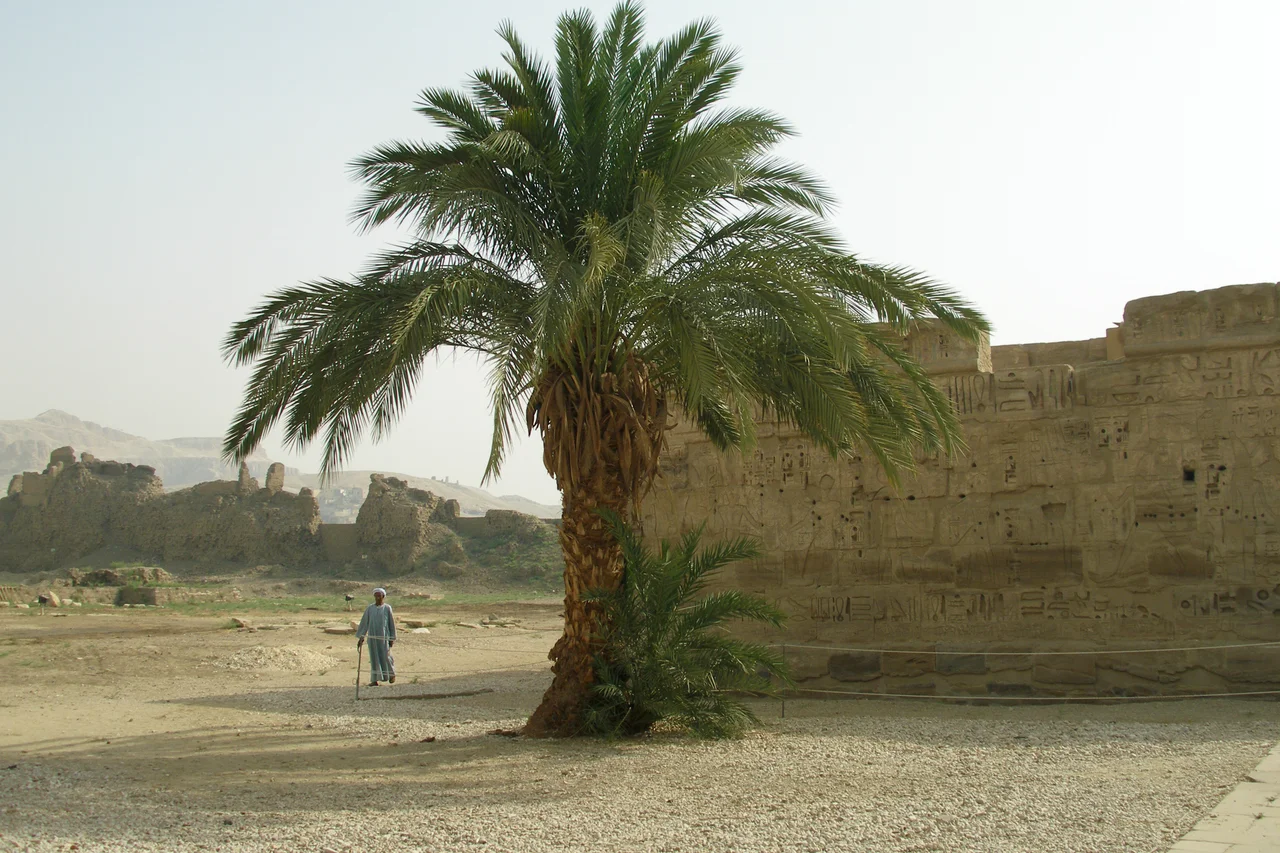
Most mortuary temples were meant for worship and remembrance. Medinet Habu was meant to hold. Ramesses III enclosed it within a colossal mudbrick wall, originally rising some eighteen meters and ten meters thick, ringing more than six hectares of sacred ground. The main entrance is a high gatehouse deliberately shaped like a migdol, the fortified Syrian tower-gate the Egyptians knew from their wars in the Levant — a building that announces its purpose before you pass through it. Inside, the temple itself follows the orthodox grand design, echoing the nearby Ramesseum of Ramesses II: a first pylon opening onto a court lined with colossal statues of the king as the god Osiris, then a second court, a columned portico, and a great hypostyle hall now open to the sky. More than seven thousand square meters of its walls are covered in carved scenes. In its day the precinct held granaries, workshops, and houses — a self-contained stronghold as much as a place of prayer.
The War of the Sea Peoples
The temple's fame rests on its walls. Across the northern exterior, in thirteen linked scenes, the campaigns of Ramesses III unfold like a vast stone newsreel. In one relief, Egyptian archers rain arrows down onto enemy ships in the only depicted naval battle of the ancient Egyptian record — the Battle of the Delta, fought when the seaborne invaders tried to force the mouths of the Nile. In another, the king drives back warriors in distinctive feathered headdresses, who travel with their women and children loaded into ox-carts, the image of a whole people on the move rather than a raiding army. These are the Sea Peoples, and much of what scholars know about them comes from precisely these carvings. The temple's long inscriptions record war after war — two Libyan campaigns and the great Northern War of Ramesses III's eighth year — set down in the formal language of royal victory, but grounded in real and desperate fighting for the survival of the kingdom.
The Cost of Conquest
The reliefs are triumphant, but they do not hide the human price of what they show, and a modern eye should not look away from it either. Scribes tallied the enemy dead by counting severed hands and other body parts heaped before the king. Captured warriors were marched home in bonds; the inscriptions plainly state that the prisoners, along with their wives and children, were enslaved and their cattle seized. Carved and actual heads of foreign captives were placed within the temple as tokens of the pharaoh's reach over Syria and Nubia. These were defeated peoples, displaced and desperate themselves — many of them refugees from a collapsing world, fleeing famine and the fall of their own homelands — and the temple records their subjugation as the glory of the man who crushed them. It is honest history carved in stone: a monument that lets us see both the scale of an ancient victory and the very real people who were broken to win it.
The Town That Lived Here
Medinet Habu did not fall silent when the pharaohs did. Long after the temple ceased to function, an ordinary town grew up inside and around its walls. By late antiquity a Coptic Christian community called Jeme filled the precinct, building mudbrick houses against the ancient carvings, raising a church in the second court, and living out generations of everyday life among the colossi of a forgotten king. The settlement lasted into roughly the ninth century AD. When archaeologists arrived at the close of the nineteenth century, much of the site lay buried under mounds of this later town, rubbish and ruins piled meters deep over the reliefs. Clearing it away — sometimes, regrettably, with little record kept of the medieval village that was swept off — revealed the temple beneath in remarkable preservation. The Epigraphic Survey of the University of Chicago has been patiently copying its walls, scene by scene, almost continuously since 1924, a labor still unfinished a century on.
From the Air
Medinet Habu sits on the Theban west bank at 25.72 degrees N, 32.60 degrees E, near the foot of the desert hills opposite Luxor. From the air it reads as a large, sharply rectangular walled enclosure of pale stone and mudbrick set against the edge of the cultivation, the great first pylon and the bulk of the mortuary temple clearly defined within. The smaller site of Deir el-Medina lies a short distance to the northwest, and the green Nile floodplain stretches to the east. Recommended viewing altitude is 2,000 to 4,000 feet AGL; the surrounding desert gives strong contrast and generally excellent visibility, though blowing dust can soften the view in spring. The nearest airport is Luxor International (ICAO HELX), about 8 km to the east across the river; Aswan International (HESN) lies roughly 200 km south.
Nearby Stories
- Temple of Seti I (Abydos) 20 km away
- Dendera Temple complex 21 km away
- Esna 22 km away
- Abydos, Egypt 49 km away
- Mersa Gawasis 116 km away
- Kharga Oasis 147 km away
- Hurghada 184 km away
- Wadi El Gemal National Park 238 km away