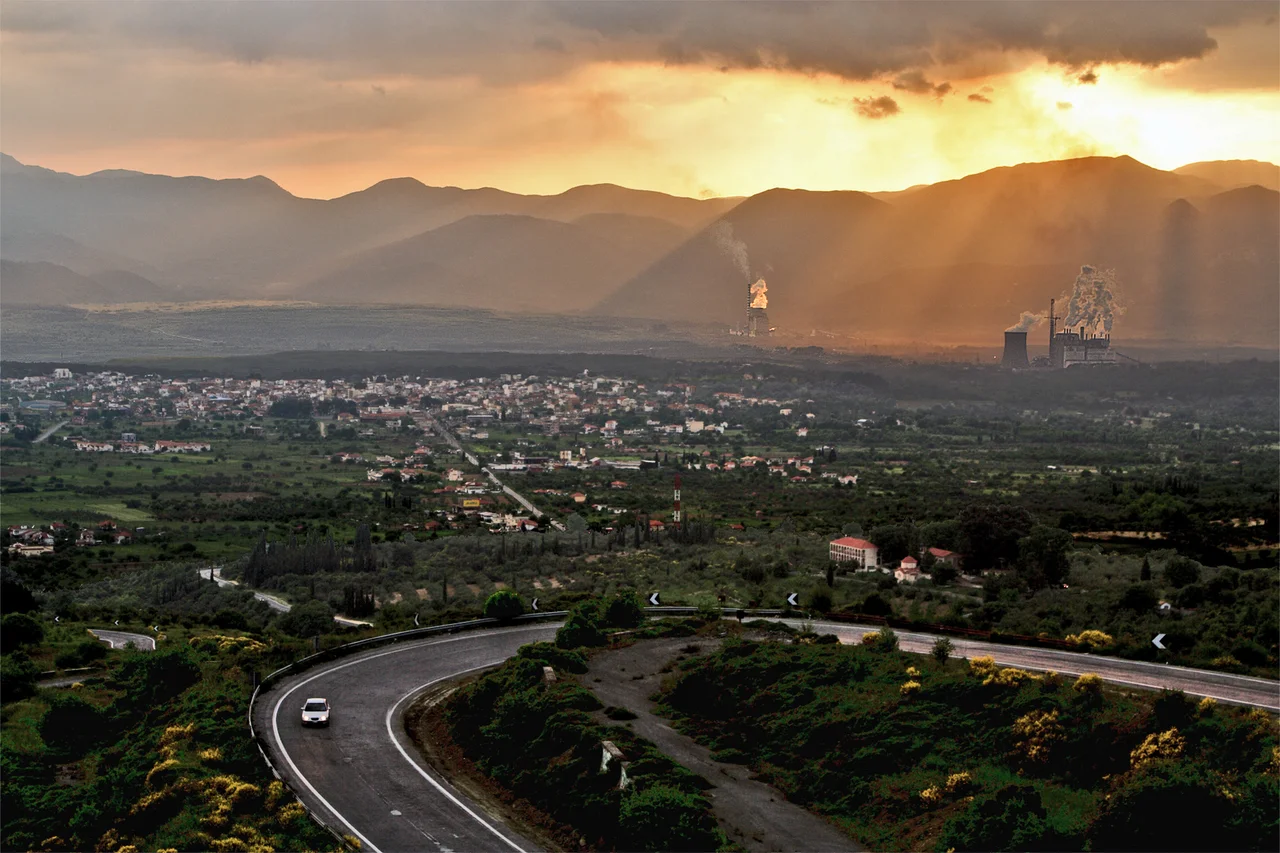

Megalopolis, Greece
Wooden tools found in the sediments beneath Megalopolis are, as of 2026, the oldest evidence of handheld wooden tools in the world — approximately 430,000 years old. The people who made them, a species called Homo heidelbergensis, butchered straight-tusked elephants and a now-extinct giant hippopotamus beside a shallow lake that once filled the basin where the modern town sits. This context matters not as mere antiquarian curiosity but because Megalopolis has always been a place defined by ambition of scale. The lake dried up. The hominins disappeared. Then, in 371 BC, the Arcadian League founded a city here specifically designed to be the largest and most powerful in the region — and called it, without irony, the Great City.
A City Built to Counter Sparta
Megalopolis was not a natural settlement that grew over generations. It was a deliberate act of political architecture. Between 371 and 368 BC, the Arcadian League compelled twenty to forty neighboring communities to contribute population and resources to a single new city, strategically positioned to counterbalance Spartan power to the south. Some communities joined willingly; others were persuaded by force. The citizens of nearby Trapezus were massacred when they refused to participate in the broader unification of the region. Lycosura, sheltered by the sanctity of its goddess Despoina, was the notable exception — its people refused to move and were spared. The new city's theatre was built to hold 20,000 spectators, making it one of the largest in the ancient Greek world. Pausanias, arriving centuries later, called it the largest theatre in Greece. The Thersileon — a covered assembly hall with 67 pillars — stood adjacent, suggesting a civic life organized around spectacle and debate on a scale unusual even for the ancient world.
The Men the City Made
Two figures born in Megalopolis became essential to understanding the ancient Mediterranean world. Philopoemen, born around 253 BC, rose to lead the Achaean League and was called by Plutarch the last of the Greeks — the final commander to project Greek military and political power in a way that made Rome take notice. He died in 183 BC, captured by his enemies, reportedly forced to drink poison. Polybius, born around 203 BC, watched the Roman conquest of Greece as a captive-turned-favored guest of the Scipio family, then wrote a history of how Rome came to dominate the Mediterranean — one of the most important surviving historical texts from antiquity. His bust, with an inscription praising his wisdom, was reportedly displayed in a bas-relief on the stoa wall at nearby Lycosura. That two men of this stature came from the same mid-sized Arcadian city within two generations is either remarkable coincidence or evidence that the city's founding ambitions created, briefly, an environment that produced greatness.
Sieges, Alliances, and the Limits of Greatness
Megalopolis spent much of its early history being fought over. In 353 BC, Sparta attempted to reduce the city while Thebes was occupied with the Third Sacred War; the Thebans still managed to send assistance, and the city survived. In 331 BC, a Spartan invasion was repelled with Macedonian help. In 317 BC, Polyperchon — the new regent of the Macedonian Empire — besieged Megalopolis on behalf of his struggle against Cassander; the siege failed. The city had been founded as a counterweight to Sparta, but this meant it was perpetually in the crosshairs of anyone maneuvering in the Peloponnese. Across these centuries, the Stoa Philippeios — 156 meters long, one of the longest in Greece — stood in the agora as a monument to the Macedonian king Philip II, who had backed the city against Sparta. Gratitude expressed in marble and stone, a reminder of how survival is often purchased.
The Ruins and What Lies Northwest of Town
The ancient ruins of Megalopolis lie northwest of the modern town center, on both banks of the river Elisson. The theatre's orchestra and cavea are still visible; the Thersileon's column bases remain in place. On an artificial terrace above stands the sanctuary of Zeus Soter, its Doric-Ionic temple partly traceable in stone. The agora was flanked on the north by the Stoa Philippeios and on the east by the Stoa Myropolis, which measured roughly 125 meters in reconstructed length. The west side held the Bouleuterion and Prytaneion — the council chamber and magistrates' hall — built over an earlier city palace. These ruins are not manicured or heavily visited; they sit in scrubby terrain near the edge of a working modern town, pieces of extraordinary ambition going slowly back to the earth.
Coal and Cooling Towers
Modern Megalopoli — the current Greek spelling drops a syllable — has a population of around 5,344 as of the 2021 census. The Megalopoli lignite mine is one of the largest in Greece, and the power plant that runs on it dominates the town's skyline with cooling towers visible for many kilometers in every direction. The smoke and particulate matter drifting from the plant have prompted the installation of air-quality monitoring stations in surrounding villages, including Isaris, eight kilometers to the southwest. Studies continue; conclusions have not yet been reached. The mine gives the town employment and defines its visual character — the same basin where Homo heidelbergensis hunted elephants 400,000 years ago now yields low-grade coal. The ancient theatre sits a short distance from all of this, roofless and patient, waiting for whatever comes next.
From the Air
Megalopolis lies at approximately 37.400°N, 22.133°E in the broad flat basin of southwestern Arcadia. The cooling towers of the Megalopolis power plant are visible from altitude for many kilometers and serve as the primary aerial landmark. The ancient theatre ruins are located northwest of the town center along the Elisson river. The nearest major airport is LGKL (Kalamata International), approximately 55 km to the southwest. Recommended viewing altitude is 5,000–10,000 feet to capture both the basin geography and the surrounding mountain ridgelines. The Megalopolis plain is notably flat relative to the rugged Arcadian highlands that surround it on three sides.
Nearby Stories
- International Flight Training Center, Kalamata 5.3 km away
- Karyes 6.8 km away
- Barony of Akova 11 km away
- Agios Andreas, Katakolo 13 km away
- Diocese of Amyclae 14 km away
- Larisa (Argos) 19 km away
- 2023 Messenia Migrant Boat Disaster 26 km away
- Panagia Skafidia Monastery 40 km away