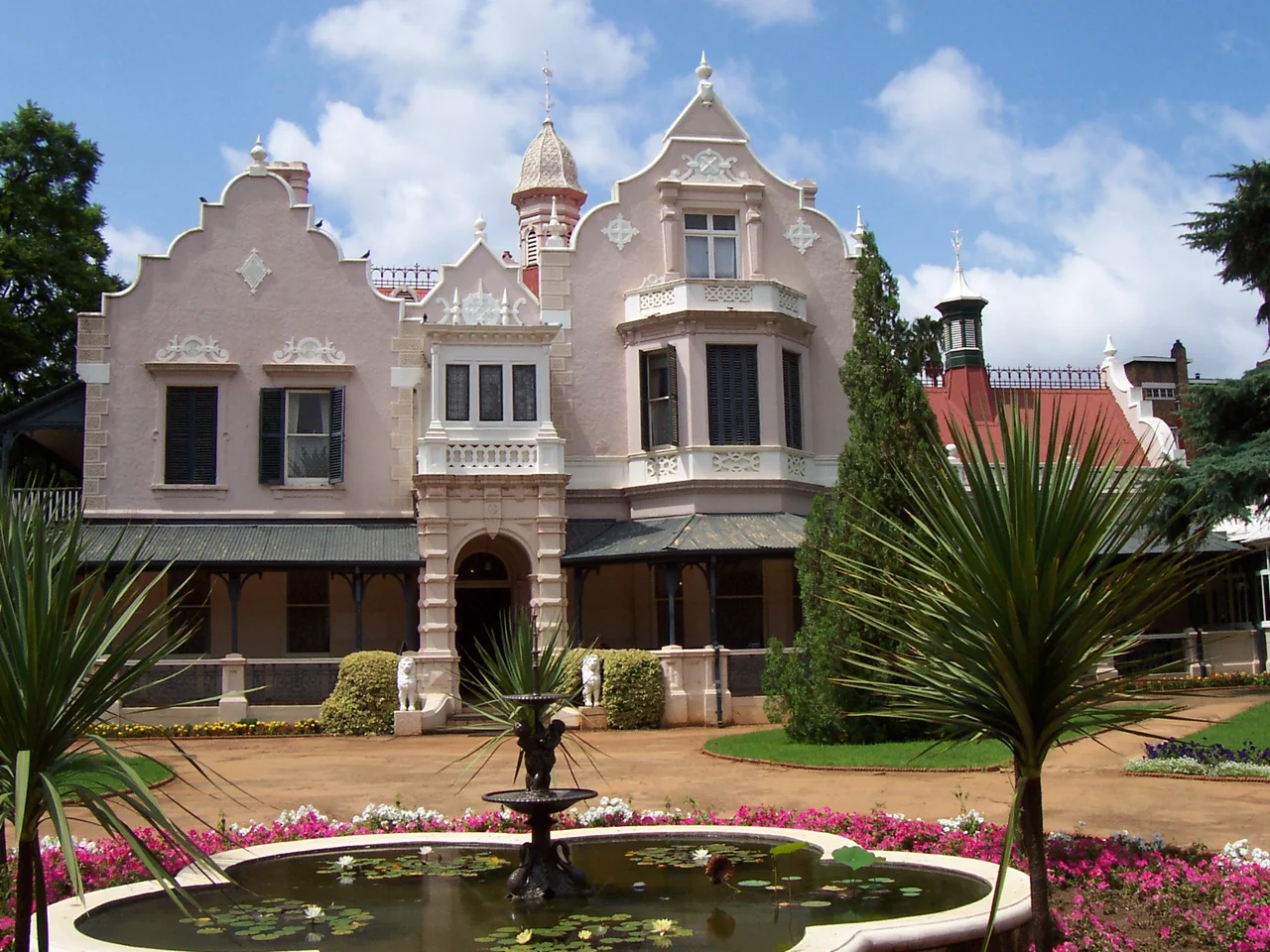

Melrose House
There is a table in Pretoria around which a war came to an end. It sits in a Victorian mansion of colored glass and ornate ceilings, looking every bit the elegant family parlor it once was. But on the night of 31 May 1902, Boer and British leaders gathered at that table and signed the Treaty of Vereeniging, closing the bloodiest conflict in South African history. Melrose House had spent two years as a military headquarters. For one evening, it became the place where peace was made.
A Merchant's Dream in Stone
The house was never meant for war. A prosperous Pretoria businessman named George Jesse Heys built it in 1886 and named it, with a romantic flourish, after the famous Melrose Abbey in the Scottish borders. It was a showpiece of its age, capturing the transition from Victorian to Edwardian taste: stained glass windows throwing colored light across the rooms, paintings by English artists, richly patterned carpets, ornate fireplaces, and cabinets of valuable porcelain. Most of these treasures belonged to the Heys family themselves. A century later, they remain - which is why stepping inside feels less like visiting a museum than walking into a wealthy household that has simply paused in time.
The General's Headquarters
Then history requisitioned it. When British forces under Lord Roberts took Pretoria in June 1900, during the Second Boer War, they seized the grand house as their command post. For more than eighteen months, the orders directing British troops across the South African veld were issued from these refined rooms. The contrast could hardly have been sharper - delicate porcelain and stained glass on one hand, the machinery of a brutal war on the other. The war had already brought scorched-earth tactics and the concentration camps in which thousands of Boer civilians perished. By 1902, both sides were exhausted, and the end, when it came, would be drafted under Melrose House's ornate ceilings.
The Stroke of a Pen
The treaty bears the name of Vereeniging, the town where Boer and British delegates thrashed out the terms. But the document itself was signed here, in Pretoria, late on the night of 31 May 1902. Its conditions were heavy for the Boers: surrender of their arms, an end to the independent republics, and the promise - distant but real - of eventual self-government under the British crown. The two Boer states that had fought so fiercely for their independence became colonies of an empire, a bitter end to nearly three years of war. The table on which those signatures were set still stands in the house, and the museum keeps the very room intact, so that visitors today can stand in the precise spot where one of South Africa's defining conflicts was brought to a close.
Preserved for the Nation
Melrose House nearly slipped into obscurity before its significance was recognized. In 1967 the Pretoria City Council bought the house and its contents for R300,000 and set about restoring it. On 17 May 1971, State President C. R. Swart opened it as a museum and declared it a national heritage site. What survives is unusually complete. Because so many of the original furnishings stayed with the house, the rooms read not as a curated exhibition but as a wealthy Edwardian household frozen mid-breath - the same carpets underfoot, the same porcelain on the shelves, the same light filtering through the same colored glass. Today the mansion endures as a rare window into late-nineteenth-century Pretoria life and one of the most consequential addresses in the country, hosting antique markets on its grounds and welcoming visitors into a home where an empire's war was laid to rest.
From the Air
Melrose House stands at 25.76°S, 28.19°E, opposite Burgers Park in Pretoria's central business district. From the air, look for the green rectangle of Burgers Park - the city's oldest, now a national monument - just south of the city center. The nearest major airport is OR Tambo International (FAOR), about 50 km south near Johannesburg; Wonderboom Airport (FAWB) lies north of Pretoria. The city's sheltered valley and dry winter air provide clear views of its historic core and surrounding Magaliesberg hills.
Nearby Stories
- Little Foot 3.9 km away
- Hartebeesthoek Radio Astronomy Observatory 18 km away
- Boksburg explosion 23 km away
- Tswaing crater 24 km away
- Secunda CTL 69 km away
- Sun City 71 km away
- Bushveld Igneous Complex 87 km away
- Battle of Bergendal 127 km away