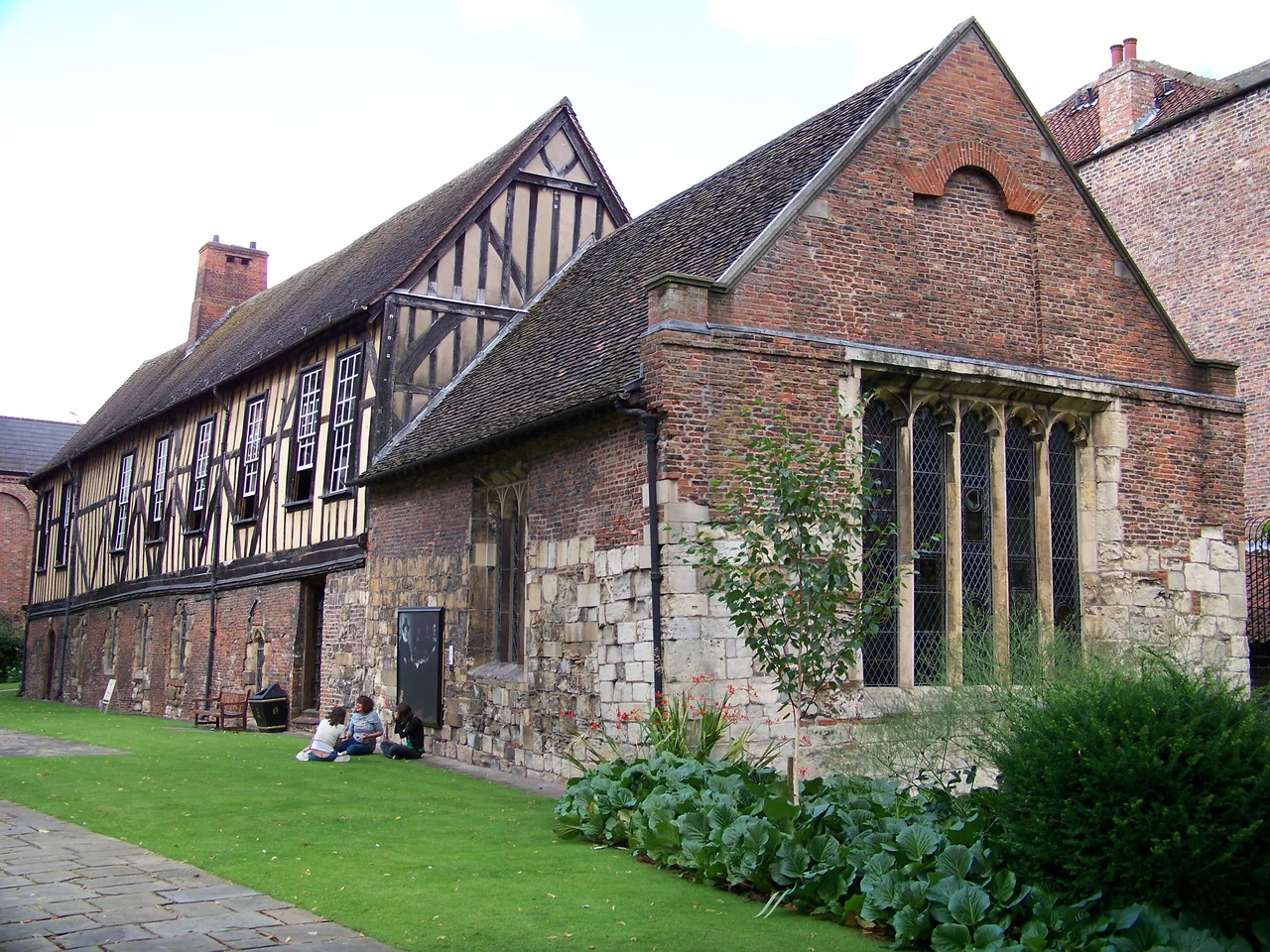

Merchant Adventurers' Hall
The roof of the Merchant Adventurers' Hall is held up by a row of oak posts that have been standing since the 1350s. Walk into the Great Hall and look up: two parallel spans of timber, complex crown posts, the joints fitted with wooden pegs rather than nails. The whole structure has been here for nearly seven centuries, and it is still doing the same job it was built to do - hosting the meetings, ceremonies and charitable business of the Company of Merchant Adventurers of the City of York. It is the largest surviving timber-framed building in Britain that has never stopped being used for its original purpose.
A Hall, an Undercroft, a Chapel
The hall was built between 1357 and 1361 by a fraternity of York merchants and traders. The building has three principal medieval levels and serves three functions. On top is the Great Hall - the meeting space, two parallel timber spans divided by a central row of supporting posts, the joints all crown-post construction held together by wooden pegs. Below it, the undercroft mirrors the same divided plan: a long brick and timber crypt-like space that was used for storage and trade. Off the undercroft is the medieval chapel, built for the use of the ill and poor in the attached hospital, and for guild members at their devotions. The chapel is still used for worship today, nearly seven hundred years after it was built.
The Royal Charter of 1430
The guild that built and used the hall went by various names in its first century. In 1430, King Henry VI granted the fraternity a royal charter, formally constituting it as a body and renaming it "The Mistery of Mercers" - mistery here meaning a craft or trade, not a puzzle. Over the following decades the guild's interests expanded from local mercery to overseas trade, and the name shifted again to The Company of Merchant Adventurers of the City of York. From the mid-fifteenth century until the early modern period, the Merchant Adventurers held an effective monopoly on York's foreign trade in textiles - particularly the export of unfinished cloth to the Low Countries and beyond. The company's records, beginning in the thirteenth century, are now mostly held in copy form at the Borthwick Institute at the University of York, with the originals still in the hall.
Survival
What makes the hall remarkable is not just that it exists but that it never stopped being used. Most medieval guildhalls in England have either been demolished, converted into other uses, or preserved as museums - frozen, looked at, untouched. The Merchant Adventurers' Hall has been continuously occupied by the same body of people, performing essentially the same functions, since the building went up. Charitable work was a guild duty from the start - the hospital and chapel were part of the medieval social safety net for sick and poor York citizens, and the company still operates as a charity today. The Great Hall has held guild dinners, ceremonies, swearings-in and ordinary business meetings in unbroken succession across the Black Death, the Reformation, the Civil War, the Industrial Revolution and two world wars. The wooden pegs are still doing their job.
Pictures on the Walls
The art in the hall is not a national collection, but the pieces are good and they fit the place. A Dutch snow scene with skaters by Jan Griffier hangs in the hall - a Flemish painter who worked in England in the late seventeenth century, his work showing the iced canals and frozen rivers of his Dutch homeland during the last bitter decades of the Little Ice Age. Joseph Farington's painting of the Old Ouse Bridge shows the medieval bridge that crossed the river just upstream of the hall - the bridge demolished and replaced in the 1810s, captured by Farington in time. And there is a portrait by William Etty, the York-born painter best known for his nudes, of his brother John Etty - a quieter family painting from one of York's most internationally famous artists.
Fossgate Door
The hall sits on Fossgate, a narrow medieval street in central York between Walmgate and the river. The entrance is easy to miss - a small gateway off the street, leading into a courtyard and the timbered front of the building. The whole site is hemmed in by later structures; the river Foss runs immediately behind. Inside, the Great Hall is unexpectedly vast, lit by tall medieval windows along the south wall. A short walk away is the Merchant Taylors' Hall, another York guildhall - smaller, more altered, less original - and a useful reminder of how unusual the Merchant Adventurers' building actually is. Most of what you see is what was there in 1361, doing what it was built to do, almost seven centuries later.
From the Air
Merchant Adventurers' Hall at 53.96N, 1.08W, on Fossgate in central York - 0.2 nm south-east of York Minster and roughly 0.1 nm north of Clifford's Tower. Best viewed at 2,000-3,000 ft AGL. York Minster's central tower is the obvious visual reference for the whole historic core. Leeds Bradford (EGNM) is 20 nm to the south-west, Doncaster Sheffield (EGCN) 28 nm to the south. The medieval city walls trace a clear oval around the historic centre; the River Ouse and the smaller River Foss meet just south of the hall, with Fossgate running along the line of the Foss. The dense block of medieval roofs around the Minster is unmistakable from the air.
Nearby Stories
- Scampston Hall 3.5 km away
- Salts Mill 4.7 km away
- Newburgh Priory 6 km away
- Brodsworth Hall 6.2 km away
- Coverham Abbey 16 km away
- RAF Leconfield 17 km away
- Macclesfield Canal 27 km away
- RAF Scampton 35 km away