.jpg)
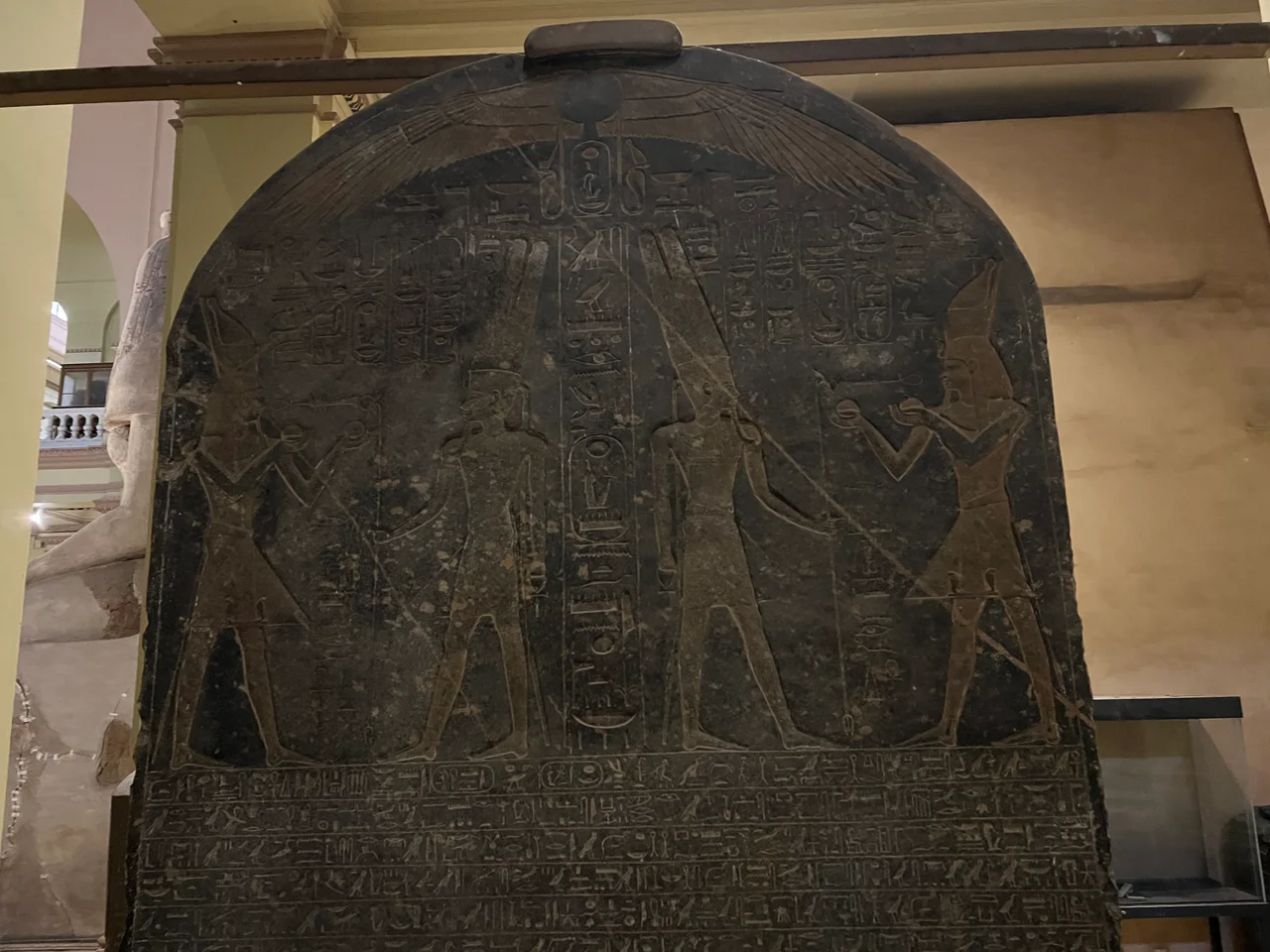
Merneptah Stele
"Won't the reverends be pleased?" The remark belongs to the archaeologist Flinders Petrie, in Thebes in 1896, the evening he realized what one line of an Egyptian victory hymn actually said. His epigrapher had been stumped by a cluster of hieroglyphs near the bottom of a towering black granite slab. Petrie looked and suggested a reading: Israel. That night he told the dinner table the stone would become better known than anything else he ever found — and on the strength of those four small signs, he was right. The Merneptah Stele was carved to glorify a pharaoh's triumph over Libya. But buried in its closing lines is the earliest reference to Israel found anywhere in the ancient world, and the only one ever discovered in Egypt.
A Pharaoh's Boast
The stele stands over three meters tall, a slab of black granite cut on the reverse of an older monument of Amenhotep III and set up in the funerary temple of the pharaoh Merneptah, who reigned from about 1213 to 1203 BC. At its top, a carved scene shows the god Amun handing a sword to the king, flanked by the goddess Mut and the god Khonsu. Below run twenty-eight lines of hieroglyphic text. The overwhelming bulk of it celebrates a single event: in Merneptah's fifth year, around 1208 BC, a Libyan king invaded Egypt from the west in alliance with northern Sea Peoples, and Merneptah crushed them in a great battle that summer. The monument is, first and foremost, exactly what such royal steles always were — a king proclaiming his power and his protection of Egypt in the grand, formulaic language of victory.
Four Signs at the Bottom
It is the last three lines that changed everything. There the inscription turns from Libya to a separate campaign east, into Canaan, and lists the places Merneptah claims to have laid waste: the cities of Ashkelon, Gezer, and Yanoam — and then a name written differently from the rest. Egyptian scribes attached small signs called determinatives to clarify what a word meant. Ashkelon, Gezer, and Yanoam each carry the sign for a city or a foreign land. But the name read as Israel is marked instead with the determinative for a people — a seated man and woman over the strokes that signal a plural. The distinction is striking: the scribe was telling his readers that this was not a walled town or a territory but a group of people. The line itself is a formula of conquest: "Israel is laid waste; his seed is no more," the standard boast of a ruined enemy whose grain has been destroyed.
Reading the Stone Carefully
What that single mention proves, and what it does not, is a matter scholars treat with care. The reading "Israel" is accepted by the great majority of Egyptologists; the main alternatives proposed over the years — "Jezreel," or a continued description of Libyans — have found little support. So the stele firmly establishes that by about 1208 BC a people called Israel existed and was known in Canaan, significant enough for a pharaoh to name among his conquests. Beyond that, caution is warranted. The "people" determinative is suggestive but not decisive; one prominent scholar noted long ago that Late Egyptian scribes were notoriously careless, and this inscription contains other slips. The text says nothing about who these people were, how they were organized, or whether they were settled farmers or roaming herders — questions still debated. What is not in serious doubt is the stone's importance: it is one of only four Iron Age inscriptions known to name early Israel, and by a wide margin the oldest of them.
An Echo Across the River
The stele was found in Merneptah's ruined temple on the west bank of the Nile, in the great necropolis across from Thebes. On the opposite bank stands Karnak, where a fragmentary second copy of the same victory text was discovered — and where the story takes a further turn. In the 1970s the Egyptologist Frank Yurco argued that a set of battle reliefs at Karnak, long credited to Merneptah's father Ramesses II, in fact belonged to Merneptah himself. The carvings show the storming of cities, one of them labeled Ashkelon, and a fourth scene of fighting against a Canaanite enemy in open, hilly country. Yurco proposed that this last scene might actually depict the Israel of the stele — a possible picture to set beside the written name. Not every scholar accepts the attribution, and the identification remains uncertain. But it captures why this weathered slab still draws crowds: a single carved name, set down to flatter a king, became one of the most scrutinized lines in the human record.
From the Air
The Merneptah Stele was unearthed in the pharaoh's mortuary temple on the Theban west bank, near 25.72 degrees N, 32.61 degrees E, in the band of ruined memorial temples between the cultivation and the desert hills opposite Luxor; the stele itself is now displayed in the Egyptian Museum in Cairo. From the air the temple zone of the west bank appears as scattered rectangular stone enclosures along the desert edge, with the Colossi of Memnon, the Ramesseum, and Medinet Habu among the larger landmarks nearby and the Nile floodplain to the east. Recommended viewing altitude is 2,000 to 4,000 feet AGL, with generally excellent visibility apart from occasional spring dust. The nearest airport is Luxor International (ICAO HELX), about 7 km to the east; for the museum in Cairo, the nearest major airport is Cairo International (ICAO HECA).
Nearby Stories
- Temple of Seti I (Abydos) 20 km away
- Dendera Temple complex 21 km away
- Esna 22 km away
- Abydos, Egypt 49 km away
- Mersa Gawasis 116 km away
- Kharga Oasis 147 km away
- Hurghada 184 km away
- Wadi El Gemal National Park 238 km away