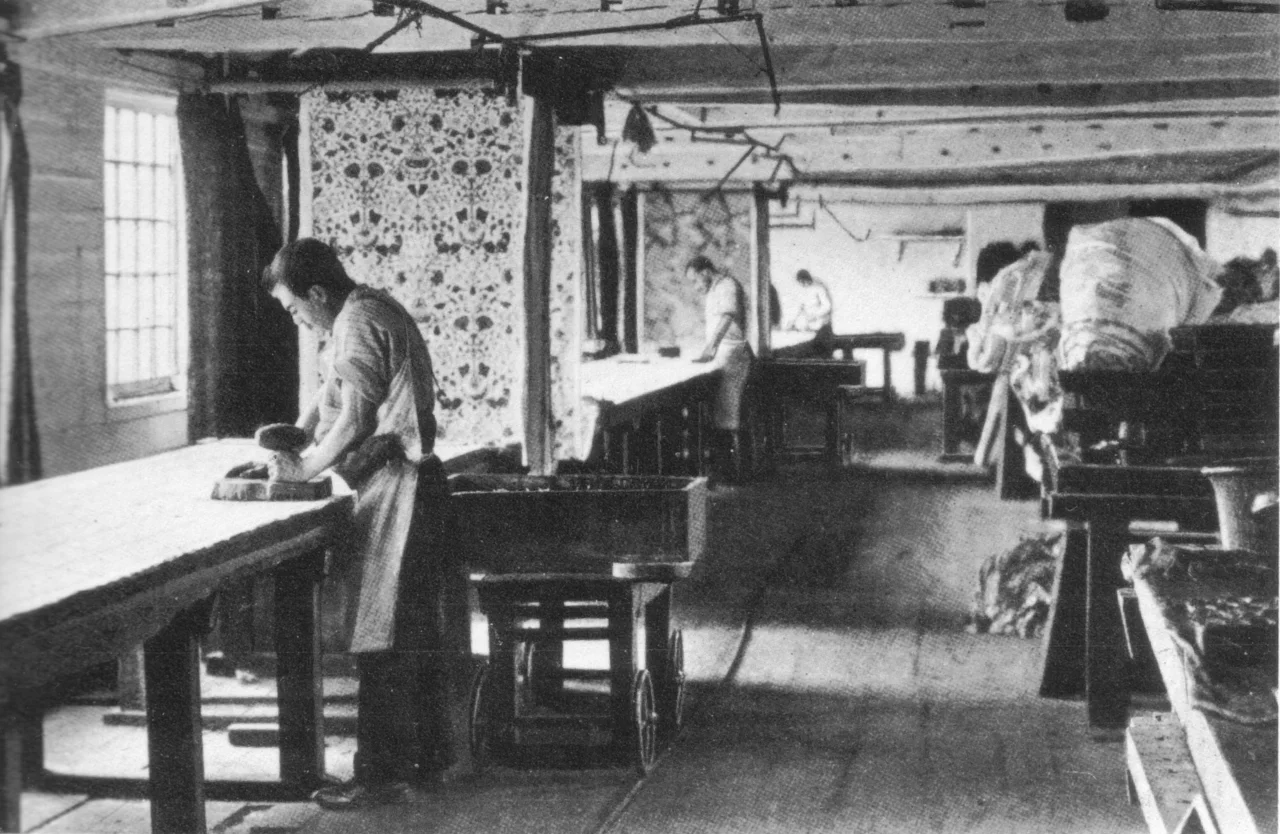

Merton Abbey Works
William Morris spent a decade chasing the perfect blue. He had tried Thomas Wardle's vat experiments in Leek, Staffordshire, and been disappointed by the results, watery and uneven and fading too quickly in the light. He had read 17th-century French dyers' manuals and pored over the indigo trade ledgers of the East India Company. He believed, fiercely, that the cheap aniline blues of the new chemical industry were ugly and decadent. What he wanted was a deep, vivid, lightfast indigo of the kind that medieval Flemish dyers had produced from fermented woad vats. In June 1881 he signed a lease on a battered seven-acre textile printing works in Merton, on the River Wandle in what was then rural Surrey, and within months he had it. The Merton Abbey Works gave him the blue. It also gave him the most productive 59 years of any Arts and Crafts firm in England.
The River That Did the Work
The Wandle is short and modest: ten miles, from Croydon to the Thames at Wandsworth. What it had, by accident of geology, was extraordinarily clean and consistent water flowing over chalk and gravel. Bleachers had worked along its banks since the mid-1600s. Calico printers arrived in the 1690s. By 1724 a calico print works had opened at Merton Abbey Mills, and in 1752 another opened just downriver at what would become the Merton Abbey Works. For 130 years the site changed hands and trades - silk, woollens, tablecloths - while the water continued to do what it had always done, dissolving dyes evenly and rinsing fabric clean. One of Thomas Welch's tablecloths from the works won a prize medal at the Great Exhibition in 1851. By 1880 Welch's firm was failing. Morris took the lease.
Two Sheds and a Wooden Bridge
The Works that Morris inherited were architecturally unpromising. Two long, two-storey buildings called sheds, one on each bank of the river, joined by a wooden bridge. Old houses fronted Merton High Street. A millpond lay south of the river. A copper mill, later a paper mill, stood to the north. The 1992 archaeological dig by the Museum of London revealed buildings on the site dating to the 1500s, traces of the medieval Merton Priory whose dissolution under Henry VIII had originally cleared the land for industry. Morris arranged the buildings to his needs. The dye workshop went on the ground floor of the north shed, with the stained glass workshop above. The hand-weaving for tapestries and carpets went on the ground floor of the south shed, with fabric printing above. Jacquard looms occupied a smaller shed on the north side. A water wheel hanging out over the river washed the cloth.
Indigo Discharge and Wandle
The blue was the breakthrough. Morris and his master dyers used a technique called indigo discharge: the cloth was dipped first in a vat of fermented indigo until it was uniformly dark blue, then printed selectively with a chemical paste that bleached the blue out of the printed areas, leaving white. Subsequent overprinting with red and yellow dyes built up the complex floral patterns that became the Morris signature. The technique was old, but Morris and his dyers refined it into a working production system. The first great Merton design printed this way was Wandle, finished in 1884, named, Morris said, "to honour our helpful stream." The pattern is still in production today, more than 140 years later. A piece of original Merton Wandle from 1884 hangs in the Victoria & Albert Museum.
Toil That Looked Like Pleasure
The American poet Emma Lazarus, who wrote the words on the Statue of Liberty, visited Merton in 1886. She left the works moved enough to write an article about it. "One is not surprised," she said, "to find his factory a scene of cheerful, uncramped industry, where toil looks like pleasure, where flowers are blooming in the windows, and sunshine and fresh air brighten the faces of artist and mechanic." The praise sounds Victorian, and it was; but Morris had structured the workshop deliberately to be the opposite of the dark satanic mills he despised. Wages were higher than the textile industry average. Apprentices were taught all stages of the craft. The yard was full of light. Lazarus's report became part of the legend of the firm and part of the propaganda for the Arts and Crafts movement worldwide.
After the Works
Morris & Co. continued at Merton until 1940. The Second World War, the collapse of demand for hand-made furnishings, and the death of the last family members associated with the firm closed it down. The site was sold to the neighbouring New Merton Board Mills, who demolished the old sheds and built over the open ground. The Board Mills themselves closed in 1984. Today the eastern half of the site is a Sainsbury's supermarket and car park. The western half is office buildings. The Wandle still runs underneath, dropping clean water across what was, briefly and remarkably, the most influential decorative arts workshop in the world. Walk by the river path on a still afternoon, and the only trace of Morris is the name on a few road signs. The fabrics he made here, though, hang on walls across six continents.
From the Air
51.4154 N, 0.1831 W in the London Borough of Merton, on the River Wandle between Wimbledon and Mitcham. The original Works site is now occupied by a Sainsbury's supermarket and office buildings; the river path along the Wandle offers the best surviving sense of the landscape. Nearest airport: London Heathrow (EGLL) 9 nm northwest.
Nearby Stories
- Battle of Britain, Northfleet 1.1 km away
- Bayham Old Abbey 5.4 km away
- Catharine Macaulay 6.4 km away
- Hatfield rail crash 8.8 km away
- Chequers 8.9 km away
- Chelmsford Cathedral 10 km away
- Queen Victoria Hospital 13 km away
- Fishbourne Roman Palace 36 km away