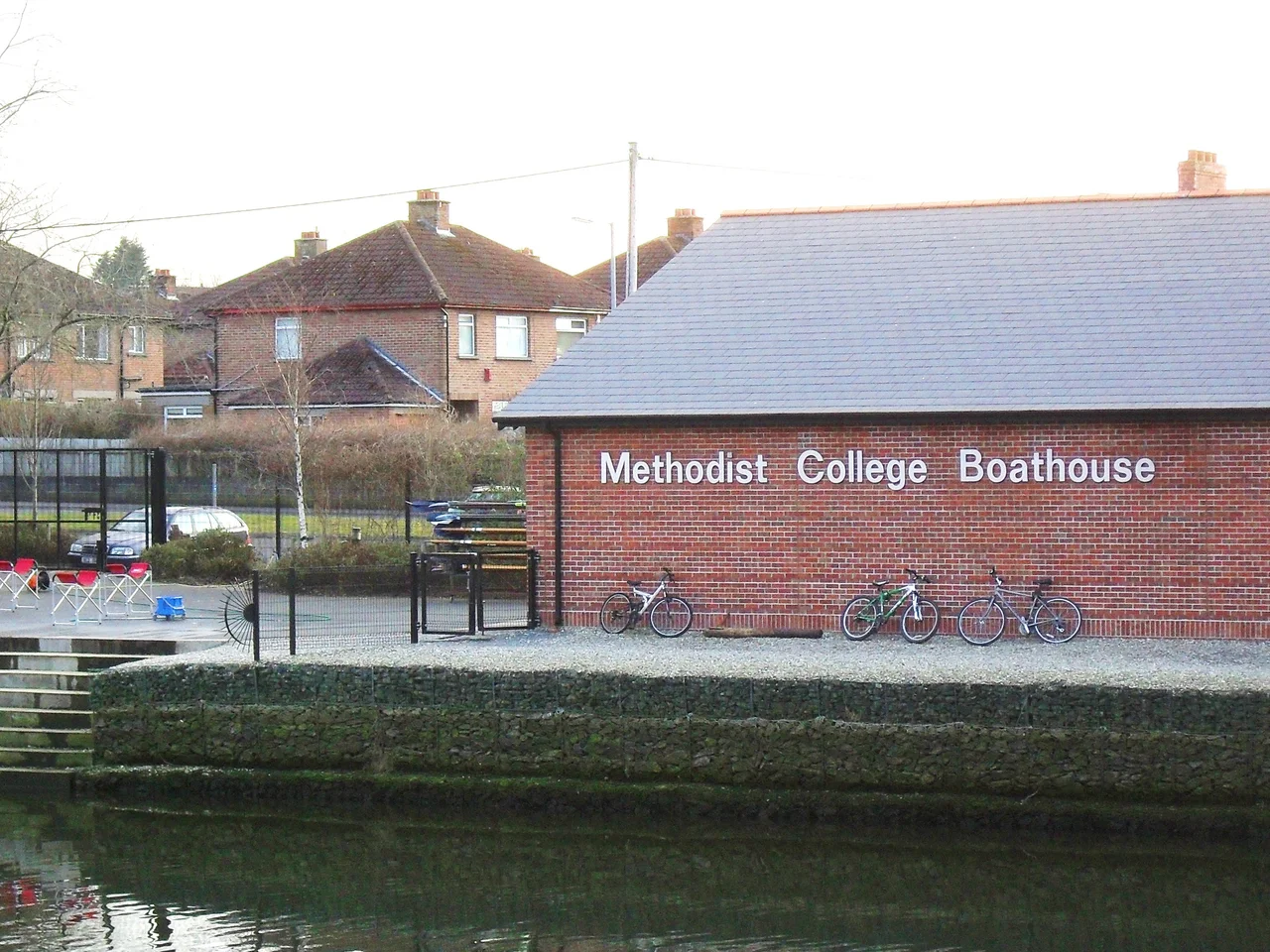

Methodist College Belfast
On 14 April 1932 in the Cavendish Laboratory at Cambridge, a 28-year-old Irish physicist named Ernest Walton became one of the first two people in history to artificially split the atomic nucleus. Twenty years later he and his collaborator John Cockcroft won the Nobel Prize in Physics for the work. Walton had grown up in a Methodist manse, the son of an itinerant preacher, and his schooling - the foundation that took him to Cambridge - was at Methodist College Belfast, the red-brick Victorian school at the foot of the Malone Road. Methody, as everyone in Belfast calls it, was already 65 years old when Walton arrived. It is now 160 years old, has educated three Nobel laureates' worth of distinguished alumni, and the science block named after Walton is still where the chemistry sets live.
Stones on the Malone Road
The school was conceived in 1844, when the Methodist Conference in Ireland approved the idea of founding their own school in Belfast. Twenty-one more years of fundraising followed. In 1865 they finally laid the foundation stone on a 15-acre site near what would soon be Queen's University, purchased by the Belfast linen merchant James Carlisle and offered to the Conference. The architects Joseph Fogerty and Son of Dublin won the design competition, and in 1868 the school opened its doors as a combined day school and Methodist theological college. The Victorian main building - red brick, white stone trim, central tower - still stands at the heart of the campus, its corridors lined with framed photographs of every cricket and rugby team since photography was invented. The theology students are long gone; the school remains.
The Whitla Hall and the Bombs
Sir William Whitla was a physician, professor of medicine at Queen's, and one of Methody's longest-serving governors. When he died in 1933 he left £10,000 in his will to build the school whatever it most needed - chapel, library, or hall. The governors chose hall. The Whitla Hall opened in 1935, a magnificent panelled space with a pipe organ, used for assemblies and concerts and prize-givings. It was barely six years old when the Belfast Blitz of April and May 1941 levelled large parts of the city. Methody was untouched. On the morning after the first raid, the school threw the doors of the Whitla open as a refuge centre for the homeless. Beds were brought in. Food was provided for the men, women and children who arrived. Sixteen members of staff and a thousand former pupils were already away on active service. By the end of the war, 101 alumni were dead. Their names are carved on the memorial in the entrance hall.
The Choir That Sang at Carnegie Hall
Methody's choirs have been winning national competitions for nearly a century, but the modern peak came in the 2010s. The Chapel Choir has performed at Westminster Abbey, Carnegie Hall in New York, and during Queen Elizabeth II's historic state visit to the Republic of Ireland in 2011 - a visit which itself was a small landmark in the peace process. The college choirs have collectively won the BBC's Songs of Praise Choir of the Year, Sainsbury's Choir of the Year, and RTE's All-Island School Choir of the Year. The Whitla Hall is where most of the rehearsals happen, the same hall where homeless families slept in 1941. The school also has a long rugby tradition - it has won the Ulster Schools Cup outright a record 37 times, more than any other school in Northern Ireland, with similar dominance in the junior Medallion Shield. Rugby and choirs are not the obvious pairing, but at Methody they are.
Walton, Bell, and the Other Famous Names
Ernest Walton, who shared the 1951 Nobel Prize in Physics, is the most famous of Methody's alumni. The Walton Building on the Methody campus - completed in the early 1990s with its science labs and computer suites - is named after him. But Walton isn't alone in the science wing of the alumni gallery. Sir William Whitla himself was an alumnus before he was a governor. Lord Roberts, Methody's most decorated military old boy, won the Victoria Cross. The poet Helen Waddell, the medievalist whose Peter Abelard was a 1930s international bestseller, came through the girls' department. So did the actress Liam Neeson... no, Neeson is from Ballymena. But the actor Stephen Boyd, the playwright Stewart Parker, and the singer Eddi Reader all attended Methody. The list of distinguished old collegians runs to multiple pages. The school sends them out and keeps in touch through Methody Collegians branches in London, Hong Kong, Toronto.
Still Here
Methody no longer boards - the final boarding houses closed in 2010, ending a 142-year tradition. Both the original boys' boarding rooms in the Main Building and the McArthur Hall girls' boarding house have been converted into classrooms. The school is now co-educational throughout, with around 2,400 pupils across the prep schools at Downey House and Fullerton House and the main grammar school. It remains a voluntary grammar school - meaning it selects its pupils on the SEAG transfer test - and is one of Northern Ireland's most consistent academic performers, although in the 2023 Sunday Times rankings it placed 19th in Northern Ireland rather than in the UK top 100, a slight dip its principals have not been shy about addressing. Walk through the front quad on a wet October morning and you can still hear, faintly, a choir rehearsing in the Whitla Hall. Some things have not changed.
From the Air
Located at 54.58°N, 5.93°W on the Malone Road in south Belfast, immediately south-west of Queen's University Belfast and the Botanic Gardens. From the air, look for the dense red-brick Victorian main building with its central clock tower at the foot of the Malone Road - it sits in a 15-acre walled campus that is unmistakable from the surrounding student housing. Queen's University's Lanyon Building is half a mile north along University Road. Belfast City Airport (EGAC) is 3 nautical miles east-north-east; Belfast International (EGAA) is 13 nautical miles west-north-west. Recommended viewing altitude: 1,500-3,000 feet to identify the Victorian main building and its later 20th-century additions clustered around the original quad.
Nearby Stories
- Larne 1.2 km away
- Ahoghill 3.5 km away
- Castleskreen 4.9 km away
- Lough Neagh 6.1 km away
- Kingsmill Massacre 14 km away
- Pasages (steam trawler) 23 km away
- Ballantrae Lifeboat Station 34 km away
- St Patrick's Isle 39 km away