.jpg)
MI6 (Secret Intelligence Service)
Captain Sir Mansfield George Smith-Cumming was the founding head of what we now call MI6. He had lost a leg in a car crash and disliked the Smith in his name; in correspondence he tended to drop it. He signed his notes with one letter, the green-ink initial C. He died at home in 1923, shortly before he was meant to retire, having served the institution he created for fourteen years. Every chief of the Secret Intelligence Service since then has signed their internal correspondence with that same letter, C, in that same green ink. There have been eighteen of them. The current C, since October 2025, is a woman: Blaise Metreweli.
1909 and the Foreign Section
Britain founded its Secret Service Bureau in 1909, the year of King Edward VII's last full reign, as a small office charged with countering an imagined German invasion threat. The Foreign Section, under Cumming, dealt with intelligence collected abroad; the Home Section, under Captain Vernon Kell, dealt with German spies in Britain. The two sections diverged over the next decade into what became MI6 and MI5 respectively. The MI prefix - for Military Intelligence - arose during the First World War when both services were nominally part of the War Office. The name MI6 was a wartime flag of convenience that stuck. The official name has been the Secret Intelligence Service since around 1920, and the legal name was set in statute only in 1994 by the Intelligence Services Act, the first time Parliament formally acknowledged that the service existed.
The Cambridge Five
Through the 1930s a Soviet recruiter in Vienna identified clever, idealistic young Englishmen at Cambridge - men sympathetic to communism in an age of fascism, men who would later be useful inside the British establishment. The most senior of the resulting Five, the longest-serving and the most damaging, was Harold Adrian Russell Philby - known as Kim. By 1944 he was running the new anti-Soviet section at MI6 itself, with full access to British operations against the USSR. When Konstantin Volkov, a Soviet defector, offered to name all the Soviet moles inside British intelligence in 1945, Philby received the memo first and tipped off Moscow. Volkov was kidnapped and disappeared. Philby was unmasked only in 1963, fleeing to Moscow before he could be arrested. He died there in 1988, having lived for twenty-five years as a Soviet pensioner.
Bletchley and the Polish Gift
On the 26th and 27th of July 1939, weeks before Hitler invaded Poland, Polish military intelligence brought representatives of British intelligence to a forest near Warsaw and handed them a reconstructed Enigma machine, along with the cryptographic techniques the Poles had developed to break the cipher. This was the foundation on which Bletchley Park was built. Through the Second World War, the Government Code and Cypher School at Bletchley - the SIGINT arm controlled by C - produced the Ultra intelligence that gave Allied commanders sight into Hitler's strategy. A two-volume official history published jointly by the British and Polish governments in 2005 revealed that 48 percent of all intelligence received by British secret services from continental Europe between 1939 and 1945 originated from Polish sources, run through the SIS officer Wilfred Dunderdale. The Polish secret agent Jan Karski brought the British their first credible intelligence about the Holocaust.
Penkovsky and the Missiles
The most consequential agent MI6 ever ran was a Soviet colonel named Oleg Penkovsky, recruited jointly with the American CIA in 1961 and run for the better part of two years. He passed thousands of photographed documents, including Red Army rocketry manuals that allowed US analysts at the National Photographic Interpretation Center to identify the deployment pattern of Soviet SS-4 medium-range and SS-5 intermediate-range ballistic missiles in Cuba in October 1962 - the photographs that triggered the Cuban Missile Crisis. Penkovsky was arrested by the KGB later that year. He was executed in 1963. A decade later, in the 1970s, MI6 began running Oleg Gordievsky, a KGB officer in London who provided crucial warnings during the 1983 Able Archer crisis - when Soviet leaders briefly feared a NATO exercise was cover for a nuclear first strike. Gordievsky was exfiltrated from Moscow across the Finnish border in 1985, in the boot of a diplomatic car. He lived in Surrey until his death in 2025.
Vauxhall Cross
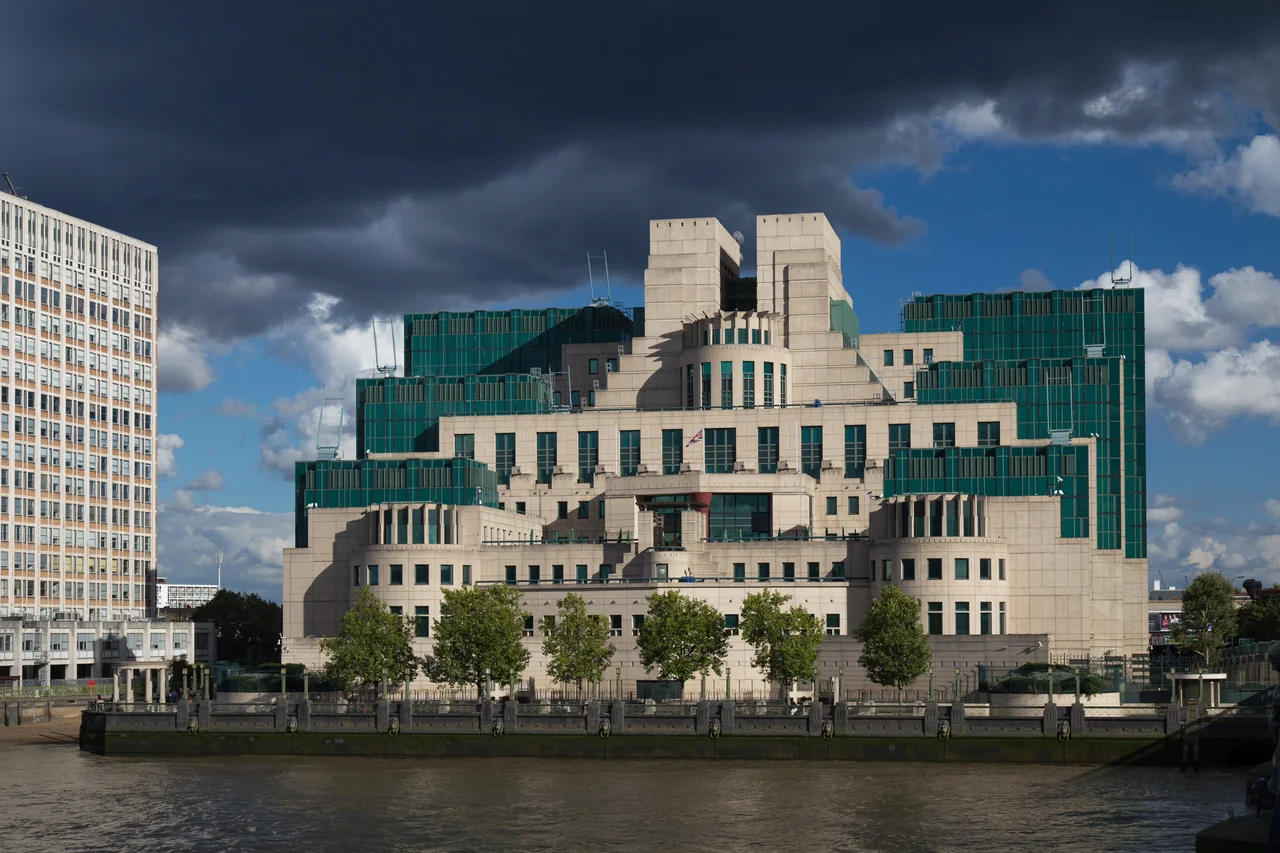
From 1924 until 1964, SIS occupied 54 Broadway, off Victoria Street, with a great deal of its real business done in the adjoining St Ermin's Hotel. After that the service moved through various central London buildings until Margaret Thatcher's government approved, in December 1987, the purchase of a striking new building under construction at Vauxhall Cross. Sir Terry Farrell designed it: a postmodern ziggurat of green glass and pale stone on the south bank of the Thames, faintly Babylonian, deliberately strange. It opened in 1994 and has been the public face of the service ever since - to the point that the James Bond films keep blowing it up. In The World Is Not Enough a bomb tears off an exterior wall. In Skyfall the building burns from inside. In Spectre, Blofeld tries to demolish what remains. The real Vauxhall Cross still stands, unblown-up, watching the Thames.
The C, and What the C Does
The chief of SIS, by long custom, signs internal correspondence with the single letter C, in green ink, as Mansfield Cumming did in 1909. The C is appointed by the Foreign Secretary and reports directly to her. The job is twofold: managing the intelligence officers who recruit and run foreign agents around the world, and serving as a kind of secret diplomat to other intelligence chiefs, maintaining the alliances - especially the Five Eyes - on which modern intelligence cooperation depends. Some Cs have been internal appointments. John Sawers, the C from 2009 to 2014, was the first outsider in more than forty years, coming from the diplomatic service. Blaise Metreweli, the present C, joined SIS in 1999 and is the first woman to hold the post. The service that began as one captain with a wooden leg and a green pen now employs an estimated 3,500 staff. It is still, on the public record, the only branch of His Majesty's Government most of whose business officially does not happen.
From the Air
The SIS Building at Vauxhall Cross sits at 51.4870°N, 0.1240°W on the south bank of the Thames just southwest of Vauxhall Bridge. From 1,500-2,500 ft AGL the green glass ziggurat is unmistakable - look for the stepped postmodern facade on the riverbank between Vauxhall Bridge and Lambeth Bridge, with the MI5 building (Thames House) visible across the river on the north bank. Nearest airports: London City (EGLC) 6 nm east, London Heathrow (EGLL) 12 nm west, RAF Northolt (EGWU) 11 nm northwest. The Houses of Parliament are just over a mile downriver to the north.
Nearby Stories
- Battle of Britain, Northfleet 1.1 km away
- Bayham Old Abbey 5.4 km away
- Catharine Macaulay 6.4 km away
- Hatfield rail crash 8.8 km away
- Chequers 8.9 km away
- Chelmsford Cathedral 10 km away
- Queen Victoria Hospital 13 km away
- Fishbourne Roman Palace 36 km away