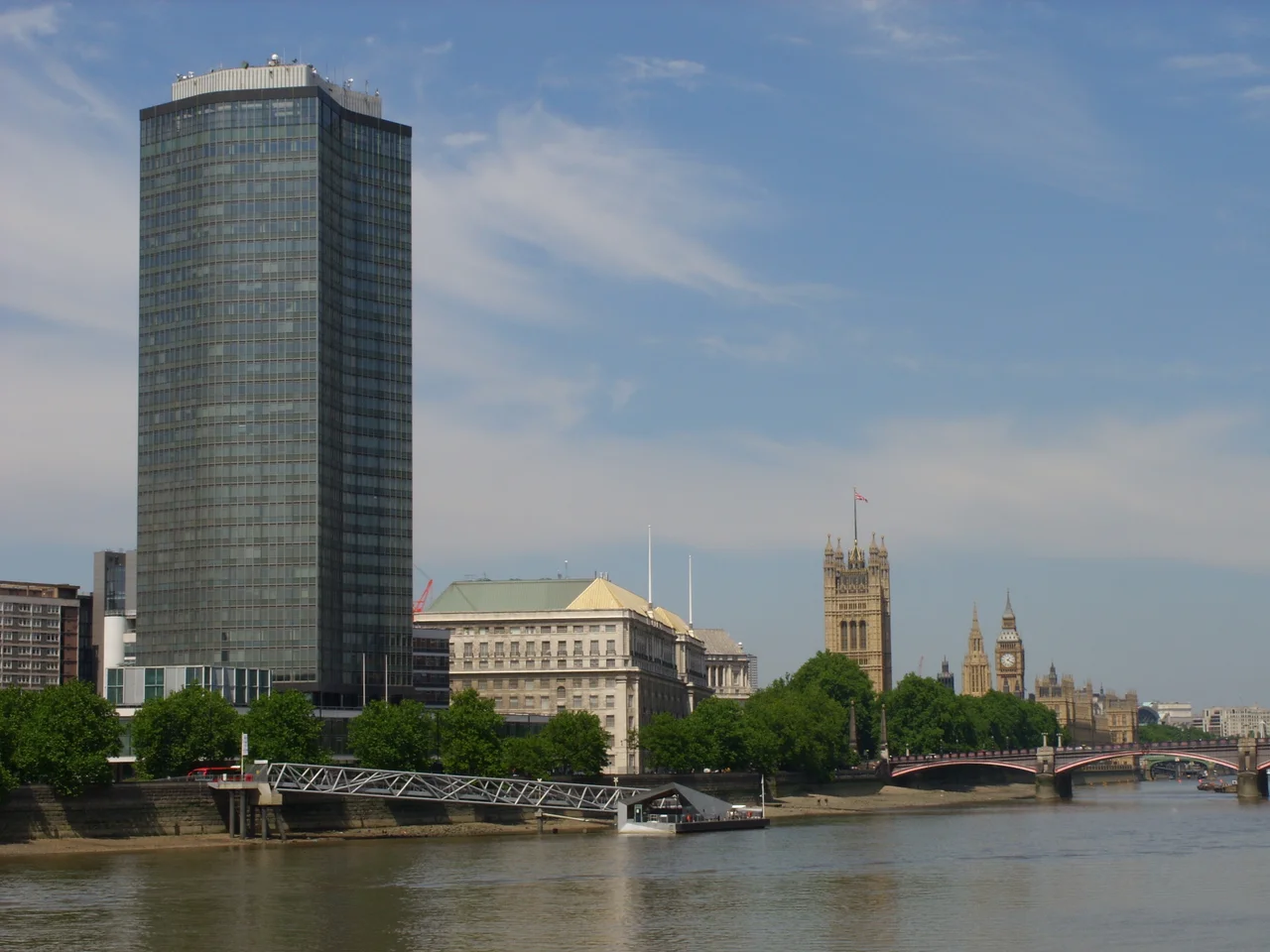

Millbank Tower
For exactly one year - from 1963 until the BT Tower opened in 1964 - Millbank Tower was the tallest building in the United Kingdom. It is no longer that. It has, however, been almost everything else: corporate HQ, election war room, United Nations annexe, television studio for Russia's RT UK, and the site of one of the most consequential student protests in modern British history. Even Nikolaus Pevsner's notoriously hard-to-please architectural guide called it one of the few London office towers to have won affection. The Pevsner editors had clearly been paying attention to what happened in November 2010.
Vickers House
The tower was built in 1963 for Vickers, the British engineering and arms manufacturer, and was originally known as Vickers House or Vickers Tower. The architect was Ronald Ward and Partners; the contractor was John Mowlem. At 119 metres it is slim, faceted, and curtain-walled in greenish glass that catches and changes with the Thames sky. It stands on Millbank, half a mile upstream from the Palace of Westminster, with Tate Britain a short walk to the north and the river running directly below the eastern facade. The building is now Grade II listed - a rare protected status for a 1960s office block, granted because the silhouette has become as integral to the south-side river skyline as anything else on it.
Labour Moves In
From 1994 the Labour Party rented two floors at the base of the south end of the site, transforming them into a general election campaign centre. From here, in 1997, the party ran the campaign that returned Tony Blair to Downing Street with a landslide. The image of Millbank-as-political-machine entered British vocabulary - Millbank became shorthand for a centralised, message-disciplined operation. After the election Labour vacated its old headquarters at John Smith House on the Walworth Road in southeast London and moved its main offices to Millbank. By 2002, the rent had become unsustainable; the party took out a 5.5 million pound mortgage and moved instead to Old Queen Street overlooking St James's Park. The United Nations also held offices in the tower until 2003, when it too left, citing high rents.
The Day Students Came
On 10 November 2010 the National Union of Students called a mass demonstration in central London against the coalition government's planned tripling of university tuition fees. The official route was a sober march to a rally; the unexpected route led several thousand protesters to break off and converge on 30 Millbank, where the Conservative Campaign Headquarters then occupied office space in the Millbank complex. The crowd surrounded the building, smashed through the lobby glass, and reached the roof. A fire extinguisher was thrown from the top - an act that almost killed police officers below and provoked widespread condemnation, including from many on the protesters' own side. The image of students standing on the roof of the Tories' campaign HQ became the defining picture of the year's politics. The fees went up anyway. But the protest, which became known simply as Millbank, helped set the tone for the wider movement that followed.
An Unusual Tenant Mix
Between 2006 and 2014 the Conservative Party themselves were based at 30 Millbank within the same complex - the political coincidence of the country's two main parties operating from the same address has fed countless jokes since. Other occupants over the years read like a directory of British public and corporate life: the Central Statistical Office, the Office for National Statistics, the Parliamentary and Health Service Ombudsman, the Local Government Ombudsman, the UK India Business Council, the Ministry of Justice records service, the Environment Agency, the World Bank's London office (until 2022), Canonical Ltd, the Audit Commission, the Open Society Foundations, and a long list of caterers, communications firms, and trading houses. From April 2018 the offices of the People's Vote anti-Brexit campaign were based here. Since February 2025 the building has housed the headquarters of Reform UK, Nigel Farage's party. Few addresses in London have hosted such an ideologically restless tenancy.
The Next Chapter
Since 2002 the tower has been owned by the brothers David and Simon Reuben, while managed by its former owner Tishman Speyer Properties. In April 2016, Westminster City Council granted the Reubens permission to redevelop the building despite its listed status. The plans call for 207 high-end apartments, a 150-room five-star hotel, gym, spa, swimming pool, a new cultural centre, and three additional storeys on the main tower. Construction was scheduled to begin in 2024 once existing tenancies wound down. Until then the building continues to function as offices - including, until its 2022 closure, the London studios of RT UK. Millbank Tower has spent more than sixty years on the river, watching governments come and go from just upstream. It has been a place where power lived. It is about to become a place where people pay to live.
From the Air
Coordinates 51.4922 N, 0.1260 W on the north bank of the Thames at Millbank, City of Westminster. From altitude the tower reads as a distinctive slim greenish prism beside the river curve, half a mile upstream of the Palace of Westminster. Tate Britain sits immediately to the north. Nearest airports London City (EGLC) about 6 nm east and London Heathrow (EGLL) about 14 nm west. Clear days reveal the entire Westminster skyline: Big Ben to the north, the London Eye across the river, Battersea Power Station to the southwest.
Nearby Stories
- Battle of Britain, Northfleet 1.1 km away
- Bayham Old Abbey 5.4 km away
- Catharine Macaulay 6.4 km away
- Hatfield rail crash 8.8 km away
- Chequers 8.9 km away
- Chelmsford Cathedral 10 km away
- Queen Victoria Hospital 13 km away
- Fishbourne Roman Palace 36 km away