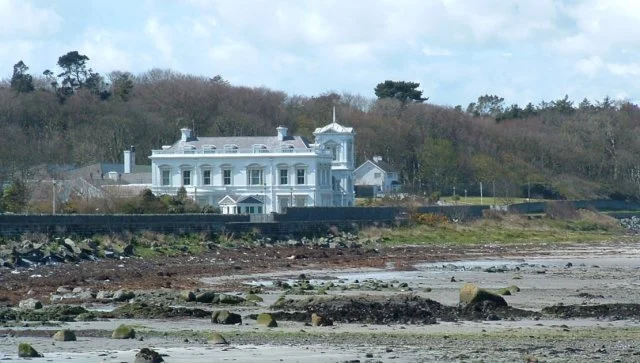

Millisle
Between 1939 and 1948, a small farm on the Woburn Road outside Millisle became a home for children who had escaped the Nazi regime. The Kindertransport had carried roughly 10,000 Jewish children out of Germany, Austria and Czechoslovakia to safety in Britain. Some of them were sent across the Irish Sea to Northern Ireland. While many lived with foster families, a number ended up at the Millisle Refugee Farm, known locally as Magill's Farm, where they were fed, schooled and quietly absorbed into village life. The farm closed in 1948 once the last of its young people had found other paths. There is no grand monument. The story is part of the village's bone structure now, carried in commemorative plaques and the long memories of the people who worked the land alongside the children they were sheltering.
The Meadow of the Mill
The name Millisle comes from the Scots words mill and isle, which together mean something close to the meadow of the mill. The Scottish settlers who arrived during the Plantation of Ulster may have brought the name with them from a hamlet of the same name in Wigtownshire, just across the North Channel. Whatever its origins, the mill in question is still standing. Ballycopeland Windmill, built in the late eighteenth century, kept grinding corn until 1915 and is now maintained as a working museum by the Historic Environment Division of the Department for Communities. Its sails turn against the County Down sky when conditions allow. Inside the miller's cottage, an electrically driven model of the mill mechanism does the explaining, and a restored corn-drying kiln gives a sense of how grain moved through the building before electric flour mills made tower mills obsolete. There is something faintly ridiculous about a wind-powered industrial site still being able to work two centuries after it was built. There is also something deeply consoling.
The Airfield That Refused to Be Built
In 1944, military engineers began construction on Millisle Airfield, intended as a base for the United States Army Air Forces. The Second World War was approaching its endgame and Allied aviation needed every paved acre it could secure. The ground had other ideas. Surveys showed the soil was unstable, the foundations were sinking, and the project was abandoned before the runways could be finished. Two concrete strips remain today, slowly being reclaimed by grass and brambles. They are easy to miss from the road. From above, they trace a faint geometry across the fields, a half-finished decision frozen in 1944. Nearby, on Tullykevin Road in neighbouring Greyabbey, a small brass plate on a field post commemorates a pilot who crashed and died there during the war. The war touched these villages in ways the road maps don't show.
Amy Carmichael
Amy Carmichael was born in Millisle in 1867. By the time she was thirty-three she had founded a mission in southern India that rescued children, mostly girls, from temple prostitution and abuse. She stayed in India for fifty-five years and never returned to Ulster. Her books, written in pain from a long illness in her later decades, are still read in evangelical circles. The Carmichael townhouse on the corner of Main Street and Abbey Road was demolished in 2002, replaced by something newer. A commemorative plaque marks where she was born. Millisle also produced William Kelly (1821-1906), a scholar and prominent figure in the Plymouth Brethren whose theological writings filled twenty volumes. Two of the most consequential nineteenth-century missionaries born within a generation of each other in a village that today has fewer than 2,500 residents. It is the kind of detail that does not fit neatly into any one story about a place.
The Lagoon and the Slow Tide
The Millisle Lagoon and Beach Park stretches 150 metres along the eastern shore of the Ards Peninsula. In 2010 it won one of eight Northern Ireland Tourist Board Seaside Awards for natural beauty and cleanliness. The lagoon itself is a shallow, tide-fed pool that warms faster than the open sea, making it a favourite of small children and elderly swimmers. Walk south from the lagoon and you find the village's other oddity: the First and Last Pub, which claims that William of Orange stopped here in 1690 on his way to the Battle of the Boyne. The pub was founded in 1790, a full century after the battle, but the legend is sturdy enough to survive its own arithmetic. North of town stands the Northern Ireland Prison Service College on a 21-acre site, and beyond that the former Lisnevin Training School, once a young offenders' institution and now sold for 1.75 million pounds in 2018. Millisle holds these things together, the windmill and the lagoon, the rescued children and the failed airfield, in the easy way that small villages have of containing complicated histories without comment.
From the Air
Millisle sits at 54.61 degrees north, 5.53 degrees west, on the east coast of the Ards Peninsula about three miles south of Donaghadee. From the air, the village is easiest to locate by the lagoon along its eastern shoreline. Ballycopeland Windmill, just to the west of the village, is a clear inland landmark. Belfast City Airport (EGAC) lies about 16 miles to the west; Belfast International (EGAA) is about 26 miles west-northwest. The two abandoned concrete runways from the never-completed 1944 airfield can sometimes be picked out in cleared light. The Copeland Islands lie just to the north, with their lighthouses providing navigation reference along the Irish Sea coast.
Nearby Stories
- Pasages (steam trawler) 0.5 km away
- Edward Harland 1.1 km away
- SS Georgetown Victory 4.7 km away
- St Patrick's Isle 18 km away
- Ballymena 19 km away
- Silent Valley Reservoir 20 km away
- Larne 23 km away
- Battle of Glen Trool 39 km away