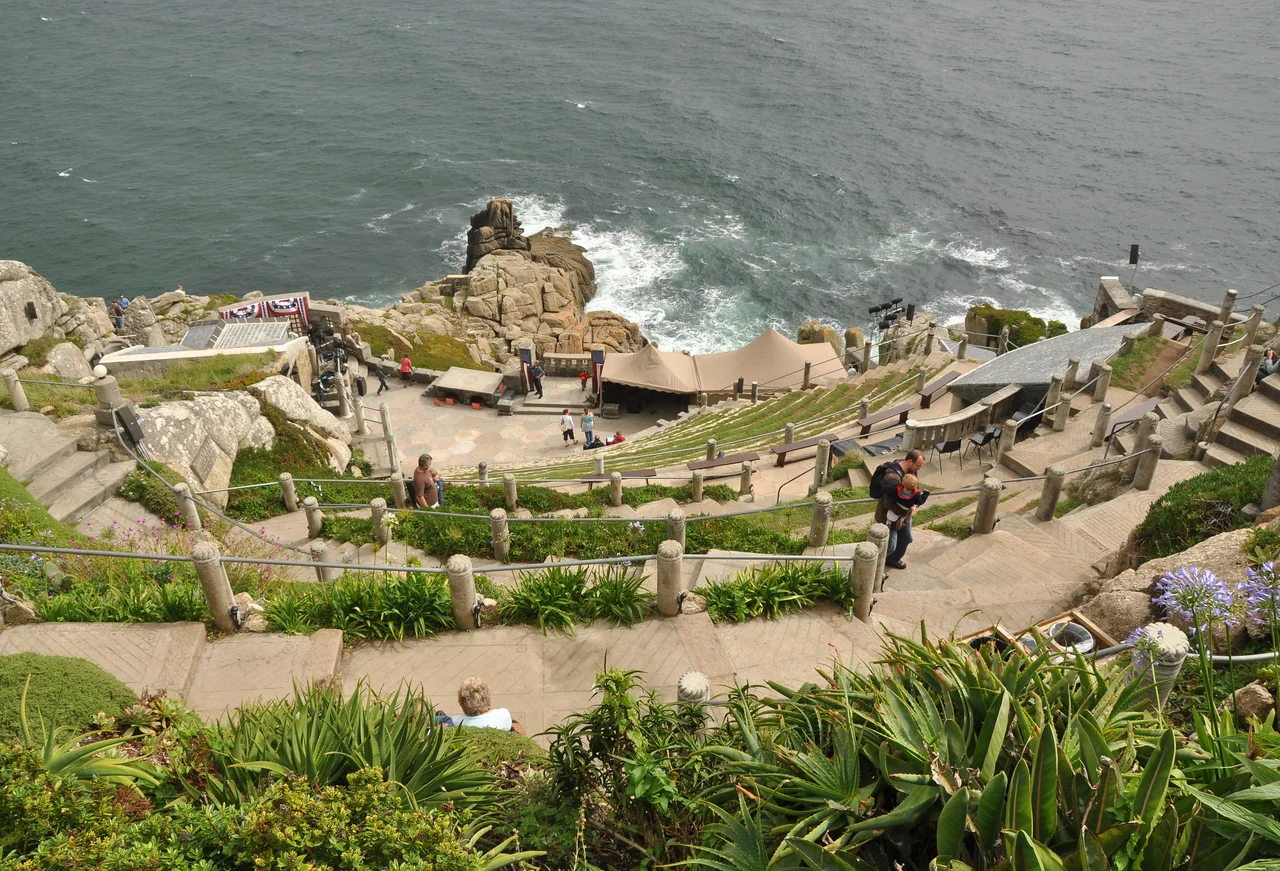

Minack Theatre
Rowena Cade was 36 years old and had recently bought a small clifftop plot at Minack Point for £100 when, in 1929, a local village group of players staged Shakespeare's A Midsummer Night's Dream in a meadow at nearby Crean. She watched the production, watched it repeated the next year, and listened when they said their next play would be The Tempest. She walked them down through her own cliff garden and showed them what she had been looking at every day since she had moved in: a rocky granite outcrop jutting straight out into the Atlantic, with a natural amphitheatre folded into the slope above it, and the wide Channel curving away below. She offered the place to them as a stage. Then she picked up a wheelbarrow and began, with one gardener and her own hands, to turn it into one.
A Woman with a Cliff
Rowena Cade had moved to Cornwall after the First World War with her mother and her sister, the future feminist dystopian novelist Katharine Burdekin, who would live with them through the 1920s. The land at Minack Point, near the village of Porthcurno about four miles from Land's End, was unfashionable and almost worthless: too steep, too windy, too far from anything for anyone to want it for a holiday house. Cade bought it for a hundred pounds and built a house there for her family. She would live on that headland for the rest of her life. By the standards of the 1920s, she was an unusual woman: practical, intensely determined, indifferent to convention and willing to put a wheelbarrow on her own back. In her old age she was sometimes mistaken for a workman by visitors who saw her hauling sand. She did not correct them.
The Tempest, 1932
Cade and her gardener, Billy Rawlings, began work in the autumn of 1931. They carved a terrace into the slope to make a flat stage, and rough seating into the turf above it. Everything had to be hauled in: timber and tools down from her house at the top, sand and concrete up via the narrow winding path from the beach far below. Cade made the trips herself, often more than one a day. In the summer of 1932 the local players performed The Tempest at the cliff edge with the Atlantic as their backdrop. The wind tore at the costumes. The acoustics, against all reasonable expectation, worked. The audience that crowded onto Cade's improvised benches understood at once that something genuinely strange and wonderful had been made on that cliff.
Fifty Winters
What followed was a working life of a kind that almost no one undertakes any more. Cade decided to keep improving the theatre. Each winter, for the next half-century, she worked on the granite seats, the terraces, the steps, the carved Celtic motifs in the cement balustrades. Billy Rawlings remained her chief collaborator. Two local masons, Charles and Thomas Angove, joined her. Friends helped. She mixed her own cement, troweling it into the seat backs while it was still wet and inscribing the names of the plays and the years they were performed. She built buttresses against the storms that battered the cliff. She designed and dug the dressing rooms, finally built in 1955, more than twenty years after the first performance. She worked into her late seventies, then into her eighties, becoming over time the most photographed sight in Cornish theatre after the theatre itself. In 1944 the Gainsborough Studios film Love Story, starring Stewart Granger and Margaret Lockwood, was shot here, though Cornish weather drove the production into a studio mock-up before they finished. Rowena Cade died in 1983, shortly before her ninetieth birthday. The theatre was, by then, very nearly finished, but she had still been adding to it that summer.
Performing Above the Atlantic
The performing season at the Minack now runs from Easter to the end of October, with several professional in-house productions each year and a long roster of visiting companies. Audiences book in advance, then bring waterproofs and cushions and sit on the granite seats Cade poured by hand, looking down past the actors to a stretch of sea that on a clear evening turns the colour of polished slate. The acoustics that Cade discovered by accident in 1932 still hold: an unamplified voice from the stage carries cleanly up to the back row. Sea birds occasionally upstage the dialogue. Choughs sometimes come over. The Minack has been registered as a charitable trust since 1976 and is now a Charitable Incorporated Organisation. In August 2022, the theatre celebrated its 90th anniversary with another production of The Tempest, the play that had started it all, performed by Hertfordshire Players to a sold-out cliff.
The Most Spectacular Stage in the World
The Minack now appears, with monotonous regularity, on lists of the most spectacular theatres on the planet. It is genuinely difficult to think of another. It was not built by a state, or a wealthy patron, or a civic theatrical organisation. It was built by a single woman in late middle age who saw what was already there, in the granite and the sea, and decided to spend the rest of her working life uncovering it. She gave the theatre, in her lifetime, to a trust she set up so it would survive her. It opens through most of the year for visitors who want to walk the terraces, read the names of plays past inscribed in the seats, and look at the Atlantic from the same angles Cade did. Standing at the back of the auditorium, you can see most of what one careful person can accomplish in fifty winters if she refuses to give up.
From the Air
The Minack Theatre sits at approximately 50.04 degrees north, 5.65 degrees west, on the cliffs at Minack Point above Porthcurno Bay in Cornwall, roughly 4 miles east-southeast of Land's End. From the air it is recognisable as a curving cluster of stepped terraces cut into a granite cliff face directly above the sea, with the white-sand beach of Porthcurno immediately to the north-east. The Logan Rock headland (Treryn Dinas) lies less than a mile to the east. The closest airfield is Land's End Airport (EGHC) at St Just, about 5 nautical miles to the north-west. The South West Coast Path runs along the clifftops above and offers spectacular views of the open Atlantic; weather can change rapidly from sunshine to sea fog.
Nearby Stories
- Mullion Cove 1.3 km away
- Great Wheal Charlotte 3.7 km away
- Castle Down 5.3 km away
- SS Georgia (1890) 30 km away
- Wheal Coates 41 km away
- 1979 Fastnet Race 55 km away
- HMS Affray 126 km away
- Routes of Santiago de Compostela: Camino Frances and Routes of Northern Spain 713 km away