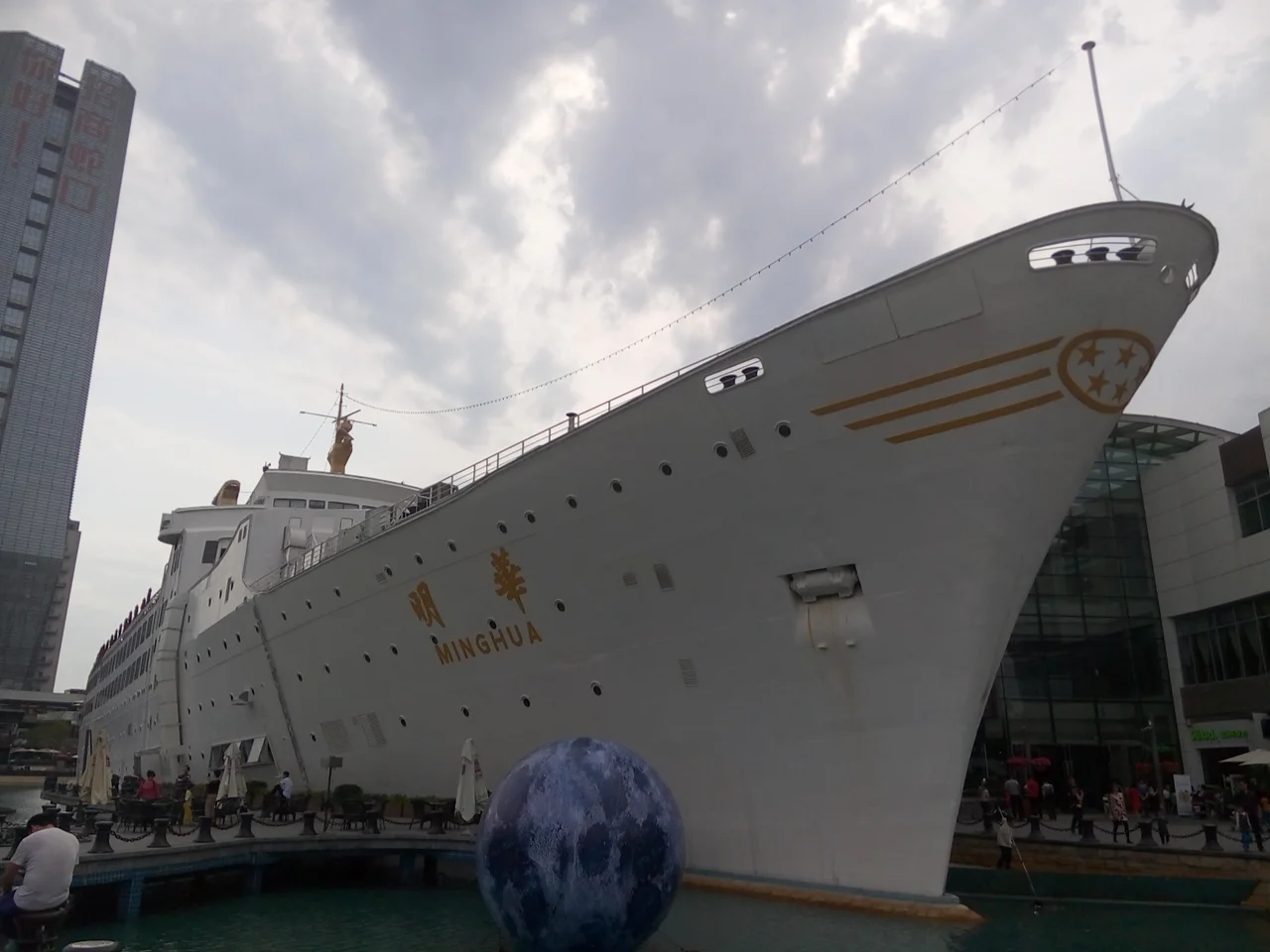

Minghua (ship)
Her final cruise to Rio de Janeiro never made it back to Marseille. In the spring of 1973, the passengers on board MV Ancerville were flown home from Tenerife with little explanation — because their ship had just been sold to China. Renamed Minghua, meaning "Spirit of China," she would go on to ferry workers building Africa's greatest Cold War railway, attempt a refugee evacuation in Vietnam, carry diplomats on a month-long goodwill mission around Japan, and host 17,000 Australian holiday-makers across the South Pacific. Then, in 1983, she sailed into Shekou and never left.
Born in Saint-Nazaire, Built for the Sea
Chantiers de l'Atlantique launched the Ancerville in 1962 for the Compagnie de Navigation Paquet, designed to run the Marseille-to-Dakar route twice a month with stops at Casablanca and Tenerife. She was a sleek, yacht-profiled liner — unusual in that her cabins were clustered forward and her public rooms aft, giving every passenger, from the 171 first-class travellers to those in the 10-berth dormitories, a view of the sea. Two 12,000-horsepower Burmeister & Wain diesel engines drove her twin propellers to a service speed of 22.5 knots, and she proved herself in sea trials by touching 25. As jet travel eroded the passenger trade through the late 1960s, she pivoted increasingly toward cruises — Mediterranean summers, West African winters, eventually South America — and in July 1970 she stopped her own disaster from becoming one: rescuing all passengers and crew from the burning liner Fulvia near the Canary Islands.
A Different World, A New Name
COSCO, the Chinese state shipping company, took ownership in April 1973 and immediately put the newly renamed Minghua to work on China's most ambitious foreign-aid project: the TAZARA Railway, a 1,860-kilometre line linking Tanzania to Zambia. For five years she ran between Chinese ports and Dar es Salaam, ferrying construction workers across the Indian Ocean and sometimes serving as an accommodation ship in port. Then came a delicate diplomatic assignment. In May 1979, she carried a 600-person Chinese government goodwill delegation led by Liao Chengzhi — a senior diplomat and President of the China-Japan Friendship Association — on a month-long voyage around Japan, calling at Shimonoseki, Kyoto, Nagoya, Toyama, Tokyo, and Nagasaki. Aboard were high-level meetings between Chinese and Japanese officials — including the first-ever encounter between a senior People's Liberation Army general and Japan's Director-General of the Defense Agency — helping to rebuild ties that had been severed for decades.
The Friendship Years Down Under
In 1979 a new Sydney-based company called Asian Pacific Cruises chartered the Minghua and refitted her in Hong Kong, bringing her capacity to 580 passengers. She departed Shanghai on 15 December that year, arriving in Sydney on New Year's Eve. What followed was four years of cruising under the banner "Minghua Friendship Cruises," in partnership with Burns, Philp & Co. — the joint venture was reportedly the first Sino-Australian commercial partnership of its kind. Australians took to her warmly, nicknaming her "the Friendship" and appreciating the informality that set her apart from more formal liners. She completed roughly 70 cruises and carried around 17,000 passengers to New Zealand, the South Pacific, Southeast Asia, Japan, China, and Hawaii. A major refit in Hong Kong in 1980 saw her hull repainted from light green to white. By 1981 her capacity had been trimmed to 450 passengers, but her reputation only grew.
Landlocked in Shekou
On 17 August 1983, the Minghua arrived at Shekou in the Shenzhen Special Economic Zone — one of China's earliest experiments in market reform — and became the centerpiece of the new Sea World entertainment complex. Her 253 hotel rooms, restaurants, bars, and cultural exhibition spaces drew visitors from across the Pearl River Delta for over a decade. Then the land around her changed: the sea was reclaimed during the 1990s for a golf course, and a ship that had once crossed oceans became permanently, physically landlocked. A fire and management difficulties closed her in 1998. Floods in 2007 briefly surrounded her with water again — a strange echo of her former life. The lifeboats came down, and in their place an ornamental lake was built along her starboard side. She was removed from Lloyd's Register in 1991, officially ceasing to be a ship by any legal definition, though the hull that crossed from Marseille to Dakar, from Dar es Salaam to Sydney, still sits in Shekou today.
A Life Written in Ports
Few vessels carry a biography as layered as the Minghua's. She appeared in two landmark Senegalese films as the Ancerville — Ousmane Sembène's Black Girl in 1966 and Djibril Diop Mambéty's Touki Bouki in 1973, films now considered classics of African cinema — before becoming an instrument of Cold War diplomacy and South Pacific leisure. She shuttled workers building socialism in Tanzania, diplomats repairing the China-Japan relationship, and sunbathing Australians bound for Bali. The transition from ocean liner to convention hall seems almost mundane against that history. Standing on her decks in Shekou today, surrounded by the towers of a city that barely existed when she arrived, you are looking at sixty-plus years of twentieth-century history compressed into a single hull.
From the Air
The Minghua sits at approximately 22.49°N, 113.91°E in the Shekou district of Shenzhen, China, on the northern shore of the Pearl River estuary. From the air at 3,000–5,000 feet, the white hull is visible against the reclaimed waterfront between the Shekou Industrial Zone and Sea World plaza. Hong Kong International Airport (VHHH) lies roughly 30 km to the southeast across the estuary. Shenzhen Bao'an International Airport (ZGSZ) is approximately 20 km to the northwest. Visibility across the Pearl River Delta is frequently reduced by haze; best views come in the cooler, drier months from October through February.
Nearby Stories
- Chapel of St. Francis Xavier 3.5 km away
- Cuiheng 4.1 km away
- 2015 Shenzhen Landslide 16 km away
- Shunde 31 km away
- Wanshan Archipelago 37 km away
- Nanxiong Formation 96 km away
- Heyuan 149 km away
- Checheng Fu'an Temple 629 km away