.jpg)
Mining Works on Towers Hill
Every town has a hill it is named for, but few hills have done as much work as this one. Towers Hill is a hump of bare granite, 421 metres above the sea and rising sharply from the flat country around Charters Towers, and almost everything important about the place radiates from it. Here, in December 1871, an Aboriginal boy named Jupiter tracked bolted horses into a gully and found the gold that started it all. Here the first crushing machines pounded ore and the first furnaces roasted it. Here a jilted man built a folly of a chimney. And here, seventy years later, the army carved bunkers into the slopes against a feared Japanese invasion. The hill remembers all of it.
Where the Gold Began
The prospecting party of late 1871 - Hugh Mosman, George Clarke, John Fraser, and the boy Jupiter - camped among the quartz-strewn outcrops on the northwestern flank of this hill, near what they would name the North Australia Reef. The Mining Warden, William Charters, granted them their claims in March 1872, and the hill gave the whole district its name: locals have called the town and its surrounds 'The Towers' since the 1870s. Clarke's mine worked the Lady Maria and Moonstone reefs from 1872, was folded into the United Kingdom-floated Mosman Gold Mine in 1886, then reopened on its own and ran successfully into the 1920s. Across its tangled life it likely produced around 70,000 ounces of gold. Clarke himself moved on to other fields and met a violent end on the Mambare River in New Guinea in 1895. Today the concrete and brick footings of his winding engine and headframe survive, with a mound of mullock now sealing the old shaft.
Furnaces and the Rainbow
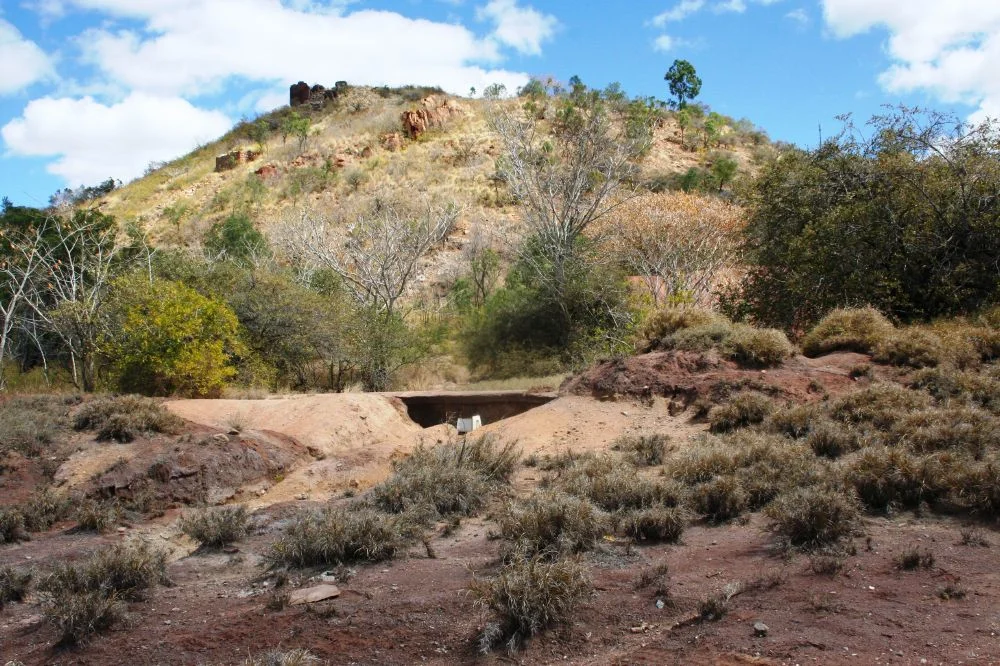
Finding gold was the easy part; getting it out of stubborn ore was the science. On the eastern slope stand the most extensive remains of a pyrites chlorination works in Queensland - a cascade of stone and brick mill foundations, the footings of two furnaces with their internal brick stairways, and the terraced base of the chlorination plant. It is, in heritage terms, a rare survivor: a snapshot of the latest extraction technology of its day, captured at the exact moment the older chlorination method was being overtaken by the cyanide process, and then adapted to it. Red tailings still stain the hill's northeastern base where the works discharged. Nearby, on the Rainbow line of reef, the Rainbow Battery crushed 15,479 tons of ore for 28,130 ounces of gold from a shaft sixty-seven metres deep, working on and off until the 1890s. Its battery foundations, settling tanks, and earth dam remain among the spinifex.
Brown's Folly
Not every story on the hill is about gold. The tallest landmark here for decades was a great brick chimney that locals knew as 'Brown's Folly.' Its builder, David Brown, would never see it become a curiosity. In 1901 he was tried for murder at the Charters Towers Courthouse, sentenced to death in November, and hanged at Brisbane's Boggo Road Gaol that December. His chimney outlived him by forty years, a blunt finger on the skyline - until 1942, when it was judged a hazard to aircraft and demolished. That single detail tells you how the hill's meaning had shifted: a mining monument torn down because the sky above Charters Towers now mattered more than the gold beneath it.
A Hill at War, a Hill at Rest
When the Second World War reached the Pacific, Charters Towers became a major Allied base, and Towers Hill was fortified. Miners' mullock dumps were repurposed into four form-cast concrete explosives stores, part of a larger complex of wartime bunkers cut into the southwestern slopes - dozens of them still hidden among the rocks, alongside the iron bases of a Victorian telegraph line that a 1950s telephone route later reused. The layering is the whole point. Few places hold the first colonial gold strike, the cutting edge of 1890s ore chemistry, a hanged man's chimney, and a Second World War magazine within a single skyline. Today the army's roads carry visitors to a lookout and an open-air amphitheatre at the summit, where films screen after dark and rock wallabies pick across the granite. The view runs for miles in every direction - the same vantage that let a prospecting party, and later a nation, see exactly what this hill was worth.
From the Air
Towers Hill sits at 20.089 degrees south, 146.252 degrees east, immediately south of the Charters Towers town grid. It is the dominant terrain feature for miles - a flat-topped granite rise of 421 m (1,381 ft) standing about 120 m above the surrounding plain, easily picked out against otherwise level inland Queensland. The summit lookout, amphitheatre, and communications masts mark the high point; the chlorination works' red tailings scar the eastern base. Charters Towers Airport (ICAO YCHT) lies just southwest; Townsville (YBTL) is the nearest major airport, about 130 km northeast. Approach below 4,000 ft AGL for the best look; note the masts on the summit. Dry winter air gives crisp visibility; summer brings afternoon thunderstorms.
Nearby Stories
- Bindal People 44 km away
- Herveys Range Heritage Tea Rooms 57 km away
- Bowen River Hotel 65 km away
- Radar Station, Charlie's Hill 71 km away
- Strathmore Homestead 126 km away
- Porcupine Gorge 153 km away
- Undara Volcanic National Park 230 km away
- Lake Dunn 276 km away