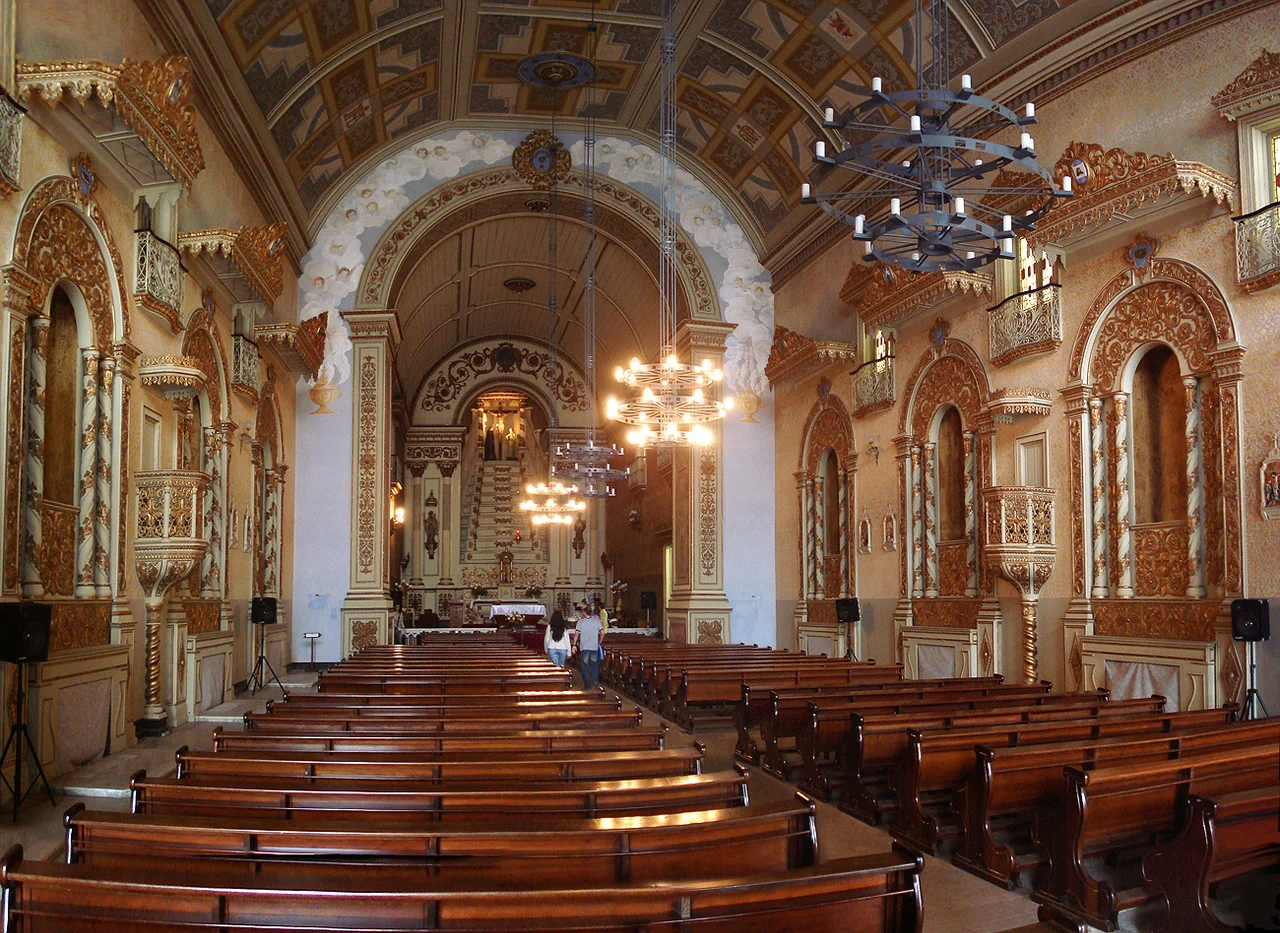

Minor Basilica of Our Lady of Sorrows
A man stood on the scaffold and, the story goes, looked back at the half-built church and cursed it: this work will never be done. His name, in the version Porto Alegre still tells, was Josino, an enslaved laborer accused of stealing from the statue of Our Lady. Whether he ever spoke those words is doubtful. What is certain is unsettling enough. The Church of Our Lady of Sorrows, begun in 1807, would not be finished until around 1904 - almost a hundred years of collapsed walls, abandoned plans, and stalled funds. Today it stands at the top of its hill on Andradas Street as the oldest surviving Catholic temple in the city, and in 2022 Pope Francis raised it to the rank of minor basilica, the first in Porto Alegre.
A Devotion Born Among the Elite
The basilica grew out of a very particular grief. Catholics had long venerated the Seven Sorrows of Mary - the prophecy of Simeon, the flight into Egypt, the loss of the boy Jesus in the Temple, the road to Calvary, the Crucifixion, the descent from the cross, and the burial - imagined as seven swords piercing her heart. In Porto Alegre, worship of Our Lady of Sorrows was already documented in 1799, with Mass said every Friday at a side altar of the old mother church. The devotees were the town's powerful: councillors, royal officials, military men, prominent merchants. From their circle came the Brotherhood of Our Lady of Sorrows, founded in 1801, and from the brotherhood came the decision, in 1806, to build a church of their own. The foundation stone was laid the following year.
A Century of Setbacks
Almost nothing went smoothly. A royal license to build did not arrive until 1809. The walls of the chancel collapsed in 1810. The order itself was formally confirmed only in 1824, then nearly destroyed by an internal fight over membership rules that emptied its ranks. For most of the nineteenth century the building stood without exterior cladding or towers - a raw shell on the hill. The original colonial baroque design was abandoned, and a new eclectic facade was commissioned from the architect Julio Weise, who gave it a Germanic weight of cornices and pilasters. The western tower went up in 1900, the eastern the next year. Construction finally ended around 1904. Historian Sergio da Costa Franco, sifting the records, found that the enslaved man behind the legend was in fact condemned for murder, not theft - a reminder of how a city smooths the cruelties of its past into folklore.
Gold, Wood, and the Passion
Step through the doors and the restrained exterior gives way to something far richer. The interior is worked in gilded woodwork, a late baroque idiom softened by neoclassical touches, glowing where light catches the gold. Its great treasure is a set of life-size baroque statues of Christ that carry worshippers through the cycle of the Passion, scene by sorrowful scene. Above the main facade, beneath a pediment bearing the date 1900 in Roman numerals, sits the symbol that explains everything: a heart transfixed by seven swords and ringed with a crown of thorns. In the niches below stand figures of Faith, Hope, and Charity by the sculptor Joao Vicente Friedrichs. The cornice spells out, in stone, the name of the venerable third order that willed the place into being.
Saved, Again and Again
Finishing the basilica was only the beginning of keeping it. The years gnawed at the structure, and emergency repairs followed in waves - the roof and ceiling in 1980, the chancel in 1996, the staircase in 1998. From 2001 onward a longer campaign, funded by the community and by state and federal cultural incentive laws, restored the altars, ceilings, decorative paintings, and choir, completing the chancel restoration in 2017. Declared a national heritage site by IPHAN in 1938 and crowned a basilica in 2022, the church endures as the deepest root of Catholic Porto Alegre - a building that, despite the curse the city likes to recall, was finished after all, and finished beautifully.
From the Air
The basilica sits at 30.0325 S, 51.2357 W, atop a hill in Porto Alegre's historic center near Andradas Street, its twin eclectic towers a useful landmark above the dense old quarter. The nearest field is Salgado Filho International Airport (ICAO: SBPA), roughly 6 km north-northeast; Canoas Air Force Base (ICAO: SBCO) lies about 21 km north and handled civilian traffic during the 2024 flood. A viewing altitude of 1,500 to 2,500 feet AGL keeps the towers and the surrounding centro in frame. Porto Alegre's humid subtropical sky is clearest in summer; winter brings frequent radiation fog that delays early flights and can hide the hill entirely.
Nearby Stories
- Itapuã State Park 22 km away
- Nova Petrópolis 37 km away
- Aparados da Serra National Park 77 km away
- Santa Cruz do Sul 77 km away
- Serra Geral National Park 111 km away
- 2009 Brasil de Pelotas Bus Disaster 161 km away
- Passo Fundo 176 km away
- Battle of the River Plate 446 km away