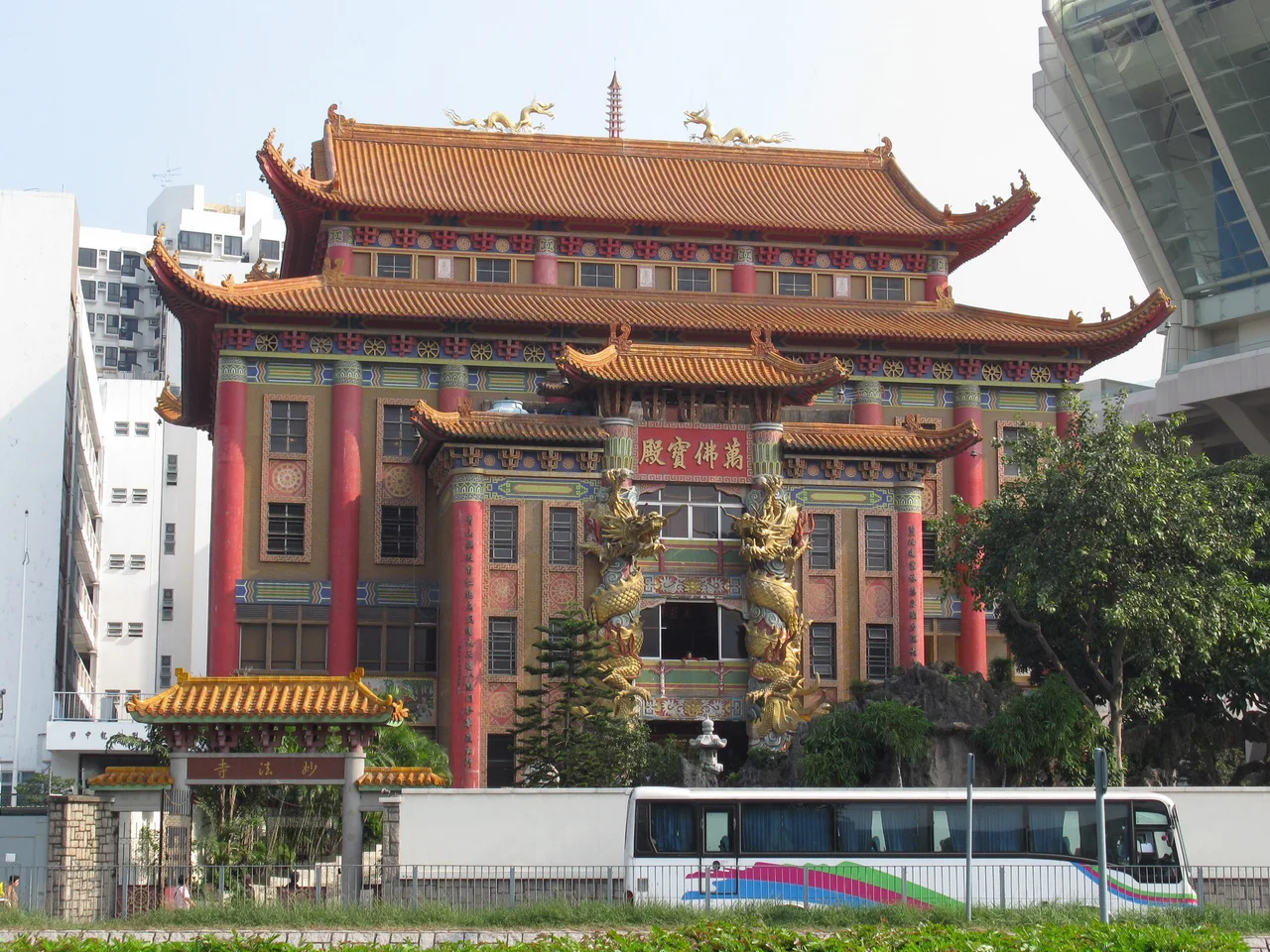

Miu Fat Buddhist Monastery
Two gold-scaled dragons, each carved in lifelike relief and stretching twenty metres up either side of the entrance columns, guard the doors of the Ten Thousand Buddhas Hall. They have been standing there since the hall's consecration in May 1980, watching over what has become one of Hong Kong's most elaborate Buddhist monasteries — a place where Sino-Thai artistic traditions meet a community committed to mercy, education, and welfare in one of the New Territories' quieter corners.
From Modest Origins to a Hall of Ten Thousand
The Miu Fat Buddhist Monastery was first established in 1950 in Lam Tei, in what was then a largely rural stretch of the Tuen Mun District. What grew over the following three decades was anything but modest. Construction of the three-storey Ten Thousand Buddhas Hall cost HK$60 million and took six years to complete, with the consecration ceremony finally held in May 1980. The investment shows in the detail: the Mahavira Hall occupies the top storey of the building, with a floor height of around 20 metres, and at its centre stand three gold-plated statues of the Buddha Sakyamuni, each approximately five metres tall. The walls surrounding them are covered in over ten thousand miniature Buddha reliefs, interspersed with murals that draw on both Chinese and Thai artistic traditions — a visual density that takes time to absorb.
The Lotus on the Roofline
By 1999 the monastery had begun work on a second major structure: a 45-metre, seven-storey main complex built alongside the Ten Thousand Buddhas Hall. Its completion was marked by a ceremony in mid-March 2010. The building houses a Buddhist shrine, a community hall, a library, and various cultural and welfare facilities — practical spaces for the community programs the monastery has long championed. What draws the eye from a distance is the Lotus Shrine on the top floor, designed to resemble a giant crystal lotus blossom when viewed from afar. It is intentional architecture, meant to be seen across the Tuen Mun landscape. The lookout from the Shrine opens onto the surrounding rural area: low hills, scattered villages, the faint industrial silhouette to the south. The monastery also operates a kitchen serving vegetarian meals to visitors, a detail that speaks to its ethos of welcome.
A Place of Practice and Community
Miu Fat has operated from the beginning on the principle of practising mercy — not as an abstract ideal but as an organizing commitment. The monastery has for decades run activities promoting Buddhist education, culture, charity, and welfare in the district. It supports the Madam Lau Kam Lung Secondary School, which operates under its auspices, extending its educational mission beyond strictly religious instruction. This combination of spiritual practice and community engagement is characteristic of the larger Hong Kong Buddhist institutions, which have historically played an important social role in districts where government services were slow to reach. Lam Tei remains a quieter neighborhood by Hong Kong standards, and the monastery's presence has shaped it accordingly — a place where the scale of the architecture signals intention, and where the kitchen always has food for those who come.
Getting There, and What You Find
Reaching Miu Fat is straightforward. The MTR's Light Rail network stops at Lam Tei station, from which the monastery is a short walk; bus routes 53, 63X, and 68A also serve the site. Arriving by Light Rail through the flat New Territories landscape, you see the complex before you reach it — the white multi-storey buildings rising distinctly above the low surrounding structures, the lotus crown just visible at the top. Inside, the scale of the Ten Thousand Buddhas Hall rewards a slow visit. The gold dragons at the entrance set the register: this is a place built to impress and to endure, but also to be used. On weekends and religious festival days, the courtyards fill with worshippers and visitors. On quieter weekday mornings, the detail work in the Mahavira Hall — the thousands of individual reliefs, the layered murals, the tall serene figures at the center — has room to speak.
From the Air
Miu Fat Buddhist Monastery is located at approximately 22.42°N, 113.98°E in Lam Tei, Tuen Mun District, on the western edge of the New Territories. From the air at 2,000–4,000 feet, the white multi-storey complex is visible against the relatively low surrounding urban fabric. Hong Kong International Airport (VHHH) lies approximately 15 km to the southwest on Lantau Island. The approach to VHHH from the northeast passes over this area; the monastery's distinctive lotus-topped tower can be identified from low altitude in clear conditions. Best visibility is in the dry season months, October through March.
Nearby Stories
- Chapel of St. Francis Xavier 3.5 km away
- Cuiheng 4.1 km away
- 2015 Shenzhen Landslide 16 km away
- Shunde 31 km away
- Wanshan Archipelago 37 km away
- Nanxiong Formation 96 km away
- Heyuan 149 km away
- Checheng Fu'an Temple 629 km away