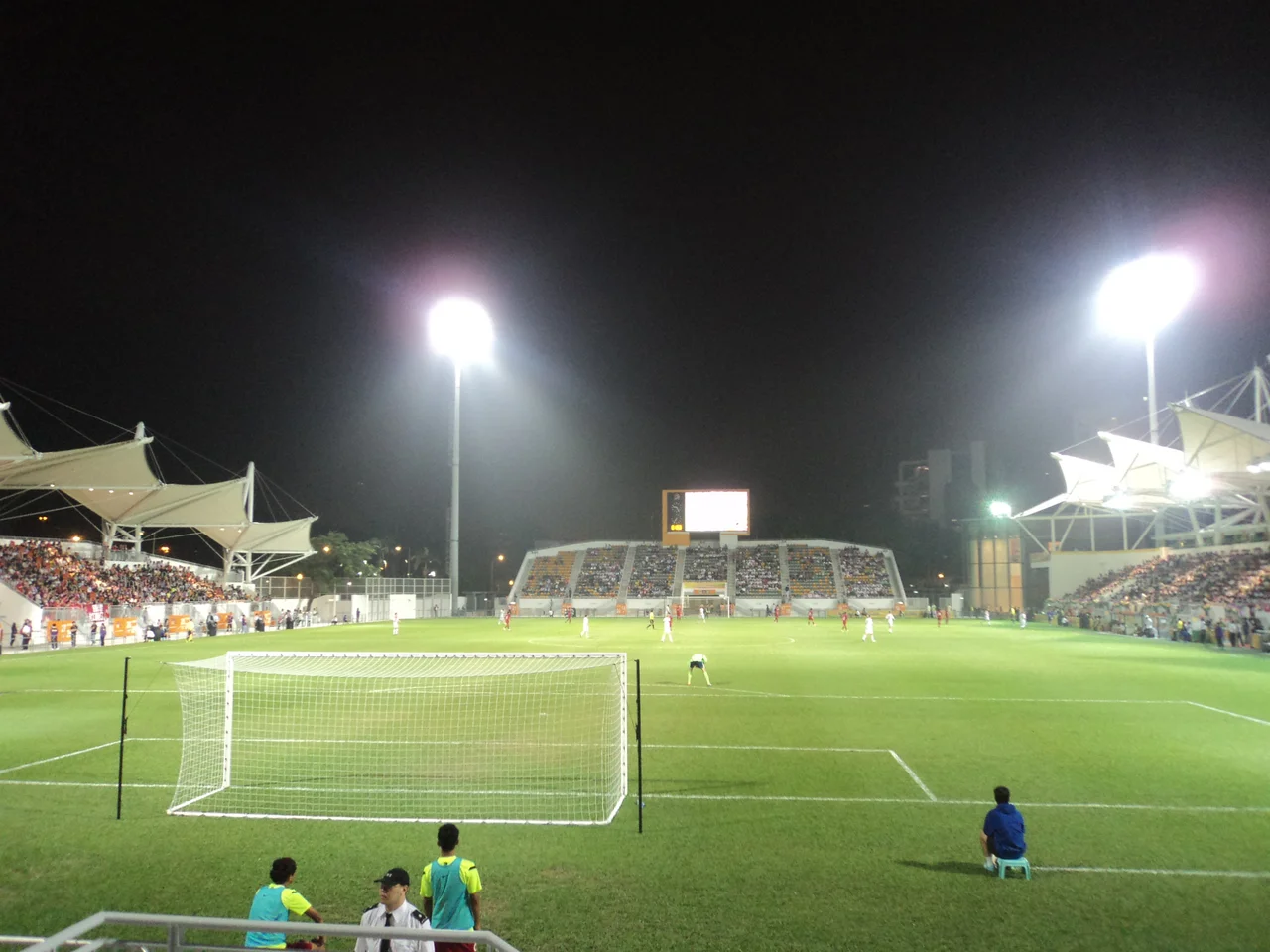

Mong Kok Stadium
Nowhere else in Hong Kong Premier League football can you sit close enough to the pitch to hear players call to each other — that is Mong Kok Stadium's defining characteristic. Squeezed into one of the most densely populated urban areas on Earth, with four stands of 1,666 seats apiece and a natural grass surface lit by 1,200-lux floodlights, it is a throwback to a time when football grounds were built into the city rather than away from it.
From Army Ground to Urban Football Cathedral
Before it was a football stadium, the site on the border of Mong Kok and Prince Edward was an Army Sports Ground. The Urban Council took it over in 1961 and converted it into the city's main football venue. For decades it hosted the great clubs of Hong Kong football — Kitchee SC among them, which continues to use it today — and the intimate atmosphere that came from putting four thousand people close to a pitch in one of Kowloon's most compressed neighborhoods became part of its identity. It is accessible by MTR from Prince Edward station on the Tsuen Wan and Kwun Tong lines, with Mong Kok East station on the East Rail line also nearby: a ground built for a city that gets around by rail.
The 2011 Renovation and Reopening
After years of aging infrastructure, the stadium underwent a significant renovation and reopened on 16 October 2011. The first match back was a Hong Kong First Division fixture between Sun Hei and Sham Shui Po SA, drawing 4,499 supporters. Sun Hei won 5–0, and Mamadou Barry claimed the honour of scoring the first hat-trick in the renovated venue. The official reopening ceremony followed on 15 November 2011, a larger occasion that saw the Secretary for Home Affairs attend along with performances from drumming troupes, wushu practitioners, and a lion dance. The Leisure and Cultural Services Department, which runs the stadium, also invited Russia's National Youth Team for a friendly international match against the Hong Kong Youth Representative Team — marking the occasion with the kind of minor international pageantry that smaller venues rarely get to host.
Rugby, Super Rugby, and a City's Sporting Ambitions
Football is the primary tenant, but the stadium's 2011 renovation brought it into conversation with other sports. Hong Kong Rugby's administrators explored using it for Asian Five Nations fixtures — the city had been playing home games at the Hong Kong Football Club's 2,500-capacity ground, and Mong Kok's renovated capacity of 6,664 offered a meaningful upgrade for international matches. Then, in May 2018, the stadium hosted something genuinely unusual: the Japanese Super Rugby franchise the Sunwolves played a home match there against the Stormers from Cape Town, South Africa, with the Sunwolves winning 26–23. For a city that has always positioned itself at the intersection of global currents, the sight of a Japanese team playing South Africans at a football ground in Kowloon was very on-brand.
What Makes It Work
Part of Mong Kok Stadium's appeal is the very thing that limits it: its size. With only 6,664 seats, crowds that would feel thin in a larger arena generate genuine atmosphere here. The natural grass pitch — maintained to international standard — is ringed by stands that give every seat a good sightline. The Flower Market Road entrance is flanked by Mong Kok's famous flower stalls and bird market just a few minutes' walk away, which means arriving for a match involves passing through one of Hong Kong's most vivid street-level environments. Three First Division clubs — Citizen, Fourway Rangers, and Sun Hei — have at various points sought to use it as a home ground, a reflection of its status as the territory's premier intimate venue. Kitchee SC, Hong Kong's most decorated club, has been the dominant presence in recent years.
From the Air
Mong Kok Stadium sits at approximately 22.33°N, 114.17°E in the heart of Kowloon, a few hundred metres south of the Prince Edward MTR station. From the air at 3,000 feet, the floodlit green pitch is clearly visible amid the dense urban grid of Mong Kok. Hong Kong International Airport (VHHH) is approximately 25 km to the west on Lantau Island. Kai Tak, the former airport whose runway once extended into Kowloon Bay just 4 km to the southeast, is now a development zone, and its old approach corridor passes directly over this area at low altitude. Night approaches to Hong Kong in clear weather reveal the stadium lights below as aircraft descend toward VHHH from the east.
Nearby Stories
- Chapel of St. Francis Xavier 3.5 km away
- Cuiheng 4.1 km away
- 2015 Shenzhen Landslide 16 km away
- Shunde 31 km away
- Wanshan Archipelago 37 km away
- Nanxiong Formation 96 km away
- Heyuan 149 km away
- Checheng Fu'an Temple 629 km away