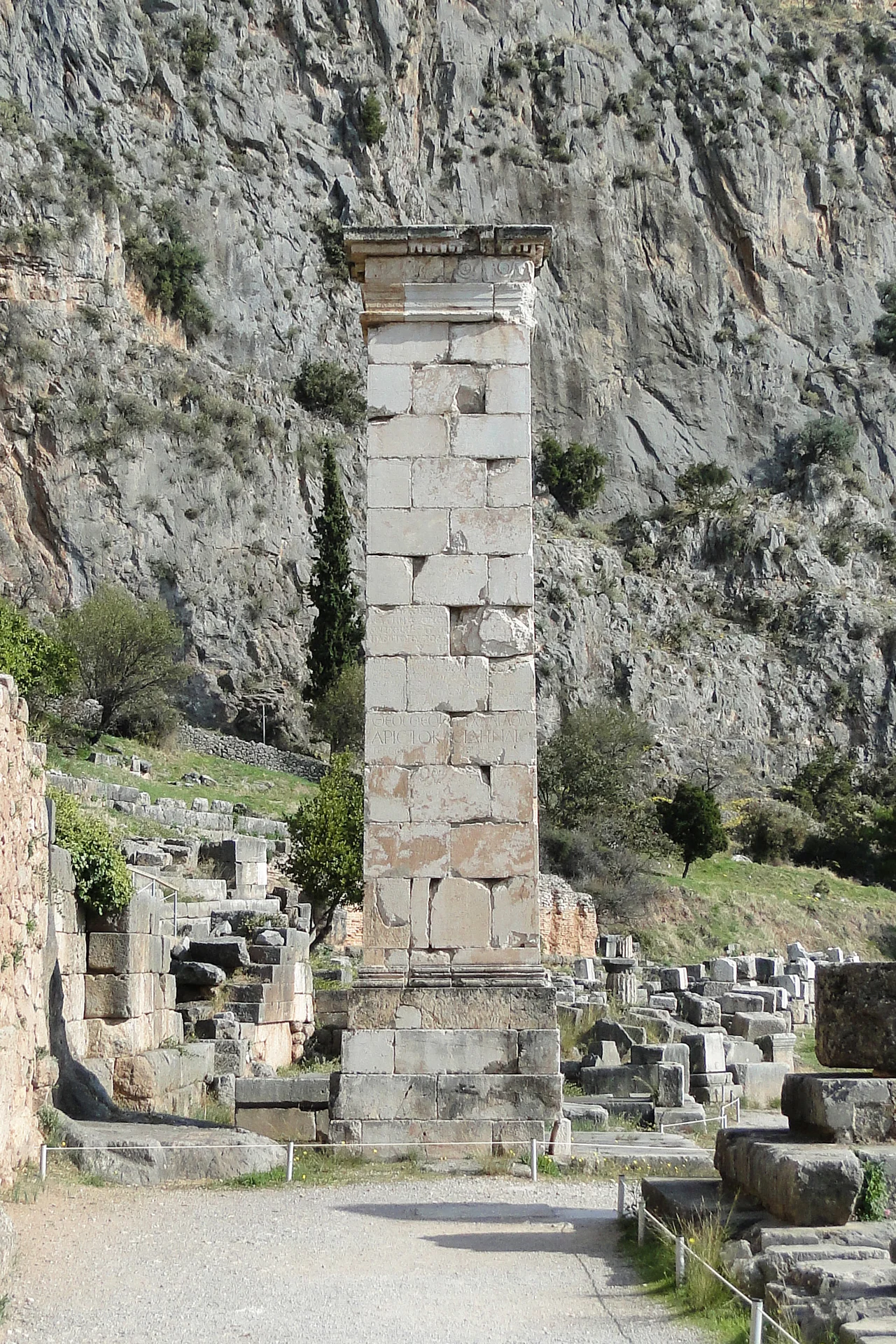

Monument of Prusias II
The inscription is blunt and specific, carved into stone for any pilgrim walking the Sacred Way to read: the Aetolian League dedicated this monument to Prusias, son of Prusias, for his virtue and the benefactions he bestowed upon them. The man being honored was not a Greek. He was a king of Bithynia, a realm in what is now northwestern Turkey, ruling a people with no obvious claim on the holiest sanctuary in the Greek world. Yet here, at Delphi, his gilded likeness sat atop a pillar nearly ten meters tall — a foreigner raised on horseback above the very threshold of Apollo's temple.
A King Arrives at the Navel of the World
Delphi was not merely a religious site. It was a statement. Every city-state, every king, every league that set up a monument along the Sacred Way was proclaiming something about itself — its power, its piety, its network of alliances. When the Aetolian League chose to honor Prusias II of Bithynia here, around 182 BC or later (the date follows from when Prusias succeeded his father on the throne), they were broadcasting a relationship. Prusias had done something valuable enough for the Aetolians that they wanted the entire Greek world to know it. The inscription does not say what. It uses the word "benefactions" — a deliberately vague term that could cover anything from military assistance to financial gifts. What mattered was the honor, public and permanent, planted at Delphi for centuries to come.
Nine Meters of Political Theater
The monument itself was an exercise in theatrical scale. Its base consisted of rows of rectangular stone blocks, rising nearly ten meters in total height — roughly as tall as a three-story building. The upper register was decorated with carved garlands and bucraniums, the stylized ox skulls that Greeks used to suggest sacrificial abundance and divine favor. At the very top, the bronze equestrian statue of Prusias himself, king on horseback, looked out over the sanctuary. Rectangular slits cut into the upper portion of the pillar may have held bronze blades to deter birds from fouling the monument, or perhaps anchored decorative floral motifs — wheat or crops — alluding to the king's generosity. The pillar stood near the northeast entrance of the Temple of Apollo, visible to every visitor climbing the Sacred Way. It was impossible to miss, and that was entirely the point.
Neighbors on the Sacred Way
The Monument of Prusias was not alone in its neighborhood. About fifteen years after it was erected, a nearly identical structure appeared just south of the temple entrance: the Monument of Aemilius Paullus, set up to celebrate the Roman general's victory over Macedonia at the Battle of Pydna in 168 BC. The two pillars stood in conversation with each other — a Bithynian king honored by Greek allies, a Roman general celebrating conquest of Greeks. The base of the Aemilius Paullus monument survives and is now exhibited in the Archaeological Museum of Delphi, where its carved frieze still shows the battle that ended Macedonian independence. The Prusias monument was restored in situ at Delphi, where the base with its carved garlands and ox-skull friezes remains visible today, stripped of the statue that once crowned it.
Prusias II: The King Behind the Stone
Prusias II ruled Bithynia from around 182 to 149 BC, succeeding his father Prusias I. His reign was turbulent. He cultivated Roman friendship while trying to maintain independence, a delicate balance in an era when Rome was consolidating power across the eastern Mediterranean. His relationship with the Aetolian League — the political confederation that built this monument — reflects the complex web of alliances that smaller powers wove to survive between larger ones. The Aetolians themselves had been a major force in Greek politics, enemies of Macedon and sometimes allies, sometimes adversaries of Rome. By the time they honored Prusias at Delphi, they were a declining power trying to maintain relevance. The monument, in some ways, captures a moment when both the Aetolian League and the Bithynian kingdom were navigating a world increasingly dominated by Rome.
Reading the Ruins
What remains at Delphi today is a pillar without its crown — stone without the bronze king who once completed it. The base holds enough to reconstruct the monument's ambition: the carved ox-skull frieze, the layered rectangular blocks climbing toward an absent equestrian figure. Scholars working from the inscription, the architectural details, and comparisons with similar pillar monuments have been able to date it, identify it, and understand its political function. It belongs to a tradition of tall honorific pillars that Greek cities and leagues erected throughout the Hellenistic world to honor powerful patrons — a tradition that blended genuine gratitude with shrewd publicity. Standing here, reading the Greek inscription that the Aetolian stonecutters left, you are reading a thank-you note written in stone for an audience of thousands.
From the Air
The Monument of Prusias II stands at approximately 38.483°N, 22.501°E within the archaeological site of Delphi, on the slopes of Mount Parnassus in central Greece. At around 570 meters elevation, the site is best viewed at a cruising altitude of 5,000–8,000 feet, approaching from the south over the Gulf of Corinth. Delphi's terraced sanctuary is visible as a series of pale stone structures clinging to steep hillside terrain. The nearest major airport is LGAV (Athens International Eleftherios Venizelos), approximately 170 km to the east. LGRX (Araxos Airport) lies roughly 100 km to the southwest across the Gulf of Corinth. Mountain weather around Parnassus can develop rapidly; early morning flights offer the clearest views.
Nearby Stories
- Battle of Vasilika 7.9 km away
- Siege of Negroponte (1470) 8.5 km away
- Battle of Kalavryta 13 km away
- Church of the Nativity of the Theotokos, Limni 14 km away
- Pellene 16 km away
- Panagia Varnakova Monastery 18 km away
- Megara 21 km away
- Karpenisi 41 km away