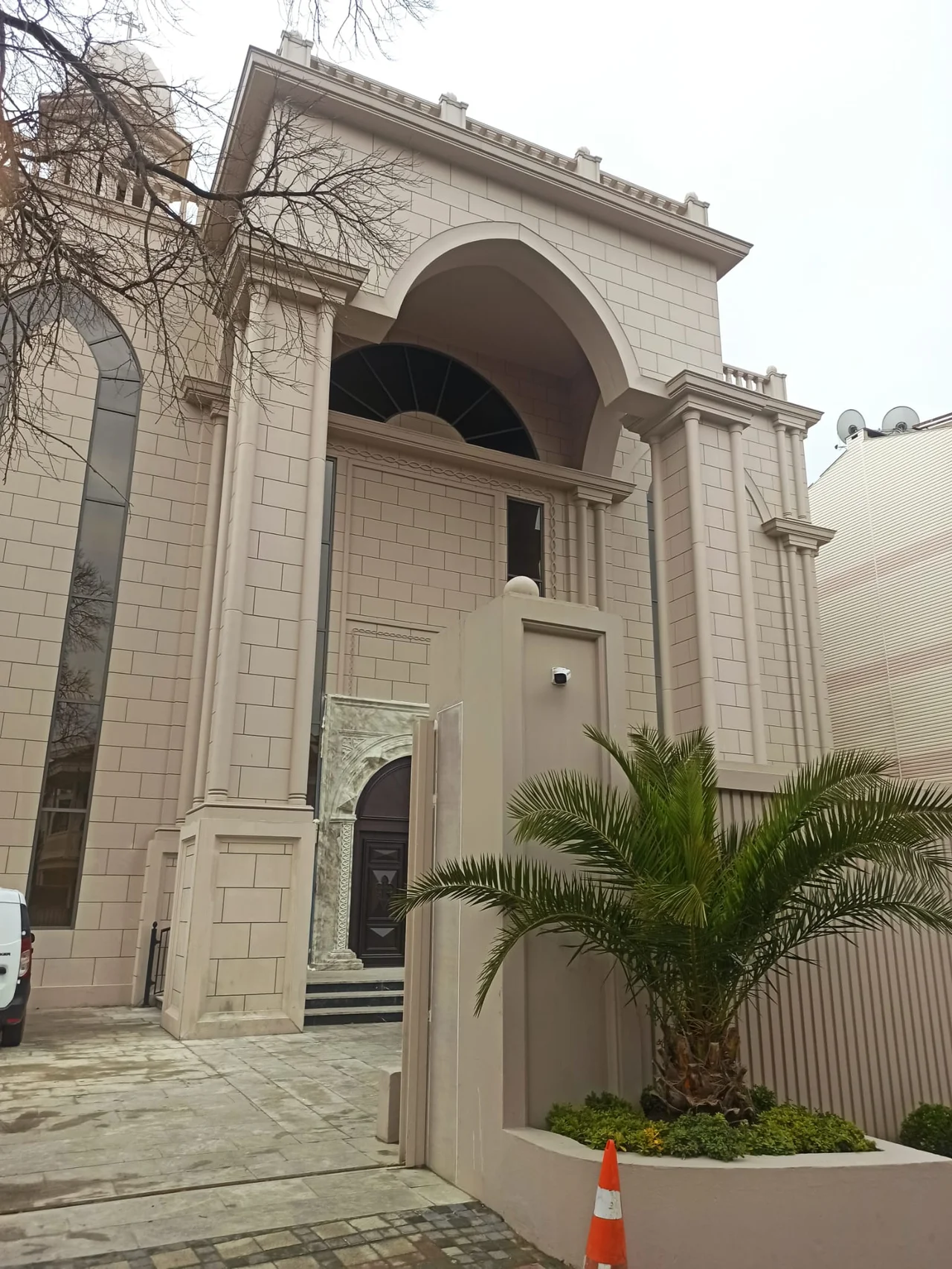

Mor Ephrem Syriac Orthodox Church
For a hundred years, the Syriac Orthodox community in Istanbul worshipped in buildings that predated the Turkish Republic — old structures, inherited spaces, rooms that had never been built with their congregation in mind. The community had been present, sometimes barely so, through decades of migration from southeastern Anatolia, through periods of political uncertainty, through the slow erosion of a diaspora scattered across Istanbul. Then, on 8 October 2023, President Recep Tayyip Erdoğan opened the doors of the Mor Ephrem Syriac Orthodox Church in Yeşilköy — the first church built from the ground up in Turkey since the Republic was founded in 1923. It is a five-story building of stone and concrete in the Bakırköy district, designed with architectural echoes of ancient Syriac monasteries in Mardin Province, with capacity for 750 worshippers and a community that had waited a very long time to fill it.
A Congregation Rooted in Tur Abdin
The Syriac Orthodox community in Istanbul did not arrive all at once. Migration from the Tur Abdin region of southeastern Turkey — the heartland of Syriac Christianity for more than fifteen centuries — moved through the twentieth century in waves. In the 1960s, pressure from surrounding communities accelerated departures from ancient villages. In the 1980s and 1990s, the armed conflict between the PKK and the Turkish military drove more families westward to Istanbul. Each wave brought people who carried with them a liturgical tradition conducted in a form of Aramaic, one of the oldest continuously spoken languages in the world, and a devotional life organized around saints and monasteries they had left behind. By the time the church opened in 2023, Syriac Orthodox believers formed the largest Assyrian community in Istanbul by a significant margin. They had been worshipping in the city for decades without a building of their own. The church in Yeşilköy is the first purpose-built home they have had.
From Announcement to Inauguration
The path to the church's opening stretched across eight years and multiple governments. In 2015, Prime Minister Ahmet Davutoğlu announced the project publicly — a significant moment, given that no new church had been authorized in Turkey in a century. Istanbul Mayor Kadir Topbaş allocated land for the building: a portion of an old Italian Latin Catholic cemetery in Yeşilköy, with the church constructed not on the graves themselves but on empty ground in front of the cemetery. On 3 August 2019, President Erdoğan laid the foundation stone in a ceremony attended by the Patriarch of the Syriac Church, Ecumenical Patriarch Bartholomew, and Istanbul Mayor Ekrem İmamoğlu. Construction cost approximately four million dollars, funded entirely by donations from the Syriac community — people who had saved and contributed across years. The community also received a value-added tax exemption applicable to places of worship, which eased the financial burden without changing who built it: the congregation did, with their own money.
Architecture in the Tradition of Mardin
The designers looked south and east for their references. The monasteries of Mardin Province — Deyrulzafaran, Mor Gabriel, stone complexes that have stood for a thousand years or more in the limestone hills of the Tur Abdin plateau — provided the architectural vocabulary. The Mor Ephrem church does not replicate those structures literally; it is a five-story urban building in a modern neighborhood. But its forms invoke the same gravity, the same sense of walls built to outlast political circumstance. The church is named for Ephrem the Syrian, a fourth-century theologian and poet born in what is now southeastern Turkey, one of the most prolific writers in the history of early Christianity. His hymns, composed in Syriac, are still sung in this church and in Syriac congregations worldwide. The building's name connects the new institution to a tradition fifteen centuries old.
What the Opening Meant
The inauguration ceremony on 8 October 2023 drew senior Turkish officials alongside community leaders, including Yusuf Çetin, Deputy Patriarch of the Syriac Orthodox Church, and Sait Susin, President of the Istanbul Syriac Kadim Foundation. The attention was not only local. Pope Leo XIV visited the Mor Ephrem church during a trip to Turkey in late 2025, a gesture that underscored the church's significance beyond the immediate community. For the Syriac Orthodox faithful in Istanbul, the opening was something more personal than a diplomatic milestone. It was the end of a very long wait for a permanent home — a building that announced, in stone and in the classical language of Syriac church architecture, that this community belongs here, that it intends to stay, that it has roots in this city as deep as any other.
From the Air
The Mor Ephrem Syriac Orthodox Church sits at approximately 40.960°N, 28.825°E in the Yeşilköy neighborhood of Bakırköy, on Istanbul's European shore. From the air at 1,500–3,000 feet, the five-story building is visible in a dense residential area close to the Marmara Sea coastline. The former Istanbul Atatürk Airport (LTBA) lies less than 2 km to the north — the Yeşilköy neighborhood was the airport's original namesake. Nearest currently operating major airport is LTFM (Istanbul Airport), approximately 25 km to the north. Approach from the south over the Sea of Marmara gives the clearest view of the coastal Yeşilköy neighborhood.
Nearby Stories
- Istanbul Canal 5 km away
- Polonezköy 8.1 km away
- MV Struma 8.9 km away
- Sea of Marmara 11 km away
- HMAS AE2 42 km away
- Bandırma 75 km away
- Sangarius Bridge 101 km away
- Edirne 135 km away