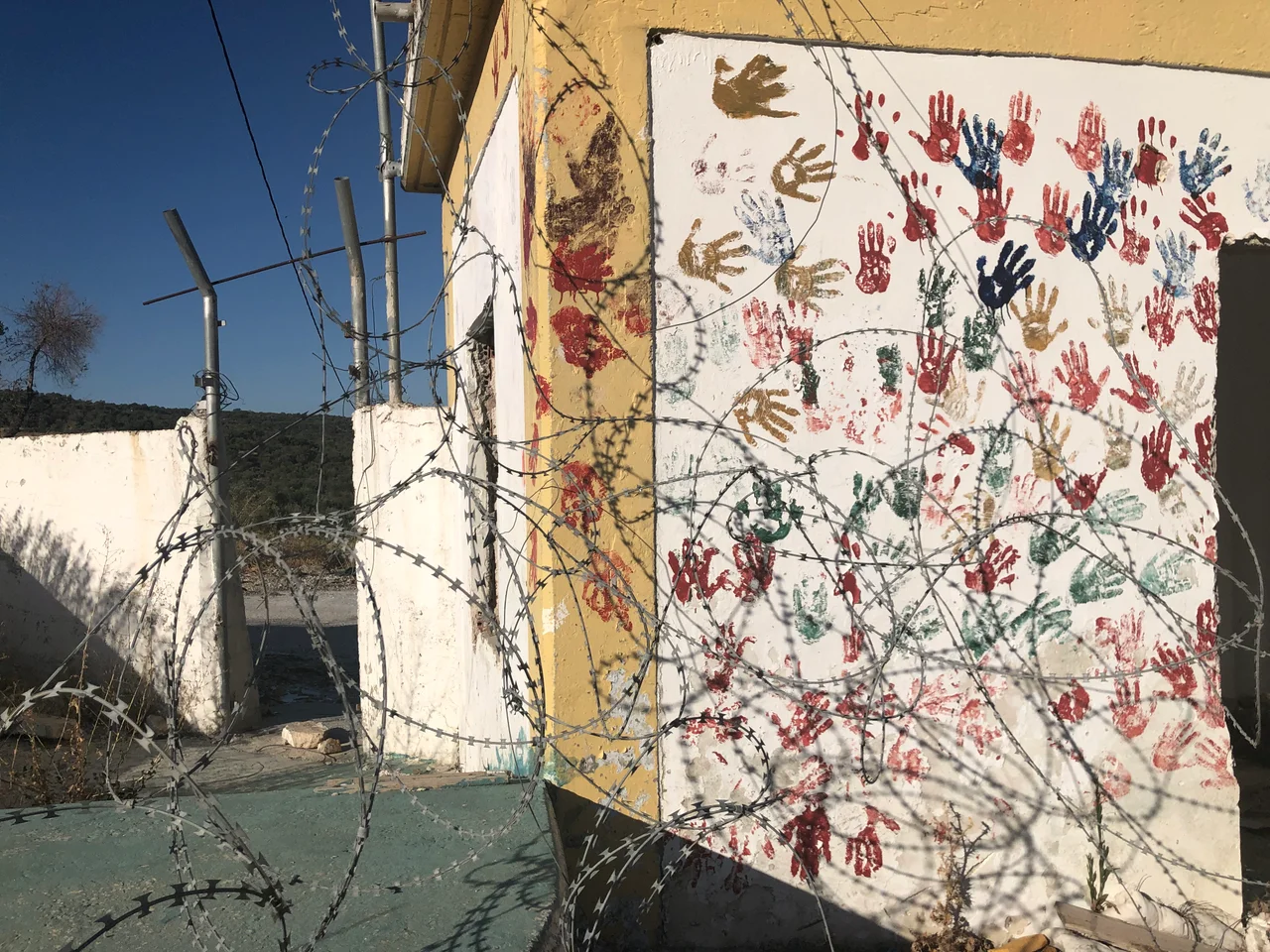

Moria refugee camp
It was built for about three thousand people. By the summer of 2020 it held many times that, perhaps thirteen thousand, by some accounts as many as twenty thousand. Among them were more than four thousand children. They were not numbers to the people who lived among them. They were families from Syria, Afghanistan, and beyond, who had crossed a sea in flimsy boats to reach the first safe shore of Europe, and then found themselves waiting, month after month, behind barbed wire on a Greek island. The place was called Moria.
A Camp That Outgrew Itself
Moria opened in early 2013 outside a small village of the same name near Mytilene, on the eastern coast of Lesbos. It was meant to be a reception center, a European Union "hotspot" where new arrivals would be registered and processed. Instead, as the wider movement of people across the Aegean swelled, it became a place where lives were put on hold. The fenced military camp filled far past its capacity, then spilled outward into a neighboring olive grove that residents came to call the "jungle." There, families built shelters from wooden pallets and plastic tarps. To stay warm, people cut down an estimated five thousand olive trees, some of them centuries old. The local villagers, watching their groves disappear and their break-ins multiply, grew angry and afraid too. Almost no one in this story was spared hardship.
What Daily Life Was Like
The conditions were, by nearly every account, among the worst in Europe. In 2018, a field coordinator for Doctors Without Borders called Moria "the worst refugee camp on earth." Their Lesbos coordinator, Luca Fontana, said he had never seen suffering on this scale. Human Rights Watch described the camp as an open-air prison. The UN human rights expert Jean Ziegler and Pope Francis each reached for the same grave comparison, the concentration camp, to convey what they had seen. Food, water, sanitation, and medical care were all scarce for the thousands crammed inside. Aid workers reported children harming themselves. These were people who had already survived war and a dangerous crossing, now enduring a different kind of ordeal in a place that was supposed to be the beginning of safety.
The Night It Burned
On the evening of 8 September 2020, fire swept through Moria. The camp had been placed under COVID-19 lockdown after an outbreak, tightening an already unbearable situation. The flames moved fast through the tightly packed, tinder-dry tents, and by the time they died the camp was almost entirely destroyed. More than twelve thousand people were left without shelter overnight, sleeping on roadsides and in fields. No one died in the fire, but in the days that followed Greek police fired tear gas at people protesting to be allowed to leave the island. The cause was disputed. Greek authorities charged several Afghan men with arson, but defense lawyers cited serious procedural violations in the trial. An independent investigation by Forensic Architecture, corroborated by the local fire department, concluded the blaze most likely began with improvised electricity wiring amid flammable shelters in hot, dry conditions, and was spread by the wind.
What Came After
Moria was never rebuilt. A temporary facility went up quickly at nearby Kara Tepe to shelter those displaced, and the Greek government, with EU backing, approved a more permanent closed reception center to be built at Vastria in the island's northeast. That plan stalled when Greece's highest administrative court revoked the construction permit over a missing environmental study. What remains of Moria today is a charred, fenced shell on the hillside outside the village, its burned accommodation blocks slowly weathering. It stands as a hard reminder of a moment when Europe's response to people fleeing war was concentrated, and overwhelmed, in one small place on Lesbos, the same island that has welcomed and watched over travelers crossing this water for three thousand years.
From the Air
Moria lies at 39.13°N, 26.50°E, outside the village of Moria a few kilometers northwest of Mytilene on the island of Lesbos. The nearest airport is Mytilene International (ICAO: LGMT, "Odysseas Elytis"), about 10 km to the south. The site sits among olive-covered hills inland from the coast; the Anatolian coast of Turkey, the crossing point for many who arrived here, is visible to the east across a narrow strait. Best appreciated from altitude in the clear, dry light of an Aegean summer.
Nearby Stories
- Eresos 9.6 km away
- Lyrnessus 15 km away
- Battle of the Oinousses Islands 17 km away
- Antandrus 31 km away
- Volissos 41 km away
- St. Helena Church 44 km away
- Akhisar Museum 70 km away
- Battle of Imbros 96 km away