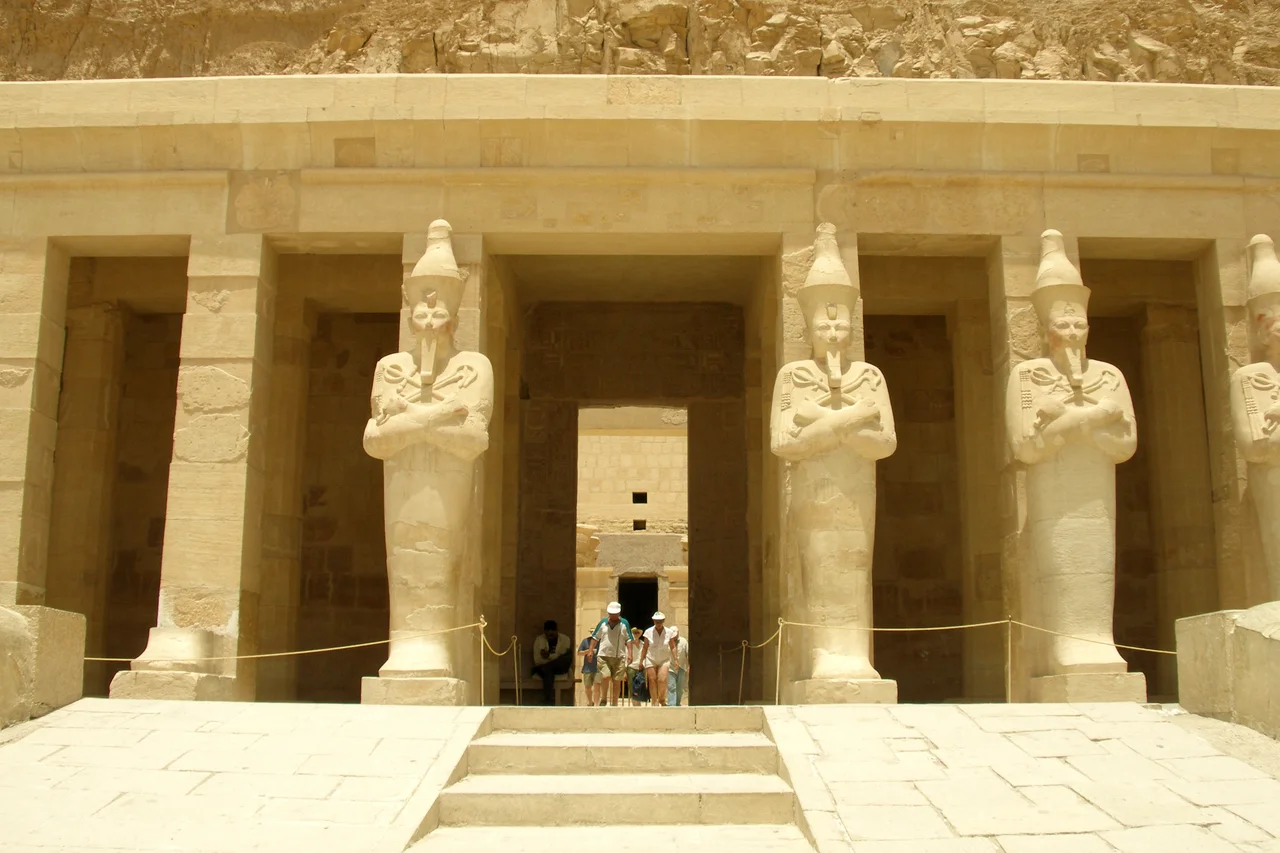

Mortuary Temple of Hatshepsut
She was a woman, and she ruled Egypt as a king. To make the case, Hatshepsut built her answer in stone against the cliffs of Deir el-Bahari, where the desert wall climbs nearly five hundred meters to the peak of El Qurn. Three vast terraces step up out of the rubble at the cliff's foot, linked by ramps, fronted by clean rows of columns that echo the limestone ridges behind them so closely that temple and mountain seem to have grown together. The Egyptians called it Djeser-Djeseru, the "Holy of Holies." Carved across its walls is a divine birth and a royal coronation, a careful argument that the throne was hers by lineage and by the will of the gods. It is one of the most admired buildings of the ancient world. It is also a monument that her own family later tried to make disappear.
The Architecture of an Argument
Hatshepsut took the throne around 1479 BC, first as regent for her young stepson Thutmose III, then as full pharaoh in her own right. Her temple was built over more than a decade, its plans revised again and again, until it resolved into something no Egyptian had quite seen before. The design borrowed from the older terraced temple of Mentuhotep II beside it, six centuries its senior, but rearranged the sacred logic. The central axis, normally reserved for the dead king's own cult, was given over instead to a sanctuary of the god Amun. On the middle terrace, two porticoes carry the temple's most famous reliefs: a trading expedition to the distant Land of Punt, its ships heavy with incense trees and exotic goods, and the divine birth of Hatshepsut herself, fathered by Amun in the guise of her earthly father. These were not decoration. They were the visual record of a reign insisting on its own legitimacy.
The Erasure
About two decades after Hatshepsut died, the campaign against her memory began. Under Thutmose III, by then a great pharaoh in his own right, her name and image were systematically attacked across the temple. Workers scratched out feminine pronouns, chiseled away her titles, replaced her figure with offering tables, and dragged her statues to a pit now known simply as the Hatshepsut Hole, where they were smashed with stone blocks. Why remains one of Egyptology's enduring puzzles. A personal grudge seems unlikely after a twenty-year wait. Scholars more often point to ideology, that a female king was a problem the record needed to solve, or to a dynastic maneuver to smooth the path for the next heir. Whatever the motive, the erasure was intense and oddly unfinished, abandoned within about two years. The damage was not the end of her story but the reason much of it had to be pieced back together.
Procession and Restoration
In its prime the temple was the climax of a yearly spectacle. During the Beautiful Festival of the Valley, priests carried the sacred barque of Amun from Karnak across the Nile, up the long causeway lined with more than a hundred sphinxes, and into the sanctuary, where the god rested a night before returning home. Centuries of harder use followed the New Kingdom. Akhenaten's agents later defaced images of Amun; an earthquake shook the structure in the ninth century BC; between the sixth and eighth centuries AD, Coptic monks built a monastery on the ruins and painted Christ over the ancient reliefs, which gave the place its Arabic name, Deir el-Bahari, the "Monastery of the North." Since 1961, a Polish-Egyptian mission has patiently consolidated and rebuilt the terraces stone by stone. The sanctuary of Amun reopened to visitors in 2017.
November 1997
On the morning of 17 November 1997, the temple was the scene of one of modern Egypt's worst attacks. Six gunmen entered the terraces and killed sixty-two people, fifty-eight of them foreign visitors and four of them Egyptians, over a span of roughly forty-five minutes. The victims had come, as travelers still come, to stand before something three and a half thousand years old. They are remembered here not as a number but as people who died in a place built to outlast death, and the temple has carried that weight quietly ever since, alongside everything else its walls have survived. Tourism to Luxor took years to recover. The temple endured, as it has endured the erasers and the earthquakes, and it remains open to those who come to see what Hatshepsut made.
What the Stone Remembers
There is a strange justice in the temple's survival. The pharaoh who tried to erase Hatshepsut could not erase the building; it was too large, too embedded in the cliff, too useful to later kings who restored what Akhenaten defaced. The chiseled-out cartouches and the smashed statues, recovered and reassembled by modern archaeologists, now tell her story more loudly than an undisturbed wall ever could. We know her because someone tried to make us forget her, and failed. Standing on the lower terrace at dawn, watching the rising sun warm the columns from grey to gold, it is easy to understand why she chose this spot, where a building could speak for a queen long after the voices that denied her had gone silent.
From the Air
The Mortuary Temple of Hatshepsut sits at 25.738N, 32.607E, on the west bank of the Nile opposite Luxor, tucked into a natural amphitheater at the foot of the Theban cliffs at Deir el-Bahari. From the air the three stacked terraces and their long colonnades are unmistakable against the sheer rock wall, with the pyramid-shaped peak of El Qurn (about 489 m) rising behind. The lush green ribbon of the Nile floodplain to the east gives way abruptly to tan desert. Best viewed from 1,500 to 3,000 feet AGL on a morning approach from the east, when low sun rakes across the terraces. Luxor International Airport (HELX / LXR) lies about 10 km east across the river. Visibility in this part of Upper Egypt is typically excellent, though spring khamsin winds can raise dust and haze.
Nearby Stories
- Temple of Seti I (Abydos) 20 km away
- Dendera Temple complex 21 km away
- Esna 22 km away
- Abydos, Egypt 49 km away
- Mersa Gawasis 116 km away
- Kharga Oasis 147 km away
- Hurghada 184 km away
- Wadi El Gemal National Park 238 km away