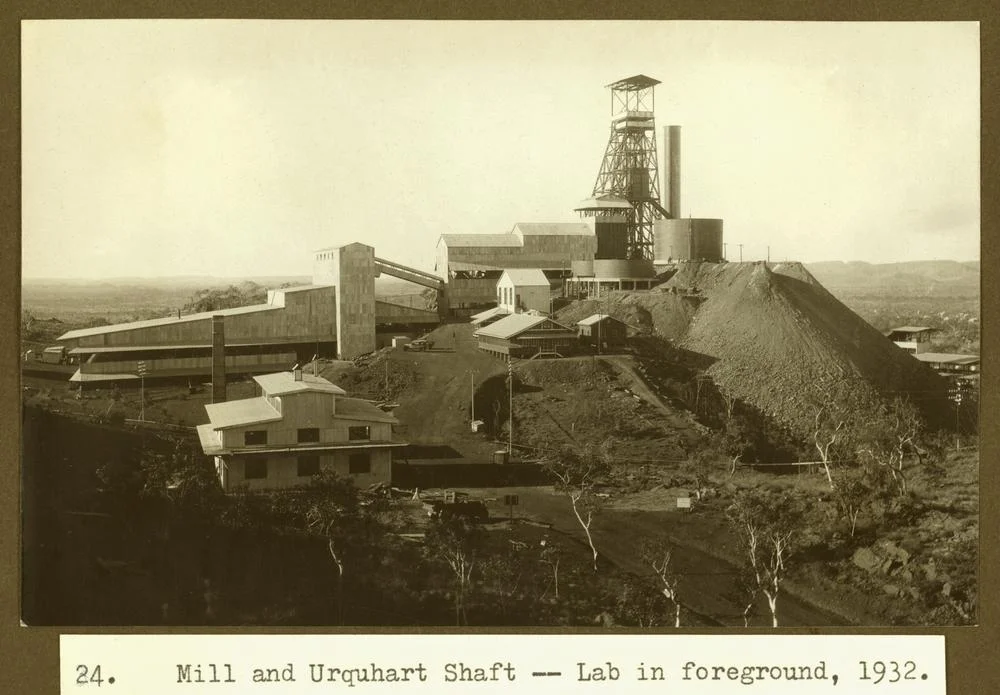

Mount Isa Mine Early Infrastructure
In February 1923 a man named John Campbell Miles was travelling through this rocky, unpromising country when he noticed lead in the outcrops at his feet. It was an unlikely find. The field had been prospected on and off for nearly sixty years, but the men who came before had been hunting copper and gold; lead was an alien tradition, and so the richest mining venture in Queensland's history lay there, largely ignored, until one traveller looked down. A century later the great mine still works, but scattered across its lease are its oldest bones - a headframe, a power station, two small dams - the surviving infrastructure of how it all began.
The Scramble for the Field
Word of Miles's lead spread fast. By the end of 1923, 118 leases had been pegged across the Mount Isa field, and a seasoned mining engineer, William Henry Corbould, quietly secured 51 of them. In January 1924 he floated the Mount Isa Mining Company. Within two years he had pulled off something almost unheard of in Australian mining: by December 1925 his company had absorbed its rivals, so that a single firm held virtually the entire mineralised area of what promised to be a major field. The early going was brutal. Through 1924 the company sank thirty-three shafts and grasped, with mounting alarm, just how much money it would take to build a mine out here. Corbould crossed to London again and again between 1924 and 1927, hunting for capital.
Lawlor's Shaft
The oldest surviving works tell the story of those lean exploration years. Robert Lawlor held a small lease at Top Camp when the government geologist inspected the area in September 1923; absorbed into the company by the end of 1924, his shaft became the main way down into the ore of the Rio Grande lode during the proving phase. What remains today is humble and evocative: a partly intact two-cylinder steam winding engine, built by May Brothers of Gawler in South Australia, resting on its concrete mounts, a return-flue boiler nearby, its iron chimney toppled alongside. The shaft mouth is sealed now with a grid. The recycled Australian-made engine is a rare survivor from the days before the heavy English machinery arrived - a glimpse of make-do beginnings.
The Headframe on the Skyline
Everything changed in 1927, when the London-based Russo-Asiatic Consolidated, chaired by the financier Leslie Urquhart, took control and brought capital and American engineers to build, in their own words, 'the most modern mine of the age'. The engineer Charles Mitke moved the main ore shaft to the town side of the long dividing ridge and supervised the sinking, in 1929, of the shaft that bears Urquhart's name. The Urquhart Shaft drove half a mile straight down - though it struck an underground reservoir and never reached its planned depth - and over the years hauled three million long tons of ore and rock annually. Its steel headframe, raised in 1930-31, was an American A-frame rather than the four-poster towers usual at the time, and that innovation helped popularise the form. Silhouetted on its hilltop, it has been a community landmark and the very symbol of Mount Isa Mines for more than ninety years.
Black Cigars and a Hidden Weir
Power came next. The American engineer J M Callow designed a steel-framed station of coal-fired boilers and generators at the base of the ridge, overlooking the tent settlement on the riverbank. Operational by 1931, it was described that year as having 'twin chimneys rising like black cigars above a roof of dazzling iron'. It lit the town and ran the mine; later it was adapted to make compressed air, a job it still does. But the oldest thing of all is the easiest to miss. Back in 1923, water was named the field's great 'temporary disability', and in a narrow gully men threw up a small stone weir - the Experimental Dam. Just a curved wall of rendered stone, later raised with concrete, now largely silted up and tucked away on the lease. Set against the colossal modern tailings dams and smelter stacks, this modest weir is the humble truth at the bottom of it all: before there could be a great mine, there first had to be water.
From the Air
The Mount Isa Mine Early Infrastructure is scattered across the Mount Isa Mines lease around 20.73 degrees south, 139.48 degrees east, in northwest Queensland. The standout visual landmark from the air is the Urquhart Shaft headframe, a steel A-frame on a hilltop amid the working mine, alongside the long corrugated-iron power station; the small Lawlor Shaft works and the silted Experimental Dam are harder to pick out among the tailings ponds and smelter stacks that dominate the modern site. The whole complex sits immediately beside the city of Mount Isa and its airport (ICAO YBMA, elevation 342 m / 1,121 ft), which lies just to the west. The surrounding terrain is rugged and arid; visibility is generally excellent in the dry season, with industrial haze near the smelter and summer storms the main hazards.
Nearby Stories
- Mary Kathleen, Queensland 16 km away
- Quamby 38 km away
- Mount Cuthbert Township and Smelter 71 km away
- Kuridala Township site 73 km away
- Moonah Creek Hanging Tree 82 km away
- Camooweal Caves National Park 82 km away
- Community Hall, Camooweal 113 km away
- Glenormiston Station 222 km away