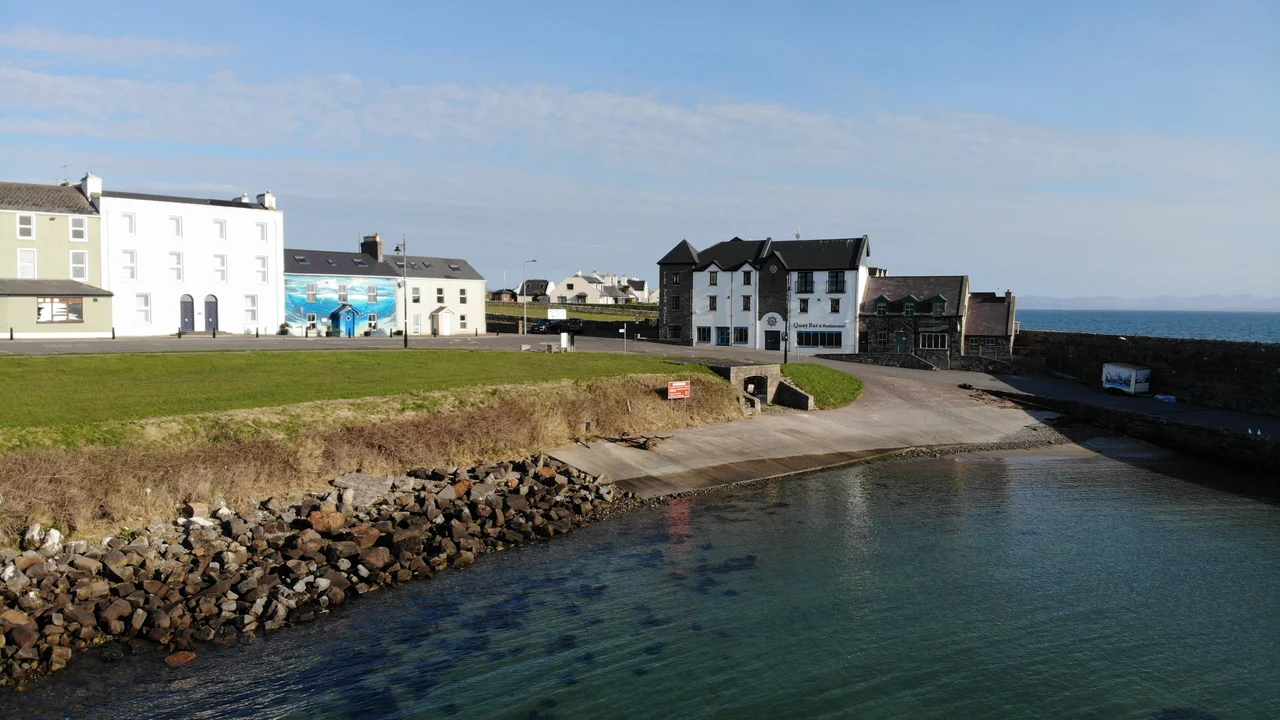

Mullaghmore
On the morning of 27 August 1979, Louis Mountbatten took his family fishing in a small wooden boat called Shadow V out of Mullaghmore harbour. He was 79, the last Viceroy of India, a cousin of the Queen, and a regular summer visitor to Classiebawn Castle on the headland above the village. Two miles off the Donegal coast, a 50-pound bomb hidden in the boat detonated by remote control. Mountbatten was killed. His 14-year-old grandson Nicholas Knatchbull was killed. His daughter-in-law Doreen Knatchbull, the dowager Baroness Brabourne, died the next day. Paul Maxwell, a 15-year-old from Enniskillen working as a boat boy for the summer, died at the scene. The Provisional IRA claimed responsibility within hours.
Classiebawn on the Headland
The castle Mountbatten stayed in was not his by birth, but by marriage. Henry John Temple, the 3rd Viscount Palmerston, began building Classiebawn Castle on the Mullaghmore peninsula in the mid-nineteenth century, a baronial pile designed by James Rawson Carroll. Palmerston had inherited the estate from Sir John Temple, who received the original 12,000-acre grant back in the 1600s. Palmerston also commissioned the stone-walled harbour in the village, built between 1822 and 1841 to designs by the marine engineer Alexander Nimmo. The castle passed through marriage to the Mountbattens. Louis spent summers here for decades. The Provisional IRA knew his schedule. The choice of target, in a small fishing village far from any military presence, was deliberate.
Shovelled Out
Mullaghmore's history with the Palmerston family is older and darker than 1979. In 1847, the worst year of the Great Famine, nine ships carrying over 2,000 evicted tenants left Sligo port bound for British North America. They had been 'shovelled out' from Palmerston's North Sligo estates. They arrived in Canada destitute and, by official accounts, half-naked. The city of Saint John in New Brunswick had to take many of them into care. The city council sent a letter to Palmerston expressing 'regret and fury' that he or his agents 'should have exposed such a numerous and distressed portion of his tenantry to the severity and privation of a New Brunswick winter, unprovided with the common means of support, with broken-down constitutions and almost in a state of nudity, without regard to humanity or even common decency.' Many of these emigrants did not survive the crossing or the first winter ashore. The graves of some are still visible at the old quarantine station on Grosse Isle in the St. Lawrence River, opposite Quebec City. The Palmerstons continued the practice, called 'assisted emigration,' into the 1860s.
The Viking Storm
Mullaghmore Head is now one of the world's premier big-wave surfing destinations. On 8 March 2012, surfers and windsurfers from across the planet rode waves measured at over 15 meters off the headland. The storm system that produced them was nicknamed the 'Viking storm,' a complicated convergence of a North American low pressure system, a Western Atlantic cyclone, and a strong Azores high that funneled a vast Atlantic fetch directly toward the Sligo coast. The waves were less than five meters short of the all-time Irish record, set off County Donegal on 13 December 2011 at 20.4 meters. Some of the surfers walked away with bruises and broken bones. Some lost their boards. The same conditions that have made Mullaghmore famous to a generation of big-wave riders are the conditions that wrecked the Armada at Streedagh just to the south in 1588.
The Working Village
Mullaghmore is small. Two hotels, a seafood restaurant, a grocery shop, a fish farm, a spiritual retreat centre, a scatter of B&Bs. Most of the businesses close for winter, except the fish farm. The sandy beach runs nearly two kilometres. There is no lifeguard on duty. Summer brings the crowds, especially the weekend around 12 July and the August Bank Holiday. The Star of the Sea building on the harbour was originally a nineteenth-century coast guard station, taken over by the Sligo Sisters of Mercy in 1929 and converted to a retreat centre in the 1970s. In 2010, the Mullaghmore Peace Garden opened on the grounds. Prince Charles, now King Charles III, visited it in 2015, the first member of the British royal family to come to Mullaghmore since the murder of his great-uncle Louis Mountbatten thirty-six years before. The visit was widely seen as a deliberate act of reconciliation.
Benbulben Watches
From anywhere in the village, Benbulben dominates the southern horizon, a flat-topped limestone tower that defines the entire North Sligo coast. The mountain has been here long enough not to care about Palmerstons or Mountbattens or surfboards. In 2007 Mullaghmore hosted the final stage of Rally Ireland, won by Sebastian Loeb on his way to a fourth World Championship. The TFI Local Link bus runs through five times a day, six on weekdays, three on Sundays, threading the village into the rest of the coast. Yeats lies buried at Drumcliff, ten kilometres south, in the shadow of the same mountain. The Atlantic keeps doing what it does. The headland, hard limestone above hard limestone, holds.
From the Air
Located at 54.47°N, 8.45°W on the Mullaghmore Peninsula, a headland jutting into Donegal Bay. Best viewed at 1,500-3,500 feet to catch the harbour, Classiebawn Castle on the headland, and Benbulben to the south. Nearest airport is Sligo (EISG), 30 km south; Donegal (EIDL) is 30 km northwest. The peninsula is unmistakable on approach; Classiebawn is a stone castellated building on the highest point.
Nearby Stories
- Roman Catholic Diocese of Killala 3.2 km away
- County Leitrim 6.2 km away
- Glencolmcille 8.3 km away
- Ballymote 8.5 km away
- Caves of the Tullybrack and Belmore Hills 15 km away
- Ballycastle, County Mayo 20 km away
- Castlederg 32 km away
- RMS Empress of Britain (1930) 80 km away