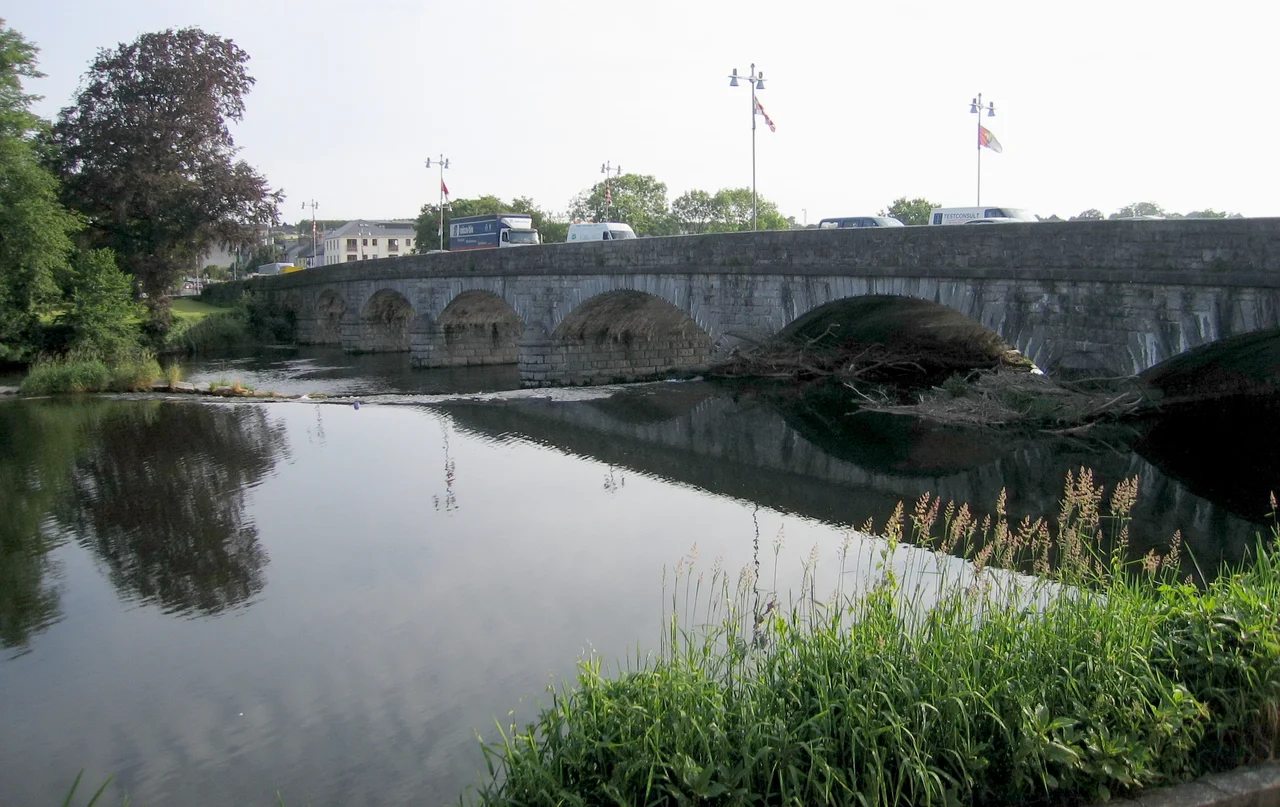

Munster Blackwater
On 9 August 2025, anglers walking the bank of the Munster Blackwater began to see something they had never seen before: salmon and brown trout floating belly-up by the hundreds, by the thousands. By the time the count was over, an estimated 32,000 fish had died. Tests found no disease, no chemicals, no pesticides, no heavy metals. Whatever passed through this river in August 2025 left no signature behind. It was the largest fish kill in the history of the Irish State - and it happened on a river the locals call An Abhainn Mhór, The Great River.
Three Counties to the Sea
The Blackwater rises in the Mullaghareirk Mountains of County Kerry and runs 169 kilometres east before turning sharply south at Cappoquin and emptying into Youghal Harbour on the Celtic Sea. It drains 3,324 square kilometres of mostly pastoral country, with a long-term average flow of 89 cubic metres per second. Along its banks lie Mallow and Fermoy in Cork; Lismore, Cappoquin, and Youghal in Waterford; Rathmore in Kerry. Its tributaries - the Awbeg (the small river), the Bride, the Allow, the Funshion (the ash river), the Finnow (the fair river) - carry place-names that are pure Irish, older than the kings who built castles overlooking them. The Earl of Desmond once held land along its length. So did the Earls of Cork. So did the abbey on Molana Island, halfway to the sea.
The Salmon River
For centuries the Blackwater was synonymous with salmon. In 1834 there were 250 fishing boats at Youghal employing 2,500 men, and salmon was sold on the quayside at one penny per pound weight. Even the disputes were about fish. In 1882 the House of Lords confirmed that the Duke of Devonshire held exclusive fishery rights to the entire river and to Youghal Bay out to Capel Island - a claim founded on a grant given to Walter Raleigh by Elizabeth I and sold on shortly afterwards to the Boyle family. Like rivers across Ireland, the Blackwater's salmon stocks declined sharply through the 20th century. Commercial salmon netting off the coast of Ireland was finally banned in November 2006. But the river was already changing in ways that no fishery law could fully address.
A Birdwatcher's Estuary
The lower river is a Special Protection Area under the EU Birds Directive, stretching from Youghal New Bridge to the Ferry Point peninsula. The mudflats of the estuary draw waders and wildfowl in numbers that matter on an international scale. The SPA hosts internationally important populations of black-tailed godwit, plus nationally important counts of Eurasian wigeon, European golden plover, Northern lapwing, dunlin, bar-tailed godwit, curlew, and redshank. Pale-bellied brent geese, common shelduck, teal, shoveler, red-breasted merganser, cormorants, little egrets, grey herons, oystercatchers - the list runs long. Little egret, golden plover, and bar-tailed godwit appear on Annex I, the EU's roster of species that require special conservation. At low tide the estuary turns into a vast feeding station, alive with movement that begins again with every fall of the water.
The Mystery of August 2025
Then the fish kill. After the bodies were counted, the investigation by Inland Fisheries Ireland and a multi-agency taskforce ran for weeks and concluded with the unsatisfying verdict that the pollutant could not be identified. On 13 September 2025, the journalist Ella McSweeney published a long report in the Irish Times detailing a series of Environmental Protection Agency violations by North Cork Creameries, a farmer-owned co-operative in Kanturk whose effluent discharges into the River Allow, a Blackwater tributary. The creamery insisted it was "entirely impossible" that its discharges had caused the kill. The EPA later confirmed no causal link. Local anglers were furious - at the slowness of the agency response, at the failure to find a culprit, at the broader culture of regulatory leniency they believed had allowed the river to deteriorate. "They failed on all counts," the secretary of the Killavullen Angling Club told an Oireachtas hearing.
Sondes in the Water
When agencies fail, citizens improvise. After the kill, local angling clubs installed their own water-quality sensors - "sondes" - running year-round, twenty-four hours a day, taking readings nobody had been taking before. It was a quiet act of independence on a river that had spent eight centuries being claimed by other people: by Norman conquerors, by Boyle landlords, by Devonshire dukes, by state agencies. The sondes do not name the pollutant; they simply watch. They watch a river that drains three counties, sustains internationally important populations of waterbirds, runs past the ruins of medieval abbeys and Cromwell's overwintering town, and that lost 32,000 salmon and trout in August of last year for reasons no one has yet been able to name.
From the Air
The Munster Blackwater is a 169 km river running west to east across Counties Kerry, Cork, and Waterford before turning south at Cappoquin and entering the Celtic Sea at Youghal (51.95°N, 7.85°W). Best viewed from 4,000-8,000 ft AGL where the full sweep of the valley is visible. The river's distinctive 90-degree bend at Cappoquin is one of the cleanest river-direction changes in Ireland and serves as an excellent navigational reference. Notable towns from west to east: Rathmore, Mallow, Fermoy, Lismore, Cappoquin, Youghal. Nearest airports along the route: Cork (EICK) approximately 30 km south of Mallow, Waterford (EIWF) approximately 40 km east of Cappoquin. The estuary mouth at Youghal Harbour has a shallow sandbar visible at low tide. SPA mudflats below Youghal New Bridge are a winter wildfowl hotspot.
Nearby Stories
- The Glen, Cork 3.8 km away
- Liam Lynch (Irish republican) 6.1 km away
- All Together Now (festival) 9.4 km away
- Castle Oliver 14 km away
- Kilbrittain 17 km away
- 1999 Tramore helicopter crash 30 km away
- Walter Siepmann 37 km away
- SM U-27 107 km away