
Murder of Lee Rigby
Lee Rigby was twenty-five years old. He was a Fusilier in the 2nd Battalion of the Royal Regiment of Fusiliers, a drummer and machine-gunner who had served in Cyprus, in Germany, in Afghanistan. He had a two-year-old son. On the afternoon of Wednesday 22 May 2013 he was walking along Wellington Street in Woolwich, on his way back to the Royal Artillery Barracks from a stint helping out at the Tower of London. He was off-duty and wearing a Help for Heroes hoodie, the British armed forces charity he supported. He never made it home. Two Islamist extremists, Michael Adebolajo and Michael Adebowale, ran him down with a car and killed him in the street. He was twenty-five.
Lee
He was born on 4 July 1987 in Middleton, Greater Manchester. He joined the Army in 2006, choosing the Fusiliers because of their drum corps; he wanted to be a drummer. He served in Cyprus and Germany as a machine-gunner, then deployed to Helmand Province in Afghanistan. By 2013 he was working as a recruiter and helping with duties at the Tower of London, having taken a less exposed posting partly to be a better dad. He married Rebecca Metcalfe in 2007. Their son Jack was born in 2010. The marriage ended in separation, but Lee remained a present father. At the time of his death he was engaged to a new partner. He was, by every account in the days and weeks that followed, a popular soldier and a beloved son, a doting father, the kind of young man whose mother's grief, when she spoke publicly, came from a place beyond anger.
The Attack
Shortly before 2.20 pm on 22 May 2013, Rigby was crossing the road on Wellington Street, near the perimeter of the Royal Artillery Barracks. Two men driving a Vauxhall Tigra, Michael Adebolajo and Michael Adebowale, accelerated into him, knocking him to the ground. They attacked him with knives and a cleaver. They did not flee. They remained at the scene, asked bystanders to call police, and told passers-by they had killed Rigby in protest at British military action. Several bystanders stood over Rigby's body to protect him from further harm. A woman named Ingrid Loyau-Kennett famously talked to the attackers while emergency services arrived. The Metropolitan Police received the first 999 call at 14:20. Unarmed officers reached the scene at 14:29 and set up a cordon. Armed officers arrived at 14:34. When the attackers charged at them brandishing weapons, the officers opened fire, wounding both. Rigby was pronounced dead at the scene. He died from multiple incised wounds, the post-mortem said.
Aftermath
Adebolajo and Adebowale were tried at the Old Bailey and found guilty of murder on 19 December 2013. On 26 February 2014, Adebolajo, the older of the two, was given a whole-life order. Adebowale was given a minimum term of 45 years. An Independent Police Complaints Commission investigation concluded that the armed officers who shot the attackers had acted entirely appropriately and with skill and professionalism. A parliamentary inquiry published in November 2014 found that Rigby's death could not have been prevented; both attackers had appeared in seven separate intelligence investigations, but the specific Facebook exchange in December 2012 in which Adebowale discussed killing a soldier had not been shared with British authorities by the platform until after the attack. In the immediate aftermath there were anti-Muslim incidents across the United Kingdom, condemned by police, by political leaders, and by the Muslim Council of Britain. An additional 1,200 police officers were deployed across London to protect Muslim communities from revenge attacks.
Help for Heroes, and a Son
In the five days after his death, the Help for Heroes charity whose hoodie Lee had been wearing received over 600,000 pounds in donations. He was given a military funeral at Bury Parish Church on 12 July 2013, attended by several thousand mourners including the Prime Minister David Cameron. His mother Lyn and stepfather Ian later established the Lee Rigby Foundation, a support network for bereaved military families that runs static caravans where grieving families can take a break together. Lee Rigby House in Staffordshire, donated by the former professional wrestler Peter Thornley, also serves this purpose. In 2023, Jack Rigby (Lee's son, who was two when his father was killed) received a Pride of Britain award for his fundraising work for Scotty's Little Soldiers, a charity that supports children bereaved by military service, in memory of the dad he can barely remember.
Memorials
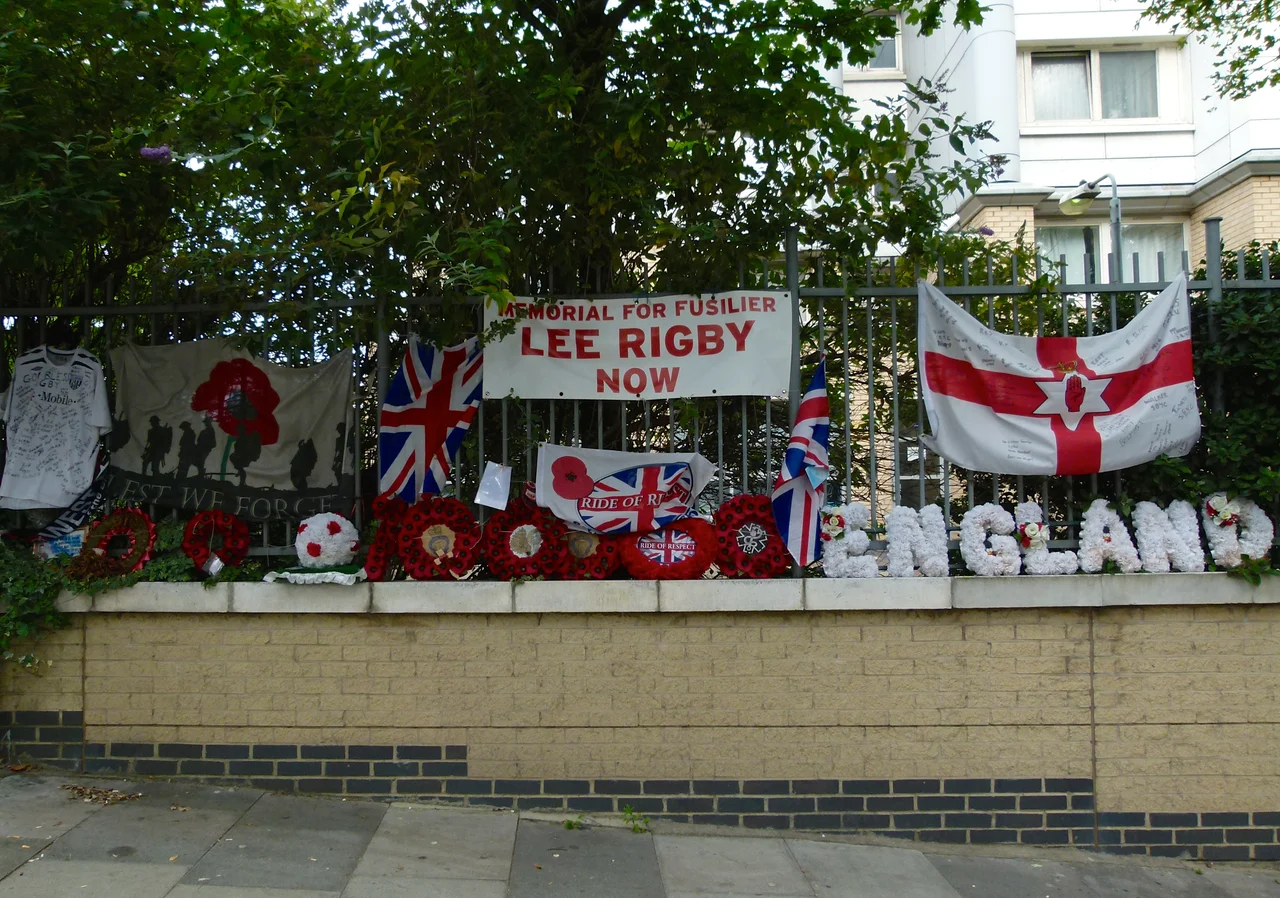
There are several. Lee Rigby's name was added to the Armed Forces Memorial at the National Memorial Arboretum in Staffordshire on 1 September 2014. A bronze drum and a plaque were unveiled in his hometown of Middleton on 29 March 2015. The family said publicly that they did not want a free-standing public memorial at the site of the attack in Woolwich, which they feared would attract the wrong kind of attention, but they did welcome a plaque inside the ruined St George's Garrison Church on Grand Depot Road. That memorial was revealed on 11 November 2015. Lee Rigby's name appears there alongside ten others who served in or lived in Woolwich and gave their lives, including victims of the 1974 King's Arms pub bombing. In February 2020 his old regiment came together for the unveiling of another memorial at Millwall Football Club's New Den, funded by supporters, with the proceeds going to charity. He is remembered as a soldier and as a father. The latter, his family have always made clear, is the one that mattered most to him.
From the Air
Located at 51.488 degrees north, 0.062 degrees east, in Woolwich. The attack site on Wellington Street lies near the perimeter of the Royal Artillery Barracks; the memorial to Lee Rigby is inside the ruined St George's Garrison Church on Grand Depot Road. London City Airport (EGLC) is about 3 nautical miles north across the Thames. This is a site of mourning. Pass through it quietly.
Nearby Stories
- Hampton, London 1.1 km away
- Queenborough Castle 3.2 km away
- Groombridge Place 4 km away
- North Weald Airfield 4.9 km away
- Kings Langley Palace 8.3 km away
- White House Farm murders 11 km away
- Port Lympne Mansion 22 km away
- Amberley Museum & Heritage Centre 31 km away