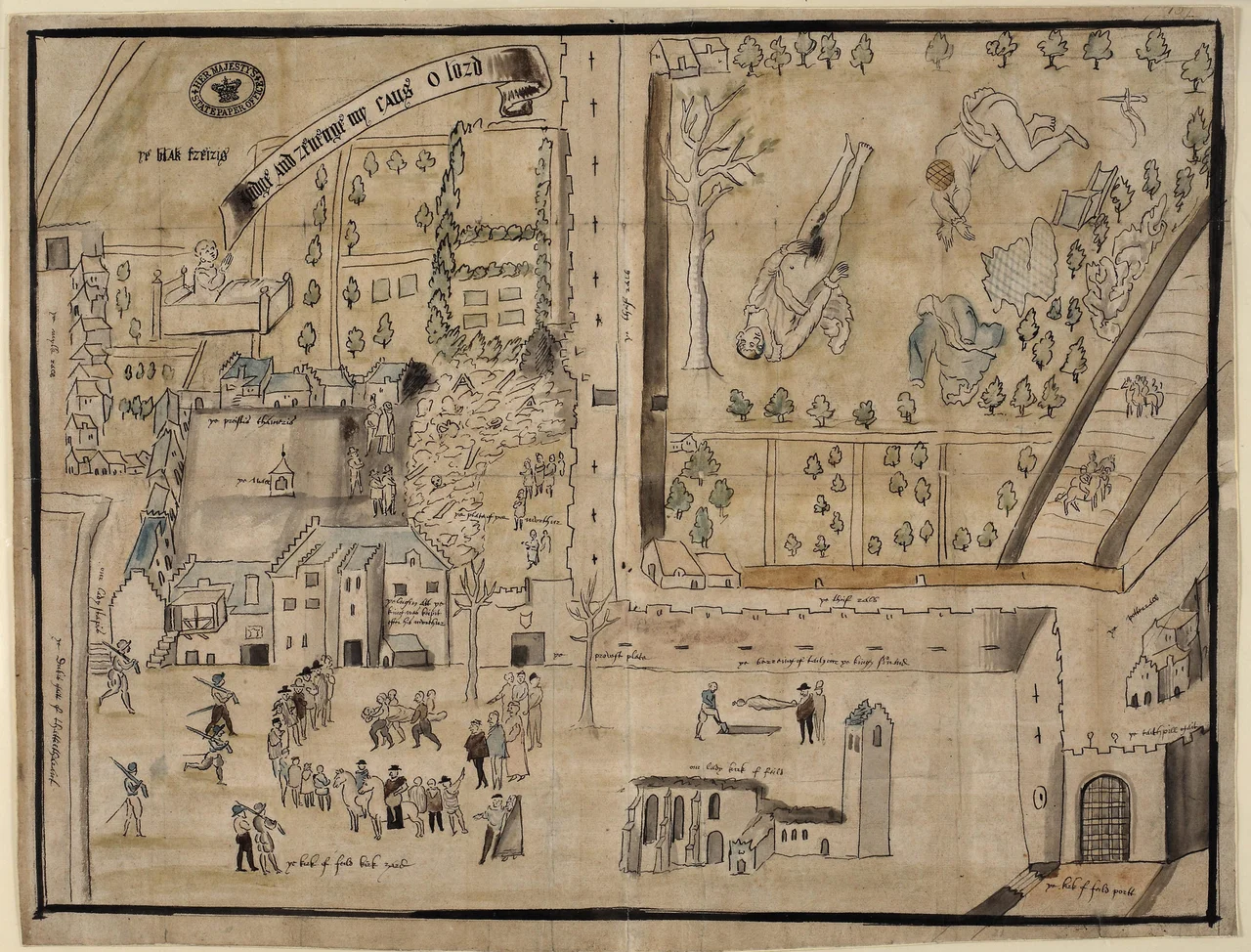

Murder of Lord Darnley
Just after two in the morning on 10 February 1567, a witness called Barbara Mertine looked out her window in Friar's Wynd and watched thirteen men go past in the dark. Then she heard the explosion, what she called the craik, that levelled the Old Provost's House at the Kirk o' Field. Eleven more men went by in the other direction. She shouted after them that they were traitors who had done an evil turn. She was right. The blast destroyed the house. But the body of Henry Stuart, Lord Darnley, husband of Mary Queen of Scots, was found unmarked in a nearby orchard, apparently strangled or smothered before the explosion ever happened. The murder cost Mary her crown and changed Scottish history. The man who almost certainly arranged it became her third husband three months later.
A Trapped Queen
By February 1567 Mary Queen of Scots was 24 years old and in a position with no good exits. She had returned to Scotland from France in 1561 to find a country that had reformed itself Protestant in her absence. She had ruled it as a Catholic for six years. Her second husband, Darnley, was 21, vain, syphilitic, and dangerous. The previous March he had helped murder her secretary David Rizzio in front of her at Holyrood while she was six months pregnant with their son, the future James VI. By early 1567 she had brought Darnley to Kirk o' Field, a house just inside the Edinburgh town wall, where he was recovering from what may have been smallpox or the late stages of syphilis. She visited him from Holyrood. Her chamber servant Thomas Nelson said the queen and Lady Reres would play and sing in the garden at night. On the night of the murder she attended the wedding banquet of her servant Bastian Pagez. Then she went to Kirk o' Field. Then she went home.
The Explosion and the Strangled Body
Early in the morning of 10 February the Old Provost's House was destroyed by gunpowder. Sir William Drury later reported that Sir James Balfour, whose brother owned the lodging, had bought sixty pounds Scots worth of gunpowder shortly beforehand. Balfour could have moved it from his own property into the cellar of Darnley's. Darnley and his servant Taylor were found partially clothed in an orchard outside the wreckage, with no marks of fire or blast on them. Another servant died inside in the explosion. Three witnesses gave sworn statements the next day: Mertine in Friar's Wynd, May Crokat across the street who was in bed with her twins when the blast threw her to the door in her shirt, and the surgeon John Petcarne who was called to attend Francisco de Busso, an Italian servant of the queen. The page who later confessed said Darnley had been taken from the house before the explosion, choked to death in a stable with a serviette in his mouth, and left under a tree.
The Earl of Bothwell
Suspicion fell immediately on James Hepburn, 4th Earl of Bothwell. He was tried for the murder in April 1567 and acquitted by a Privy Council stacked in his favour. He then forced his supporters to sign the Ainslie Tavern Bond pledging to back his marriage to the queen. He carried Mary off to Dunbar, possibly with her consent and possibly without; the truth is one of those things that resists modern certainty. Three months after Darnley's murder, Mary married Bothwell. Whatever her own role in the killing, and historians have argued for centuries about that, her marriage to the man everyone believed had done it destroyed her politically. The Confederate Lords rose against her. A few weeks later Bothwell fled. He died years later as a prisoner in Dragsholm in Denmark, kept chained in a cell so long, the legend goes, that the floor wore down where he paced. He is buried at Farevejle Church.
Forced to Abdicate
Mary was captured at Carberry Hill, paraded through Edinburgh, and imprisoned at Lochleven Castle. There she was persuaded to abdicate in favour of her infant son James, who became James VI. She escaped, raised an army, lost the Battle of Langside, and fled south into England, where Elizabeth I held her under house arrest for nineteen years before having her beheaded at Fotheringhay in 1587. Six of Bothwell's servants and acquaintances were tried and executed for Darnley's murder. Captain William Blackadder, who had rushed out of a tavern at the Tron when he heard the explosion, was hanged on 14 June 1567 by an assize of men loyal to Darnley's father. In December 1567, John Hepburn of Bowtoun, John Hay, William Powrie, and George Dalgleish were condemned to be hanged and quartered. Dalgleish had delivered the casket letters to the Earl of Morton; his head was set on the Netherbow gate. French Paris, the queen's valet who said Bothwell had told him of the plan, was executed on 16 August 1567. Today the site of the Old Provost's House is buried beneath the South Bridge of the University of Edinburgh's Old College. Generations of students have walked over it without knowing.
From the Air
55.95 N, 3.18 W, near the junction of South College Street and South Bridge in central Edinburgh, on the south side of the Royal Mile. The Old College of the University of Edinburgh, designed by Robert Adam and finished by William Henry Playfair, now occupies the site of the medieval Kirk o' Field; the murder happened where South Bridge crosses what was the church quadrangle. Edinburgh Airport (EGPH) is 9 km west. Recommended viewing altitude 2,500-3,500 ft for a city overview. The Flodden Wall once ran along the south side of the murder site; some traces of it survive in the buildings and street layout of the Old Town.
Nearby Stories
- Ardoch Roman Fort 2.2 km away
- Craignethan Castle 3.1 km away
- Haddington 3.8 km away
- Balvaird Castle 4.3 km away
- Battle of Kilsyth 9.4 km away
- Siege of St Andrews Castle 9.9 km away
- Neidpath Castle 11 km away
- Melrose Abbey 15 km away