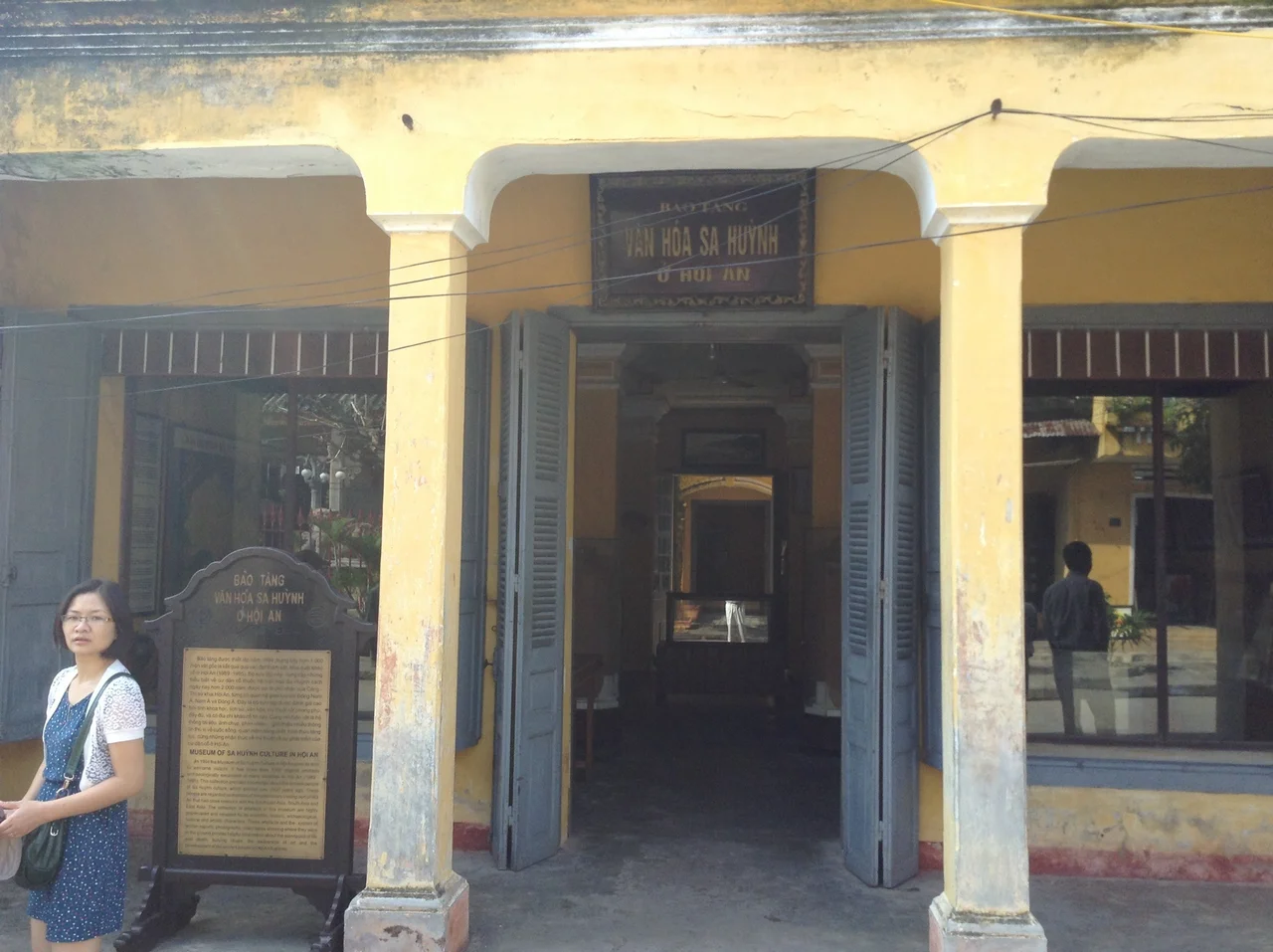

Museum of Sa Huỳnh Culture
Long before Chinese merchants moored their junks in Hội An's river and Japanese traders built their covered bridge, the people the archaeologists call Sa Huỳnh were already here — and already connected to the world. Their culture stretched across central Vietnam from roughly 1000 BCE to 200 CE, and their dead were buried in distinctive ceramic jars alongside goods that came from South India, Southeast Asia, and China. The Museum of Sa Huỳnh Culture, opened in 1994 in the heart of the ancient town, holds Vietnam's largest and most significant collection of their artifacts. It is a small museum about an enormous story.
Jar Burials and Long-Distance Trade
The Sa Huỳnh are defined archaeologically by their burial practice: the dead were placed in large, lidded terracotta jars and interred along with objects that reveal the reach of their trade networks. Earrings of nephrite — a stone not found in central Vietnam — appear alongside iron tools, glass beads of Indian manufacture, and bronze objects. These were not isolated villagers. They were participants in a maritime exchange that stretched across much of monsoon Asia, centuries before the Silk Road sea routes became famous. The museum's collection makes this visible: case after case of jewelry, tools, and ceramic vessels recovered from sites in and around Hội An, including the critical excavation at Bai Ong on nearby Cham Island.
The Bai Ong Find and the 3,000-Year Timeline
The museum's most significant holding comes from Bai Ong, a site on Cham Island approximately 15 kilometers offshore from Hội An. Excavations there extended the Sa Huỳnh timeline back by 3,000 years — pushing the culture's earliest traces to around 1000 BCE and establishing that the islands the Cham people later held sacred had been inhabited, and used as a burial ground, long before recorded history. The Bai Ong collection gives the museum its claim to national significance: no other institution in Vietnam holds a comparably deep record of Sa Huỳnh material. What looks at first like an unremarkable room of terracotta becomes, with context, one of the most important windows into the pre-Champa history of this coast.
Between the Champa and the Living Town
The Sa Huỳnh did not simply disappear. Scholars trace a cultural continuity between them and the Cham people, the Malayo-Polynesian civilization that built Hội An into a major trading port during the first millennium CE. The Champa Kingdom, which dominated the central Vietnamese coast for over a thousand years, drew on foundations the Sa Huỳnh laid: the knowledge of the sea, the trade routes, the anchorages. Walking from the museum back into Hội An's ancient streets — the Japanese Covered Bridge, the merchant houses with their Chinese tiles and Vietnamese proportions — is to walk across layers of settlement. The Sa Huỳnh were the first, but the town has been continuously inhabited and rebuilt on top of everything they left.
A Small Room, Carefully Kept
The museum occupies one of Hội An's heritage buildings on Trần Phú Street, the town's main cultural corridor. It is not large. Two rooms hold the core collection, displayed without theatrical lighting or elaborate staging — the objects speak more clearly for the restraint. The terracotta burial jars are the centrepieces: some complete, some fragmentary, their forms simple and striking. Labels and interpretive text place each piece within the broader Sa Huỳnh story, connecting a particular bronze ring or glass bead to a trade network that once made this stretch of coast one of the most commercially active in Asia. For anyone who has just walked the ancient town, the museum provides the deep history that makes the surface legible.
From the Air
The Museum of Sa Huỳnh Culture sits at approximately 15.877°N, 108.326°E in the compact heart of Hội An old town, a few blocks from the Thu Bon River. From the air at 1,500–2,000 ft, the old town appears as a dense cluster of tiled rooftops at a bend in the river, distinct from the newer construction of greater Hội An. Cham Island (Cù Lao Chàm) is visible offshore to the east on clear days. Da Nang International Airport (VVDN) is approximately 25 km north-northeast. Chu Lai Airport (VVCA) lies about 50 km to the south.
Nearby Stories
- Bach Ma National Park 7.4 km away
- Tam Kỳ 9.1 km away
- 1968 Kham Duc C-130 Shootdown 27 km away
- Lý Sơn Island 33 km away
- Hue–Da Nang Campaign 33 km away
- Hải Vân Pass 35 km away
- Operation Masher / White Wing 153 km away
- Battle of the Paracel Islands 285 km away