
Museum on the Mound
The name itself is a wink: MUS£UM ON THE MOUND, with a pound sign standing in for the E. Tucked into the basement of the old Bank of Scotland headquarters at the top of the Mound, the museum exists for the simplest of reasons. The building handled money for three centuries, and somewhere along the way the bank decided that money itself deserved a museum. Walk down into the basement of a Baroque Revival pile crowned with a green dome, and you find yourself face to face with a Bank of England note worth one million pounds.
A Bank That Made Its Own Notes
The Bank of Scotland was founded in 1695, only a year after the Bank of England, and from the start it did something unusual: it printed its own banknotes. It still does. That right, peculiar to a handful of Scottish banks, runs through the museum's collection like a thread. Cases hold paper money from across three centuries, from elaborate copperplate notes signed by hand to the polymer notes in circulation today. The high-denomination Bank of England note on display, worth one million pounds, is the kind of paper that backs the Scottish banknotes you can actually spend. It rarely leaves the vault. Here, it sits behind glass, a small rectangle representing more money than most visitors will see in a lifetime.
The Baroque Pile on the Mound
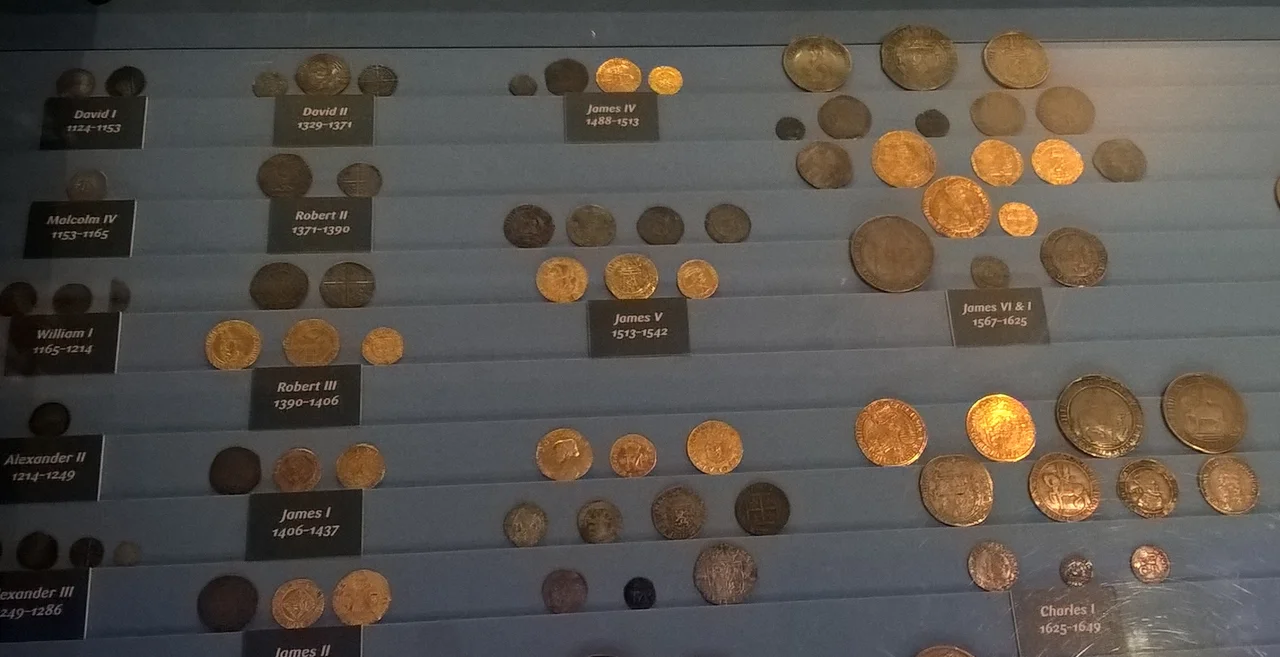
The building is half the story. Designed in the Palladian style by Richard Crichton and Robert Reid and finished in 1806, it was reworked twice in the 19th century, first by David Bryce in 1863 and then by John Dick Peddie and Charles Kinnear in 1878. The Mound itself is artificial earth, dumped between the Old Town and the New Town when the Nor Loch was drained, so the bank's foundations sink dramatically downslope. That awkward geography is what gave the museum its space. The basement, carved into the hill, is large enough to display centuries of coinage, including ancient barter tokens, Scottish hammered silver, and notes that survived bank runs, wars, and revolutions in design.
Ian Rankin and the Rebirth
The museum has lived more than one life. A modest display of artefacts opened in a single basement room in 1986, by appointment only, with the crime novelist Ian Rankin doing the honours at the launch. For twenty years it stayed small and quiet. In 2006 the bank reopened it as a proper public museum, free to enter, and visitor numbers climbed past 50,000 a year. A 2017 announcement that Lloyds Banking Group would close it provoked enough public anger that the closure was reversed. The museum still occupies the basement of what is now part of Lloyds Banking Group, a quiet survivor of corporate reshuffling. The collection traces the bank's history from 1695 to the present, with architectural models showing how the dome above came to dominate Edinburgh's skyline.
Why Money, Here
Edinburgh has banking in its bones. The Scottish Enlightenment produced Adam Smith and the foundations of modern economics; the city's lawyers and merchants built one of Europe's earliest financial centres. The Museum on the Mound makes that intellectual lineage tangible. There are coins minted before Scotland had a parliament, barter tokens from the medieval Lowlands, and exhibits on building societies, insurance, and the slow strange evolution of trust itself. The museum is small enough to see in an hour and odd enough to remember for years afterwards. The pound-sign logo on the door says it all: this is a museum that takes its subject seriously without ever quite taking itself seriously.
From the Air
Coordinates 55.9503 N, 3.1933 W, on the Mound between Edinburgh's Old Town and New Town, just north of Edinburgh Castle. The green copper dome of the Bank of Scotland headquarters is a useful landmark from the air; the museum lies in its basement. Edinburgh Airport (EGPH) is about 8 nm west; Edinburgh-Newbridge approaches typically pass north of the city centre. Best identified at lower altitudes by the dome itself and the Castle Rock just to the south. Variable Scottish weather; clear sightlines often limited by haar (sea fog) drifting in from the Firth of Forth.
Nearby Stories
- Ardoch Roman Fort 2.2 km away
- Craignethan Castle 3.1 km away
- Haddington 3.8 km away
- Balvaird Castle 4.3 km away
- Battle of Kilsyth 9.4 km away
- Siege of St Andrews Castle 9.9 km away
- Neidpath Castle 11 km away
- Melrose Abbey 15 km away