_hug.jpg)
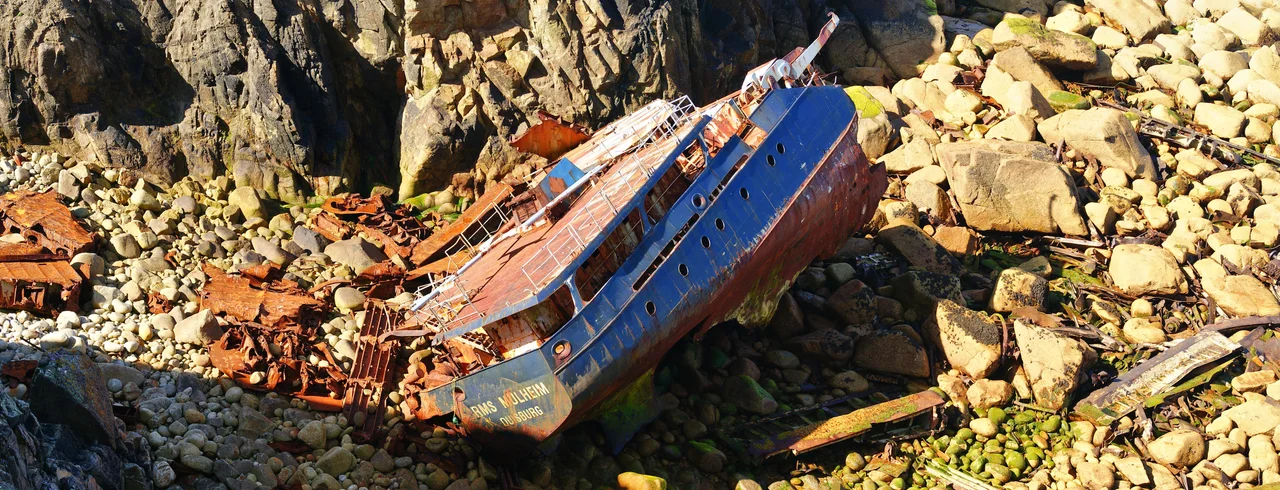
MV RMS Mulheim
The official accident report listed the cause in language that bordered on the absurd: the chief officer's trousers had caught on a control lever, he had fallen, struck his head, and gone unconscious. While he lay on the wheelhouse floor in the small hours of 22 March 2003, the MV RMS Mulheim steamed steadily on autopilot toward the cliffs below Land's End at full speed. By the time anyone realised what had happened, the German-flagged cargo ship was already aground in Gamper Bay, wedged into a granite gully where she remains today, slowly dissolving into the Cornish coast.
A New Ship Meets an Old Coast
The Mulheim was not old. Built at the Tulcea Shipyard in Romania, her keel laid in March 1998 and launched in May 1999, she was barely four years into her working life when she met Land's End. At 1,599 gross tons and 2,500 deadweight, she was a workhorse coaster, the kind of vessel that hauled bulk cargo around the edges of Europe without making news. On the night she ran aground she was carrying 2,200 tonnes of shredded plastic from Cork in Ireland, bound for Lubeck in Germany. The cargo was almost worthless. The cliffs that caught her were 270 million years old, granite forced up from the Cornubian batholith when Pangaea was still cooling.
The Trousers Defence
The Marine Accident Investigation Branch report read like dark comedy. The chief officer, alone on watch in the dead of night, had bent down to retrieve something. The hem of his trousers caught on the lever controlling the engine throttle. He lost his footing, fell, and struck his head on the deck. He did not regain consciousness in time. The autopilot, indifferent to its driver, held course. At 0510 the Mulheim drove onto the rocks at Castle Zawn at full speed. The crew of six woke to grinding metal and the sound of waves smashing against a hull that was no longer afloat. A rescue helicopter from RNAS Culdrose lifted them off in darkness. Nobody died, but the ship was finished within hours.
What the Sea Keeps
Salvage proved impossible. The Mulheim was lodged too deep into the cliffs, the sea too persistent, the geometry too cruel. So the salvors took what they could, the fuel and the worst of the pollutants, and walked away. The Atlantic took the rest in instalments. By 2010 photographers were documenting the rusting hulk as if it were a piece of accidental land art, ochre and orange against grey granite, the bow already gone. By 2013 little remained but stern bulkheads and twisted plates of decking. Today she is a smear of metal in a fissure of rock, visible at low tide if you know where to look. The Cornish coast has been doing this to ships since before England was England. The Mulheim is simply the most recent contribution.
Why Land's End
The cape that finished the Mulheim has been finishing ships for as long as ships have rounded it. The Atlantic funnels into the western approaches of the English Channel, squeezing prevailing southwesterly weather against an unyielding granite peninsula. Tides race past Longships Lighthouse at five knots. Fog appears with little warning. The coast itself offers almost no refuge for a vessel in trouble: just cliffs, zawns, and shallow rocky coves where the swell rolls in unbroken from three thousand miles of open ocean. Sailors had a saying for the stretch from the Lizard to Land's End. They called it the Graveyard of the Atlantic, and they meant it literally.
From the Air
Wreck site at 50.073 N, 5.708 W, in Gamper Bay just south of Sennen Cove and immediately north of Land's End cape. Nearest airfield is Land's End Airport (EGHC), about two nautical miles inland to the northeast. Best viewing altitude 1,500 to 2,500 feet, ideally on an outbound westerly run from EGHC so the wreck appears against the white sand of Whitesand Bay to the north. Expect strong gusts off the cliffs in any westerly wind, persistent low cloud in maritime air, and the standard Atlantic-coast caution about deteriorating visibility behind cold fronts.
Nearby Stories
- Mullion Cove 1.3 km away
- Great Wheal Charlotte 3.7 km away
- Castle Down 5.3 km away
- SS Georgia (1890) 30 km away
- Wheal Coates 41 km away
- 1979 Fastnet Race 55 km away
- HMS Affray 126 km away
- Routes of Santiago de Compostela: Camino Frances and Routes of Northern Spain 713 km away