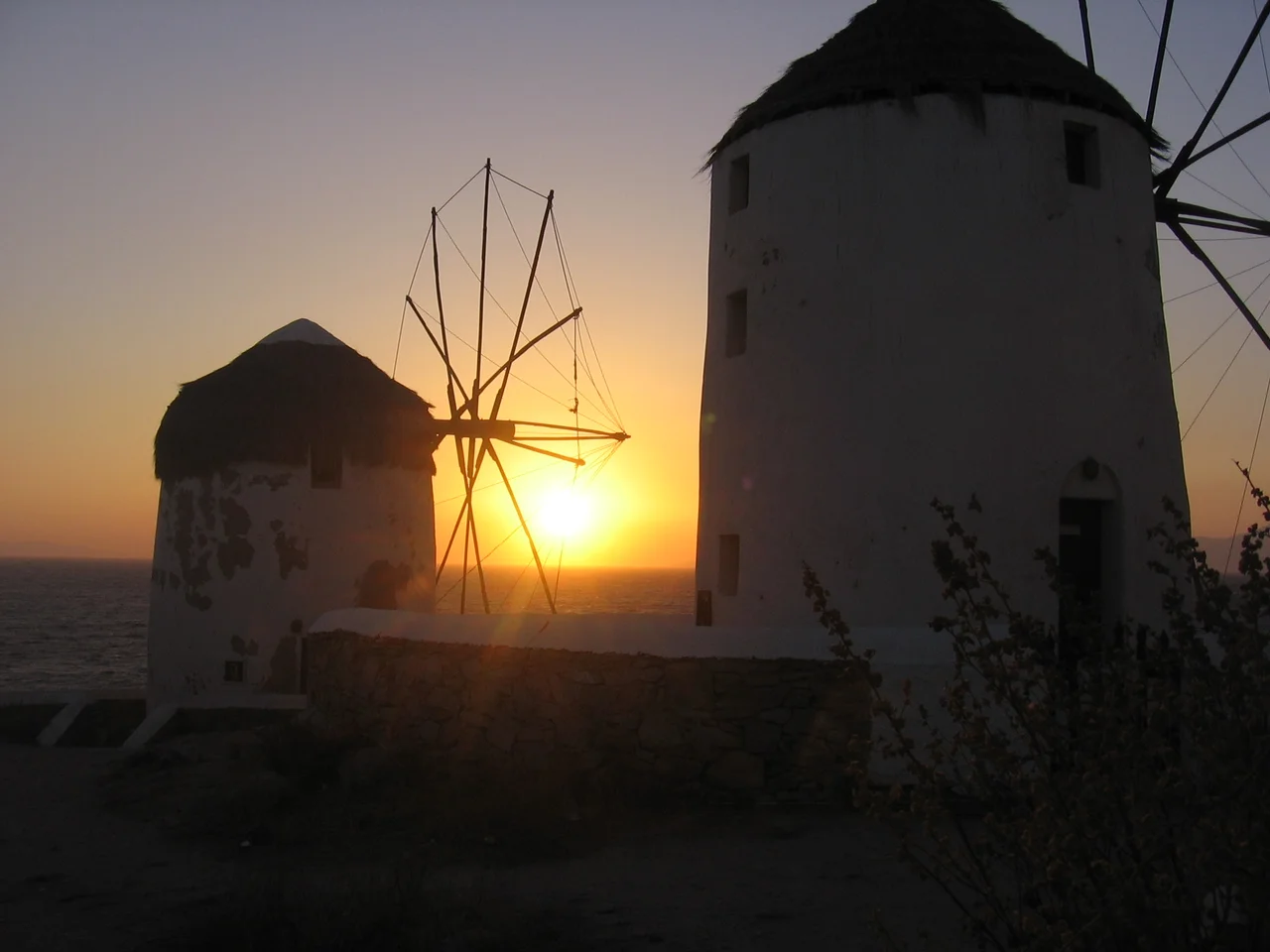

Mykonos Windmills
The wind never really stops here, and the builders knew it. Stand on the low hill above Alefkandra harbour and you understand why the Venetians chose this exact rise: the meltemi, the dry summer wind that screams down out of the north, hits this slope first and hardest. Where other people curse a relentless wind, the Mykonians built machines to eat it. Sixteen round, whitewashed towers with pointed thatched caps and tiny windows still stand against the sky, sails long gone, but the wind they were built to harness blows just as hard as it did five centuries ago.
Built to Catch the Meltemi
Most of the windmills went up in the 16th century, when Mykonos was under Venetian rule and Venice dominated the eastern Mediterranean. The location was no accident. Every mill is round, white, and crowned with a pointed roof of wood and straw, with windows kept small against the gales. Almost all of them face north, toward the source of the island's strongest winds across the largest part of the year. Construction continued in fits and starts into the early 20th century, but the design barely changed, because the wind never did. Sixteen survive today; seven of them stand together in a row on the landmark hill in Chora, the cluster most visitors picture when they think of Mykonos at all.
Bread for a Thousand Ships
These were not decorations. They were industry. The mills ground wheat into flour, and for the better part of three centuries that flour fed the crews of ships threading through the Cyclades. Mykonos sat at a useful crossroads of Aegean sea routes, and a vessel could reprovision here before the long haul east or west. Grinding grain became one of the island's most important sources of income, a rare reliable trade for a place that ancient writers dismissed as poor and rocky. The wind that made farming hard made milling profitable. It was a neat, hard-won reversal of fortune, written into stone and straw on a windy hill.
When the Sails Stopped
Their decline was slow and then complete. As steam and electricity spread through the 19th and early 20th centuries, wind power became a quaint inefficiency, and one by one the great sails came down. By the middle of the 20th century the last mill had ceased production. What saved them was the very thing that had made them work: they were impossible to ignore. The towers stand on a hill where the whole village of Chora and a slice of the harbour spread out below, and they had become the island's signature long before anyone called it that. One mill now operates as a museum, and the rest endure, restored and white, doing the only job left to them, which is to be unforgettable.
The Most Photographed Hill in the Cyclades
There is a particular hour, just before sunset, when the light goes gold and the white plaster of the mills catches fire with it, and the crowd on the hill falls briefly quiet. Below, the rooftops of Chora tumble toward Little Venice, where balconies hang out over the water. The windmills are the first thing a boat sees coming into Alefkandra and the last thing the eye holds at dusk. They are found in some form on nearly every Cycladic island, but here, lined up against the open Aegean and the wind that built them, they have become the face the whole island wears.
From the Air
The Mykonos windmills stand at approximately 37.44°N, 25.33°E, on a low hill above Alefkandra harbour on the southwest edge of Chora (Mykonos Town). From the air the row of seven white towers in Chora is a distinctive cluster on the headland between the town and the open sea. Mykonos Island National Airport (LGMK) lies about 4 km southeast of town. The sacred island of Delos sits a short distance southwest, and the strong northerly meltemi wind is a defining feature of the area's flying conditions in summer. Best light is the hour before sunset, when the whitewashed towers glow gold above the harbour.
Nearby Stories
- Andros 5.1 km away
- Chalandriani 5.7 km away
- Kouros of Apollonas 11 km away
- Ikaria 15 km away
- Archaeological Museum of Sifnos 38 km away
- Emporio, Chios 44 km away
- Archaeological Museum of Andros 49 km away
- Astypalaia 83 km away