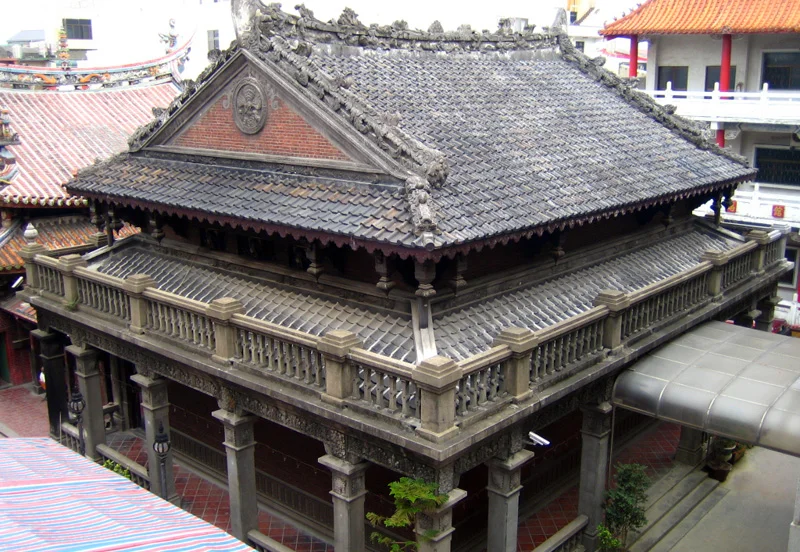

Nanyao Temple
Mazu governs the sea. In the world of southern Chinese folk religion, she was born a mortal woman on Meizhou Island in Fujian province, spent her life saving sailors from storms, and died young — after which the devotion she had inspired in coastal communities only deepened. Her temples followed the waves of Fujianese migration across the Taiwan Strait, and by 1738 the settlers of what would become Changhua City had built her a home. They called it the Mazu Temple. Later in that same year, as the main hall took shape, it received a new name: Nanyao Temple. Almost three centuries on, the temple they built still stands in Nanyao Village, now carrying a Ministry of the Interior designation as a historical building, its architecture grown into a layered compound that reflects every era of Taiwanese history since the Qing dynasty.
Mazu and the Migrants Who Built Her Temple
Mazu worship traveled with the Fujianese who crossed the Taiwan Strait seeking land and opportunity. For people whose lives depended on the sea — fishermen, merchants, sailors, and the families who waited on shore — Mazu's protection was not abstract but urgently practical. The temple at Changhua was founded in 1738, during the height of Qing-era settlement in western Taiwan, and it served a community still new enough to the island that its members drew comfort from bringing familiar devotions to unfamiliar ground. The name change from Mazu Temple to Nanyao Temple, which happened within months of the main hall's completion in November 1738, reflects local custom in naming: Nanyao, meaning roughly 'southern shrine,' situated this temple within the spatial logic of Changhua's growing urban fabric. The goddess remained the same. The building continued to evolve.
A Building That Grew with Its Community
The Nanyao Temple's architecture accumulated across time rather than being designed and built at a single moment. The original two-tier structure received a third tier during the Japanese colonial period, when Taiwan's religious landscape was being reshaped by colonial priorities. Rather than displacing the existing building, the addition extended it — a pattern of accretion rather than replacement that characterized many of Taiwan's working temples. In December 1872, a face-cleaning room was added to the left side of the temple, accompanied by cylindrical pillars constructed to support it. These additions record the temple's growing importance to its community: as more people came and more functions were needed, the building expanded to accommodate them. Each addition became part of the building's character, not an intrusion upon it.
Three Styles Under One Roof
The Nanyao Temple compound consists of a ceremonial arch, the Sanchuan Gate (a three-doorway entrance hall), the main hall, a Guanyin Hall, a Heavenly Hall, and a pilgrims' building. These elements follow the classical layout of southern Chinese temple architecture — but the Guanyin Hall breaks from that tradition in a revealing way. Its construction blends Fujian vernacular style with Western and Japanese elements, making it a physical record of the overlapping cultural forces that shaped Taiwan during the colonial period. The main hall maintains the traditional aesthetic while the Guanyin Hall experiments with synthesis. Together, they embody the complexity of Taiwanese cultural history: not a simple layering of one culture over another, but a genuine mixing in which multiple traditions became something local.
Recognition and Continuity
On 25 April 1985, Taiwan's Ministry of the Interior formally designated the Nanyao Temple as a historical building — a recognition that placed the structure within the national heritage framework and extended formal protection to its fabric and character. The designation came nearly 250 years after the temple's founding, acknowledging what the residents of Changhua had maintained through their own devotion and investment across all those generations. Today the temple continues to function as an active religious site where Mazu is worshipped, festivals are observed, and pilgrims come as they have always come — seeking the goddess who governs the sea even in a city that sits comfortably inland. The building around them is historic monument and living temple simultaneously, and has been for almost three centuries.
From the Air
Nanyao Temple is located at approximately 24.068°N, 120.539°E in Nanyao Village, Changhua City, Changhua County — in the city center rather than the rural hinterlands, making it visible as part of the urban landscape from the air. Changhua City lies roughly 15 kilometers east of Lukang on the western edge of the Taichung Basin. From the air at 3,000 to 5,000 feet, the city's compact grid pattern and the temple's distinctive multi-tiered roofline are discernible in good visibility. The nearest major airport is Taichung International Airport (RCMQ), approximately 20 kilometers to the southeast. The Taiwan High Speed Rail passes nearby with a station at Changhua, making this area well-connected and visible in relation to transport infrastructure from altitude.
Nearby Stories
- Huwei, Yunlin 2.8 km away
- Geographic Center of Taiwan 4.2 km away
- Gaomei Wetlands 15 km away
- China Airlines Flight 611 21 km away
- Shei-Pa National Park 25 km away
- Yushan Weather Station 27 km away
- TransAsia Airways Flight 222 30 km away
- Battle of Xiapi 1136 km away