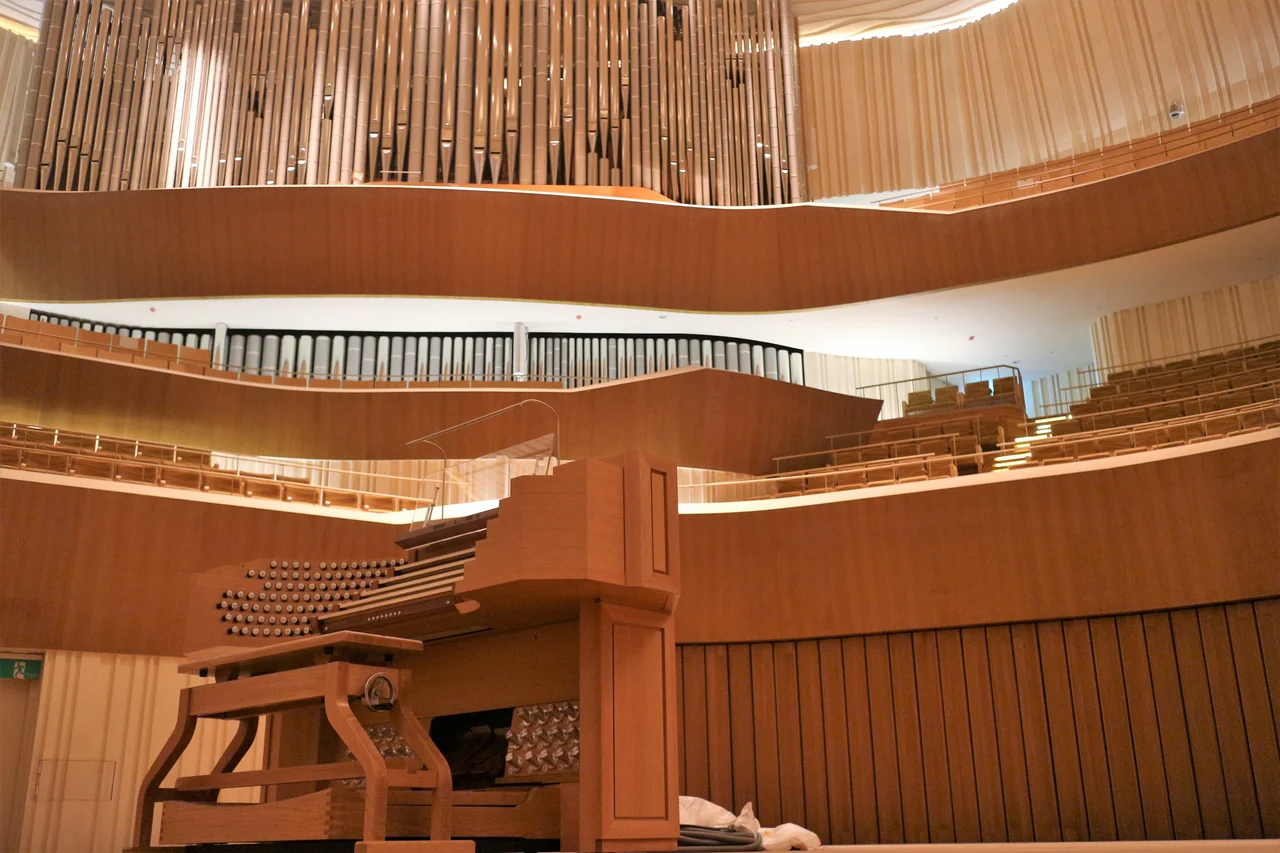

National Kaohsiung Center for the Arts
The pipe organ has 9,085 pipes. It is the largest in Asia, built by the century-old German firm Johannes Klais Orgelbau, and it sits inside a concert hall that seats 1,981 people, which is itself inside a building that The Guardian called "the biggest arts venue on Earth." The National Kaohsiung Center for the Arts -- known locally as Weiwuying -- opened in October 2018 on the site of a former military training base in Fengshan District. Its white, wave-shaped roof stretches across 35,000 square meters, sheltering four performance halls and an outdoor theater that can accommodate 30,000 people. TIME Magazine named it one of the World's Greatest Places in 2019. The numbers are staggering. The story behind them is even more compelling.
From Drill Ground to Concert Hall
The land beneath Weiwuying has known many purposes. During the Qing dynasty and the Japanese colonial period, the site served as a military recruitment and training base in southern Taiwan. After the Kuomintang retreated to Taiwan, the camp continued in military use until 1979, when the Military Council determined it was no longer suitable. The land sat fallow for years. In 2003, Taiwan's Executive Yuan initiated an ambitious redevelopment plan: a three-in-one project combining a metropolitan park, an arts center, and a business district. The arts center became one of Taiwan's top ten national stimulus projects. The entire Weiwuying Metropolitan Park now covers 66.6 hectares, with the performing arts center occupying 10 of them. Where soldiers once drilled, audiences now listen to Mahler symphonies and watch contemporary dance.
A Dutch Architect and Kaohsiung's Banyans
Dutch architect Francine Houben of the firm Mecanoo, which won the design competition in 2007, drew her primary inspiration from an unexpected source: the banyan tree groves that still shade parts of the Weiwuying park. Banyans spread horizontally, their canopies creating vast sheltered spaces beneath. Houben translated this into a sweeping, undulating roof that allows visitors to enter the building from any direction, blurring the boundary between interior and exterior. The roof itself is constructed from 4,500 aluminum alloy panels, forming curves that were fabricated using techniques borrowed from Kaohsiung's shipbuilding industry. This was not mere aesthetic homage -- it was practical engineering. The city's shipyards had decades of experience shaping steel into compound curves, and the same craftsmen who built hulls for ocean-going vessels helped form the interior walls that guide sound through the performance spaces.
Four Halls, One Vision
Beneath the canopy, four distinct halls serve different artistic needs. The Opera House, with 2,236 seats arranged in a horseshoe, was the first venue in Taiwan to install a mainframe computer for staging operations. Its seats are upholstered in shades of red and purple patterned with Taiwanese flowers. The Concert Hall uses a stepped vineyard layout that wraps the audience around the stage, with adjustable acoustic shells to fine-tune sound quality. The Playhouse seats 1,209 for drama and dance. The Recital Hall, the most intimate at 434 seats, hosts chamber music and solo performances. To accommodate the wildly different acoustic requirements of opera, orchestral music, drama, and recital, the building employs three simultaneous construction methods: reinforced concrete, steel frame, and steel-reinforced concrete. The interior walls are continuous steel-skinned curved surfaces that flow from floor to ceiling without visible joints.
Southern Taiwan's Cultural Anchor
Before Weiwuying, Taiwan's major performing arts venues were concentrated in the north, principally in Taipei. The National Kaohsiung Center for the Arts changed that equation, giving southern Taiwan its first national-level performance venue and shifting the cultural center of gravity southward. The outdoor theater on the building's south side connects directly to the park's central lawn, creating a performance space that merges architecture with landscape. On warm evenings, the sounds of rehearsals drift across the grass where families picnic and joggers circle the park's trails. The center is accessible via Weiwuying Station on the Kaohsiung MRT, placing world-class performance within subway distance of the city's residents. From the air, the building's white canopy is unmistakable -- a luminous wave set in a green rectangle of park, a cultural landmark as visually striking from above as it is acoustically precise within.
From the Air
Located at 22.621N, 120.339E in Fengshan District. The white wave-shaped roof is a distinctive landmark within the green rectangle of Weiwuying Metropolitan Park (66.6 hectares). Nearby airports: RCKH (Kaohsiung International Airport, 10 km southwest). Best viewed at 2,000-5,000 ft AGL. The park contrasts sharply with the surrounding dense urban fabric of eastern Kaohsiung.
Nearby Stories
- Taimali 7.2 km away
- Meinong East Gate Tower 15 km away
- Kunci Temple 20 km away
- Checheng Fu'an Temple 42 km away
- Dongji Island 49 km away
- Orchid Island 69 km away
- South Penghu Marine National Park 77 km away
- Hong Kong 12 549 km away