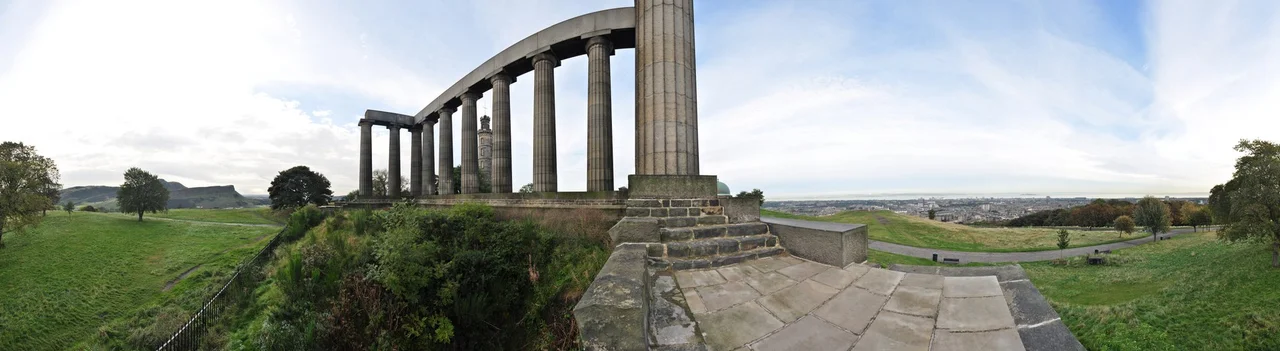

National Monument of Scotland
Locals call it Edinburgh's Disgrace, and they have called it that for nearly two hundred years. Twelve Doric columns stand on the summit of Calton Hill, supporting a fragment of entablature and nothing else. There is no roof, no pediment, no cella. There was meant to be a Parthenon up here, a full-scale replica of the temple on the Athenian Acropolis, raised in honour of the Scottish soldiers and sailors who died in the Napoleonic Wars. The money ran out in 1829. The columns have been waiting ever since.
Scotland's Parthenon
The ambition was extraordinary. In 1822, after years of campaigning by the Highland Society of Scotland, a proposal landed before Edinburgh's great and good: raise £42,000 and build a facsimile of the Parthenon on Calton Hill. Sir Walter Scott backed it. Lord Cockburn and Lord Jeffrey lent their names. Behind the campaign stood Thomas Bruce, 7th Earl of Elgin, who had spent the previous decade controversially extracting marble sculptures from the actual Parthenon and shipping them home to Britain. The Royal Association of Contributors was incorporated by Act of Parliament in July 1822. The foundation stone was laid the following month with great pomp. The architects Charles Robert Cockerell and William Henry Playfair designed the structure between 1823 and 1826. Work began on the hill in 1826.
The Pride and Poverty of Scotland
Sixteen months after the appeal launched, only £16,000 had been raised. Parliament dangled the possibility of a £10,000 grant. Construction crawled forward. By 1829 the twelve massive columns and their entablature stood where the western end of the temple would have been, and the money was gone. The Association tried for more. Subscriptions dried up. The building campaign collapsed. What remained on the hilltop was unmistakably the start of something grand, and unmistakably abandoned. The nicknames came fast and cruel: Scotland's Folly, Edinburgh's Disgrace, the Pride and Poverty of Scotland. The intended Scottish Valhalla had become a punchline.
The View From the Acropolis
Calton Hill rises just east of Princes Street, and the climb is short. From the top, the city unrolls in every direction: the Old Town's spires to the west, the Firth of Forth to the north, Arthur's Seat to the south. Nelson's Monument stands a few yards from the columns, an upturned telescope topped with a time ball. The unfinished temple, paradoxically, makes the view. It frames the sky. People sit between the columns and eat sandwiches. Tourists pose for photographs. The thing that was meant to glorify the war dead has become a meeting place, a viewpoint, a backdrop for first dates. It works in a way nobody planned.
A Disgrace, Reconsidered
Generations of architects have proposed finishing it. In 2004 a fresh plan circulated; it went nowhere. In December 2008 a single stone lintel that had drifted out of alignment was repositioned at a cost of £100,262, and that has been the extent of the work. The monument was given Category A listed status in 1966, which protects it as it stands. The campaign to complete the Parthenon always meets the same response: leave it alone. The columns have become part of Edinburgh's identity, a reminder that the city once thought of itself as the Athens of the North and tried, with characteristic ambition, to prove it. The Disgrace, after two centuries, has become a monument to honesty about reach exceeding grasp.
From the Air
Coordinates 55.9547 N, 3.1819 W, on the summit of Calton Hill in central Edinburgh, just east of Princes Street and north of Holyrood. The unfinished colonnade of twelve Doric columns is a distinctive landmark from the air, particularly visible at lower altitudes alongside Nelson's Monument's tower a few yards to the west. Edinburgh Airport (EGPH) is about 8 nm west; arrivals from the south frequently overfly the city core. Best viewed at 2,000 to 4,000 feet AGL. Calton Hill rises to 103 metres (338 feet) above mean sea level, giving the columns prominence against the surrounding cityscape.
Nearby Stories
- Ardoch Roman Fort 2.2 km away
- Craignethan Castle 3.1 km away
- Haddington 3.8 km away
- Balvaird Castle 4.3 km away
- Battle of Kilsyth 9.4 km away
- Siege of St Andrews Castle 9.9 km away
- Neidpath Castle 11 km away
- Melrose Abbey 15 km away