
Nauta
Manuel Pacaya led his people out of the mission. That is where Nauta begins. In the late 1820s, a Kokama leader at the Jesuit reduction at Laguna on the Huallaga River had had enough of the mistreatment his community endured from the authorities. He gathered a group of families, built a raft, and floated downriver in search of a place to start again. They camped where the Maranon and Ucayali rivers meet, and while clearing their campsite they found a large abandoned pottery jar - a mauta in their language. They named the place after it. A bureaucratic transcription turned mauta into nauta, which in Spanish means sailor or navigator. The name stuck. The town remains.
The Founding Document
Manuel Pacaya approached Damian Najar, the Subprefect of Maynas then based in Moyobamba, to request formal authorization for the settlement. On December 17, 1829, Najar wrote to the Governor of Misiones and to Father Mariano, the priest at San Regis, authorizing Pacaya to establish a town "to serve the republic as a separate government or district." The official founding came on April 30, 1830. The new Subprefect, Carlos del Castillo, appointed Juan Gosendi as the first interim governor. Even though Nauta's origin was indigenous, the founding documents prescribed a Spanish-style colonial town with a plaza, a church, and a grid, reflecting the administrative habits of the Maynas Missions that still ran the region in the early republican era. In 1832, construction began on the main church - now the Ukamara Theater - the first historical and religious monument in this part of the Peruvian Amazon.
The Steamboat Arrives
Through the 1830s and 40s, Nauta grew as a river trading post. Its position at the confluence of the Maranon and Ucayali - the two rivers whose joining creates the Amazon proper - made it a natural hub. Small watercraft from Brazilian Amazonian villages, from upriver Peruvian settlements, and from the missions downstream all converged here. In 1853, a Brazilian-owned paddle steamer completed a run all the way from Belem to Nauta, a journey of more than 3,000 kilometers against the current. The French explorer Paul Marcoy, traveling through Peru between 1843 and 1861, described Nauta as the district capital with 750 inhabitants, calling it the most populated settlement in that part of the lowland jungle. The town outpaced Iquitos, its future rival, for decades. The rubber boom of the late nineteenth century would eventually shift commercial weight downstream, but Nauta's founding priority as a river hub never fully diminished.
Lagoon of Stories
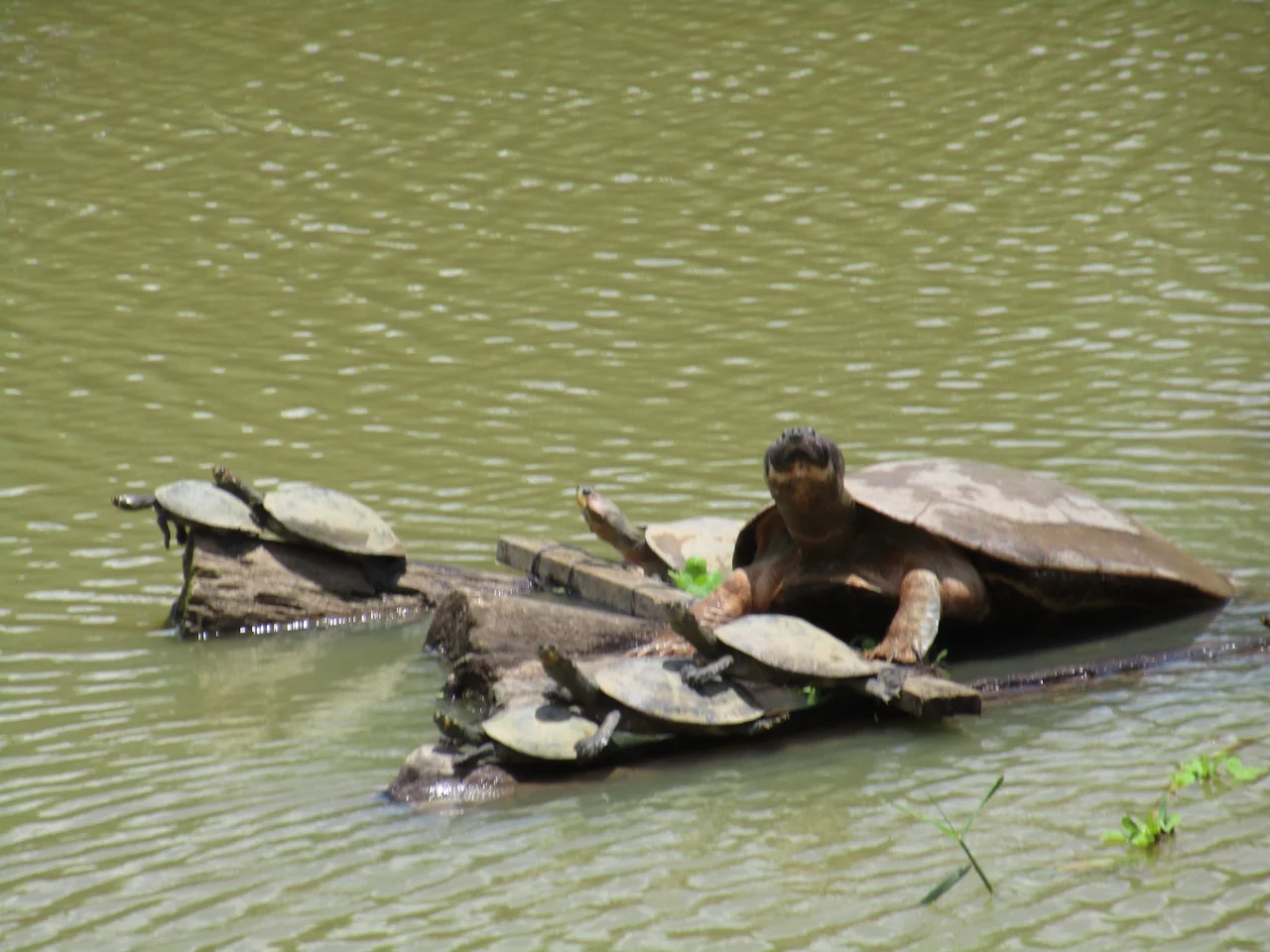
At the center of Nauta sits Lake Sapi Sapi - a shallow freshwater lagoon where yellow-spotted river turtles sun themselves on fallen logs, arrau turtles surface briefly to breathe, and pirarucu, the giant Amazonian fish that can exceed three meters in length, prowl the deeper channels. Crocodilians lurk among the aquatic grasses. Local legend speaks of a mysterious mermaid who once appeared here, beautiful and strange, drawing townspeople to the water. Small boats circle the lagoon for visitors who want to see the wildlife up close. The Plaza de Armas in the center of town features hand-crafted statues of mythical figures from Kokama tradition, placed there by residents to represent the native culture of the area. A bronze bust of Manuel Pacaya watches over the plaza, alongside the Iglesia de Nauta - now serving as a parish theater - and the market where traders from nearby villages come to exchange goods.
Gateway to Pacaya-Samiria
Nauta is the primary access point to the Pacaya-Samiria National Reserve, one of the largest protected areas in Peru and one of the most biologically rich wetlands on Earth. The reserve covers more than two million hectares between the Maranon and Ucayali, a seasonally flooded forest where the water rises and falls by as much as eight meters through the year. Entry requires a permit from Peru's forestry and wildlife service. Visitors typically access the reserve by river through the community of 20 de Febrero, then travel by motorized canoe into channels that lead past floating meadows, flooded forests, and villages built entirely on stilts. The reserve holds pink river dolphins, giant river otters, black caimans, Amazon manatees, and over 500 species of birds. Lodges along the river route offer multi-day expeditions guided by local boatmen.
A Language Worth Saving
The Kokama language - Kukama-Kukamiria in its older form - is the mother tongue of the people who founded Nauta. For most of the twentieth century, it was in steep decline. Schools taught only Spanish. Children were punished for speaking their home language. By the early 2000s, fluent speakers were mostly elderly, and linguists feared the language might disappear within a generation. Radio Ucamara, a local community radio station in Nauta, set out to reverse that. In 2013, residents produced a children's rap video in Kukama-Kukamiria - a collaboration that gained international attention. The station helped establish a school called Ikuar, which teaches the language through songs, traditional stories, and daily immersion. The work has slowed the decline. Whether it will reverse it depends on the next generation of Kokama children in this town their ancestors founded nearly two centuries ago.
From the Air
Located at 4.51 degrees S, 73.58 degrees W, at the confluence of the Maranon and Ucayali rivers that together form the Amazon. Nauta sits at about 110 meters elevation on the north bank of the Maranon. The nearest major airport is Iquitos (SPQT), 100 km north, connected to Nauta by the only road in the region - a 2-lane highway through secondary rainforest. From cruising altitude, look for the V-shaped confluence where two brown rivers meet and combine to form a much wider main stem. The Pacaya-Samiria wetlands spread southward as a mosaic of lakes, oxbows, and seasonally flooded forest.
Nearby Stories
- Department of Loreto 29 km away
- Maynas province 68 km away
- Iquitos Varzea 79 km away
- Matsés National Reserve 114 km away
- Peruvian Amazonia 169 km away
- Puerto Nariño 310 km away
- Murder of Bruno Pereira and Dom Phillips 318 km away
- Cruzeiro do Sul, Acre 325 km away