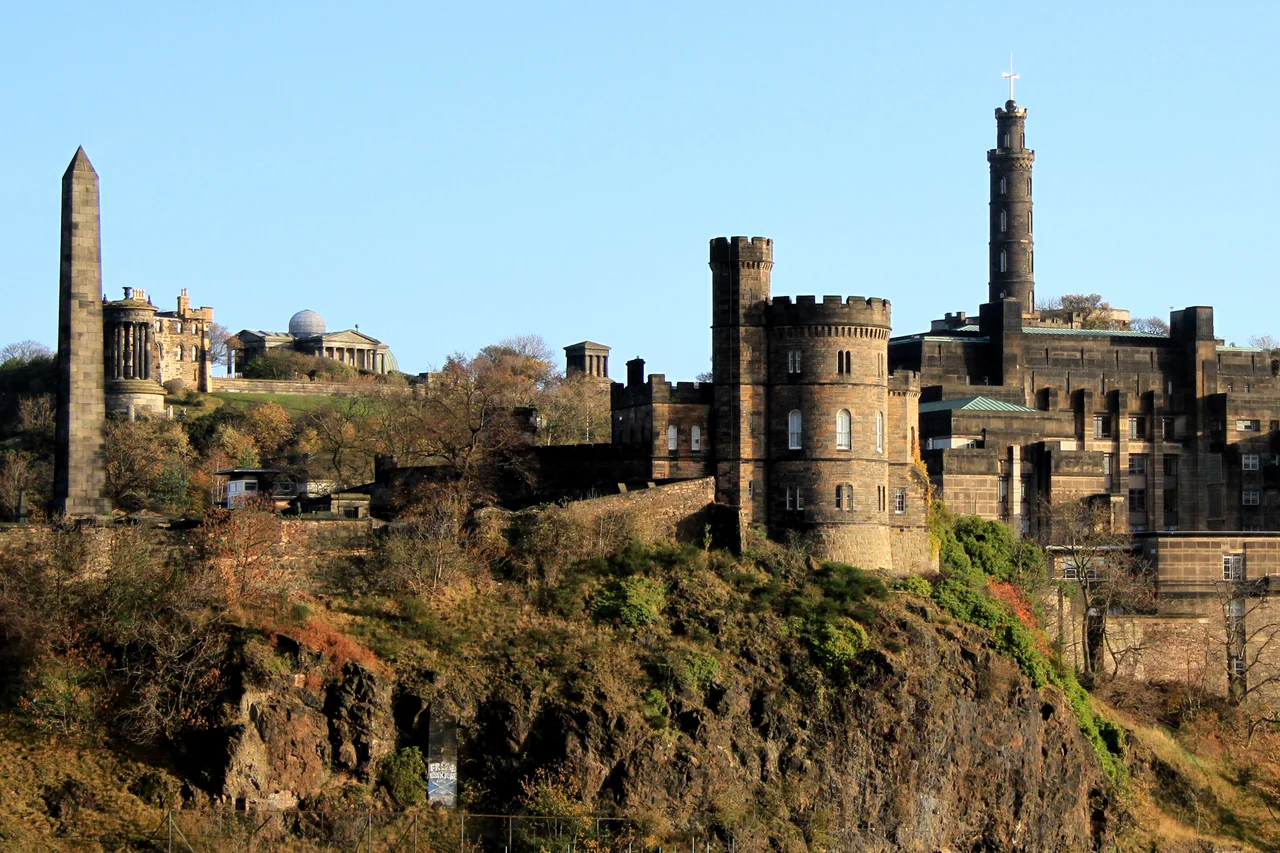

Nelson Monument, Edinburgh
At one o'clock, every weekday, two things happen in Edinburgh at the same time. A black-painted iron ball, the size of a small chair, slides down a mast on top of an inverted-telescope tower on Calton Hill. And from the Half Moon Battery at Edinburgh Castle, half a mile across the city, a 105mm field gun fires a single round. The ball and the gun are the same signal. Both were designed to tell ships anchored in the Firth of Forth, miles away, exactly what time it was - because in the age of celestial navigation, time was longitude, and longitude was the difference between landfall and shipwreck.
A Monument Shaped Like a Spyglass
The tower itself was raised between 1807 and 1815 to honour Vice-Admiral Horatio Nelson, who died at Trafalgar in October 1805. The design, by Robert Burn, made the monument look unmistakably like a nautical telescope: tapered, ringed, crowned with a small viewing platform. Above the plaque commemorating Nelson is a stone carving of the San Josef, a Spanish ship of the line captured by Nelson at the Battle of Cape St Vincent in 1797. The carving is small enough that most visitors miss it, but for those who notice, it is the kind of detail that makes the monument feel intimate, less a piece of imperial bombast than a sailor's keepsake scaled up to landmark size.
The Time Ball
The time ball was added later, in 1853, at the suggestion of Charles Piazzi Smyth, the Astronomer Royal for Scotland. Smyth, an early astrophotographer who once dragged a telescope up the Great Pyramid of Giza to measure stars from the apex, understood that ships in Leith roads needed precise time more than they needed anything else. He wired the time ball to a clock in the adjacent City Observatory: at exactly one o'clock, the clock triggered the mast, the ball dropped, and any ship in sight of Calton Hill could set its chronometer. The connection was an underground electrical cable, then a piece of bleeding-edge technology. A ship's chronometer, accurate to within seconds, could be the difference between knowing where you were and guessing.
The Gun That Replaced the Sky
Edinburgh has a problem. It is famously cloudy, often shrouded in haar that rolls in off the North Sea. A time ball is useless when nobody can see it. So in 1861, eight years after the ball started dropping, the One O'Clock Gun was added to Edinburgh Castle - an audible signal for the days when fog made the visual one impossible. The two systems ran in parallel for over a century. Today the original clock no longer triggers the mast; the time ball is operated manually, dropped in response to the firing of the gun. The signal arrives in reverse of the original sequence, the audible cue now leading the visual one, but the two still happen at the same moment.
Climbing the Spyglass
Visitors can climb the tower, paying a small admission, ascending a tight spiral staircase to the platform at the top. The view sweeps Edinburgh: the Old Town's ridge, the Firth glittering north, Arthur's Seat to the south, and on a clear day the hills of Fife beyond the water. From up here, the logic of the time ball becomes obvious. You can see every anchorage from Leith to Granton, every place a navigator might once have stood on deck waiting for one o'clock. The tower is small as monuments go, but the geography it commands is large. Nelson would have understood the placement immediately.
From the Air
Coordinates 55.9543 N, 3.1826 W, on the summit of Calton Hill in central Edinburgh. The tower stands 32 metres tall, topped with the time-ball mast, and sits a short walk from the unfinished colonnade of the National Monument of Scotland. From the air, the tower's distinctive spyglass profile is recognizable at lower altitudes. Edinburgh Castle, where the One O'Clock Gun fires daily (except Sunday) at 13:00 local, is about 0.6 nm west. Edinburgh Airport (EGPH) lies about 8 nm west. Best viewed at 2,000 to 4,000 feet AGL; Calton Hill itself rises to 103 m (338 ft) above mean sea level.
Nearby Stories
- Ardoch Roman Fort 2.2 km away
- Craignethan Castle 3.1 km away
- Haddington 3.8 km away
- Balvaird Castle 4.3 km away
- Battle of Kilsyth 9.4 km away
- Siege of St Andrews Castle 9.9 km away
- Neidpath Castle 11 km away
- Melrose Abbey 15 km away