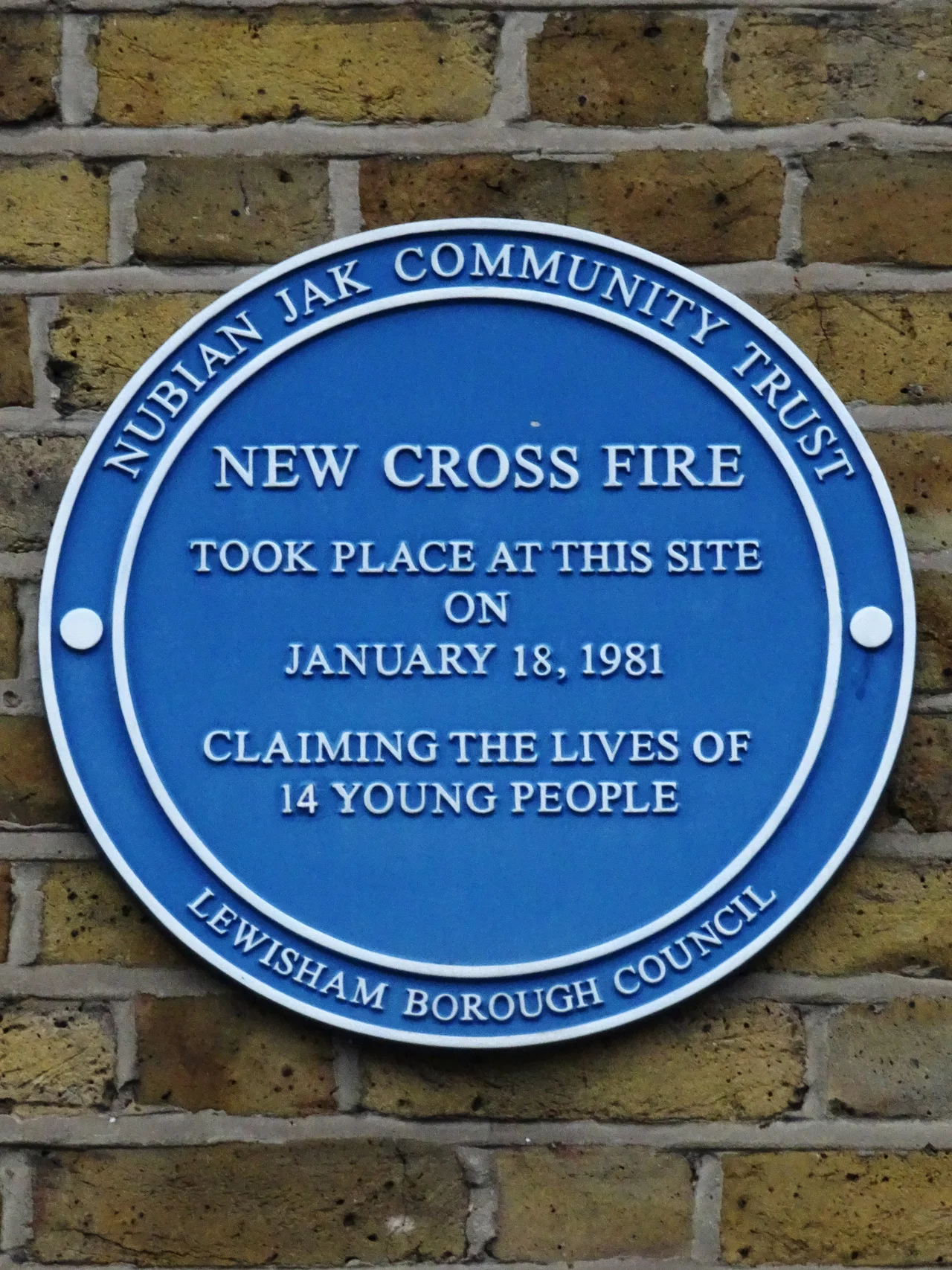

New Cross House Fire
Yvonne Ruddock turned sixteen the week before. Angela Jackson was eighteen. The two friends decided to share their birthday party at Yvonne's house, 439 New Cross Road, on the night of Saturday, 17 January 1981. Music played from the front room. Friends arrived from across south-east London, kids who knew each other from St. Andrew's youth club in Brockley and from school. Sometime in the small hours, fire broke out inside the house. By dawn on Sunday, 18 January, thirteen of those young people were dead. They were aged between fourteen and twenty-two. None of them had expected to be in the newspapers that week, much less to become the spark of a movement.
Thirteen Names
The dead were Black British teenagers, most of them children of Caribbean migrants who had built lives in Deptford and Lewisham and Peckham. Yvonne Ruddock did not survive her own birthday party. Her family found themselves planning funerals instead of celebrations. Two years later, Anthony Berbeck - one of the survivors, who was twenty when he died - took his own life. Many who knew him believed he never escaped the night, even after he walked out of it. Local people pushed for the toll to be counted as fourteen, and a memorial plaque at Catford Civic Hall lists the fourteen young people who died in the New Cross Fire of 18 January 1981. Each name belonged to someone with a future that had been quietly assumed - exams to sit, jobs to find, children one day. The fire ended those futures in a single night.
Nothing Said
What followed felt, to the bereaved families and to Black London more broadly, like a second injury. There had been complaints from neighbours about the party noise. A white Leyland Princess car was reportedly seen driving away. In the climate of 1981 - the same year as the Brixton riots, with relations between Black communities and the Metropolitan Police already broken - the suspicion of a racist attack felt unavoidable. Then the press barely covered it. While royal-wedding stories filled column inches that spring, the deaths of thirteen Black teenagers slipped past Fleet Street with a shrug. There was no message of condolence from Downing Street. The slogan that emerged from the grief said exactly what it needed to say: '13 Dead, Nothing Said.'
The Day of Action
One week after the fire, more than a thousand people packed into the Moonshot Club in New Cross. Out of that meeting came the New Cross Massacre Action Committee, chaired by the publisher and activist John La Rose. They organised what would become, in Tribune's later assessment, the largest mass movement for racial justice on British soil up to that point. On 2 March 1981, around 20,000 people marched for eight hours from Fordham Park, through south London, across the river, and on toward Hyde Park. Placards read 'Thirteen Dead, Nothing Said' and 'No Police Cover-Up.' Journalists watching from the windows of Fleet Street offices reportedly made monkey noises at the marchers below - a moment that captured, with brutal clarity, what the protest was actually about.
An Open Verdict
The investigation went sideways. Police quickly leaned toward an accidental fire that started inside the house, and forensic work eventually backed that view. But the way the inquiry treated the witnesses - young Black teenagers, many of them traumatised survivors of the same fire - left families convinced that the truth had been buried under poor questioning and assumption. An inquest in 1981 returned an open verdict. A second inquest in 2004, twenty-three years later, returned an open verdict again. No one was ever charged. To this day, no official version of what happened that night feels settled enough to close the book. The papers of the campaign now live in the George Padmore Institute archive in north London, open to anyone who wants to read them.
The Blaze We Cannot Forget
Forty years on, the New Cross fire is recognised as a turning point in Black British history - a moment when a community that had been told to be patient and grateful decided, instead, to march. The cultural response came fast and ran deep. Linton Kwesi Johnson's dub poem 'New Crass Massahkah' set the night to a low, mourning groove. Benjamin Zephaniah wrote '13 Dead.' Johnny Osbourne recorded '13 Dead and Nothing Said.' Sir Collins, a reggae producer whose son Steve died in the fire, made an album in memory of the victims. In 2020 the events anchored Steve McQueen's drama Alex Wheatle in the Small Axe series. Poet Jay Bernard's Surge: Side A won the Ted Hughes Award in 2018. A blue plaque went up at the site in 2011. Thirteen trees stand on Hackney Downs, with plaques at either end. A stone memorial sits in Fordham Park where the march began. Darcus Howe called it, decades later, 'the blaze we cannot forget.' That is the work the memorials do - they refuse to let the forgetting happen.
From the Air
439 New Cross Road sits in south-east London at 51.476 N, 0.030 W, in the borough of Lewisham. The site lies about three miles south-east of central London, between Greenwich to the north-east and Peckham to the west. Nearest major airport: London City (EGLC), roughly five miles to the north-east; London Heathrow (EGLL) lies west of central London. From cruising altitude the area reads as dense Victorian terraced housing along the A2 corridor, with the curve of the Thames just north.
Nearby Stories
- Battle of Britain, Northfleet 1.1 km away
- Bayham Old Abbey 5.4 km away
- Catharine Macaulay 6.4 km away
- Hatfield rail crash 8.8 km away
- Chequers 8.9 km away
- Chelmsford Cathedral 10 km away
- Queen Victoria Hospital 13 km away
- Fishbourne Roman Palace 36 km away