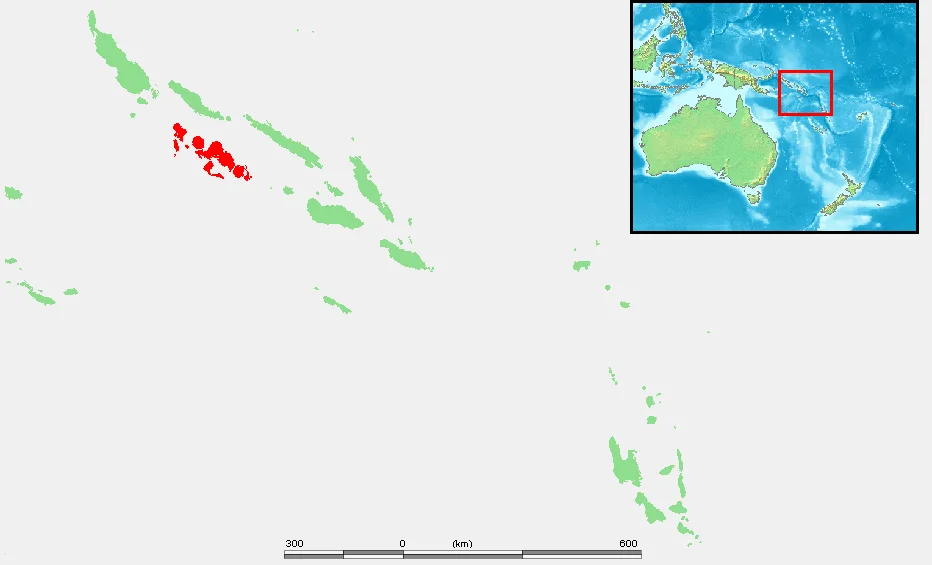

New Georgia
The 13th-century builders stacked the stones high on the headlands of central New Georgia, raising megalithic shrines whose purpose archaeologists are still decoding eight centuries later. By the 15th century, the Roviana people had shifted seaward, building a new capital on Nusa Roviana in the barrier islands of the southern lagoon. From that island hub they ran a trade and raiding network that reached across hundreds of miles of Pacific water, their war canoes carved with the spirit figureheads now held in museums as far away as London. The island has a very long memory.
A Volcanic Spine
The island itself is a slab of volcanic rock 85 kilometers long and 41 kilometers wide, the 203rd-largest island in the world and the biggest in Solomon Islands' Western Province. Mount Masse rises 860 meters at the crown. Cyclones roll through regularly; mangroves fill the marshy inlets; coral reefs rim the coast. Across the Kula Gulf to the west stands the perfect cone of Kolombangara. Across the Blanche Channel to the southwest lies Rendova. To the northeast is Choiseul, to the southeast Vangunu. New Georgia forms the southern edge of a long body of water the Americans would later call the Slot. The dense canopy drops nearly to the waterline, leaving almost no open ground.
Ten Languages on One Island
About 19,000 people lived on the island at the 1999 census. Most settled along the southern coast, where the water is calmer and the land workable. The biggest village is Munda on the west, with Sege holding the southeastern shore. The Kalikoqu tribe occupies the Roviana Lagoon, one of the great chiefly districts alongside Saikile. What is striking is the linguistic density: islanders speak ten different Melanesian languages across one volcanic island, all part of the New Georgia subgroup of Northwest Solomonic tongues within the broader Austronesian family. The valleys and lagoons divided people enough that over centuries each pocket developed its own distinct speech.
Chief Ingava and the Colonial Peace
Captain John Shortland sailed past in August 1789, returning to England with four ships of the First Fleet, and named what he saw. More than a century later, on 15 March 1893, Captain Herbert Gibson formally declared the island part of the British Solomon Islands Protectorate. The Colonial Office sent Charles Morris Woodford as Resident Commissioner in 1897 with a mandate to stop the labor trade and the firearms trade. His deputy Arthur Mahaffy, installed at Gizo in January 1900 with twenty-five armed police recruited from Malaita, Savo, and Isabel, had a different charge: to suppress headhunting. Their first target was Chief Ingava of the Roviana Lagoon, whose raids on Choiseul and Isabel had killed and enslaved hundreds. The suppression was brutal and fast. Two years later, in 1902, Reverend John Frances Goldie arrived to establish the Methodist Mission, which came to so thoroughly dominate the Western Solomons that colonial administrators found their authority second to his.
The Worst Jungle Fighting
The Empire of Japan occupied New Georgia early in the Pacific War and built the airfield at Munda under camouflage of living palm trees. Allied landings came on 30 June 1943, opening the New Georgia Campaign. What followed was seven weeks of the most miserable fighting the Americans had yet faced in the Pacific: rain, mud, malaria, and Japanese defenders dug into coral ridges the jungle rendered almost invisible. Munda itself did not fall until 5 August. The port at Bairoko Harbor, only 13 kilometers to the north, held out until 25 August. By the time the island was declared secure on 23 August 1943, fighting continued on nearby islands into October. At Seghe on the southeast coast, the Australian coastwatcher Donald Gilbert Kennedy ran a one-man intelligence post throughout the campaign, radioing Japanese ship and aircraft movements from a hidden outpost in the jungle.
A Lagoon of Layers
What remains on New Georgia now is a landscape that holds all of this at once. The megalithic shrines of the Roviana highlands are still there, still being mapped by archaeologists. The war canoe traditions continue in carving workshops around the lagoon. Munda has become a town again, with an upgraded international airport and a growing dive-tourism industry built around reefs and wartime wrecks. The jungle is steadily reclaiming the battlefields, swallowing foxholes and rusting ordnance. Few places concentrate quite this much history into a single coastline: stone-age shrines, colonial pacification, Methodist missions, and one of the Pacific war's grim campaigns, all within a short boat ride along the southern shore.
From the Air
New Georgia sits at 8.25 S, 157.5 E in the Solomon Islands' Western Province. The island is about 85 km long on a roughly northwest-southeast axis, covered in dense tropical forest with Mount Masse reaching 860 m near the center. Munda International Airport (AGGM) is on the west coast; best viewing altitude 6,000-8,000 feet to take in the whole island and the Roviana Lagoon system to the south. Nearest major field is Honiara International (AGGH) about 150 nm southeast. Frequent cyclones and tropical squalls.
Nearby Stories
- Battle of Kolombangara 9 km away
- Battle off Horaniu 25 km away
- 2007 Solomon Islands Earthquake 38 km away
- Vella Lavella 52 km away
- Woodlark Island 449 km away
- Païta 1774 km away
- Maré Island 1835 km away
- 1737 Kamchatka Earthquake 6719 km away