
New Street, Birmingham
The street is recorded for the first time in 1296, written in the borough rentals as novus vicus. New Way. It probably opened in 1166 to give the de Birmingham family a direct route from their new market at the Bull Ring to their feudal overlords' stronghold at Dudley Castle. Eight and a half centuries later, the same line of paving stones runs from Victoria Square to the Bullring shopping centre, more or less pedestrianised, lined with Boots and Pret a Manger and the occasional surviving Victorian facade. The street has carried every kind of traffic a city can produce. It has also carried a great deal of grief.
The Bond Street of the Midlands
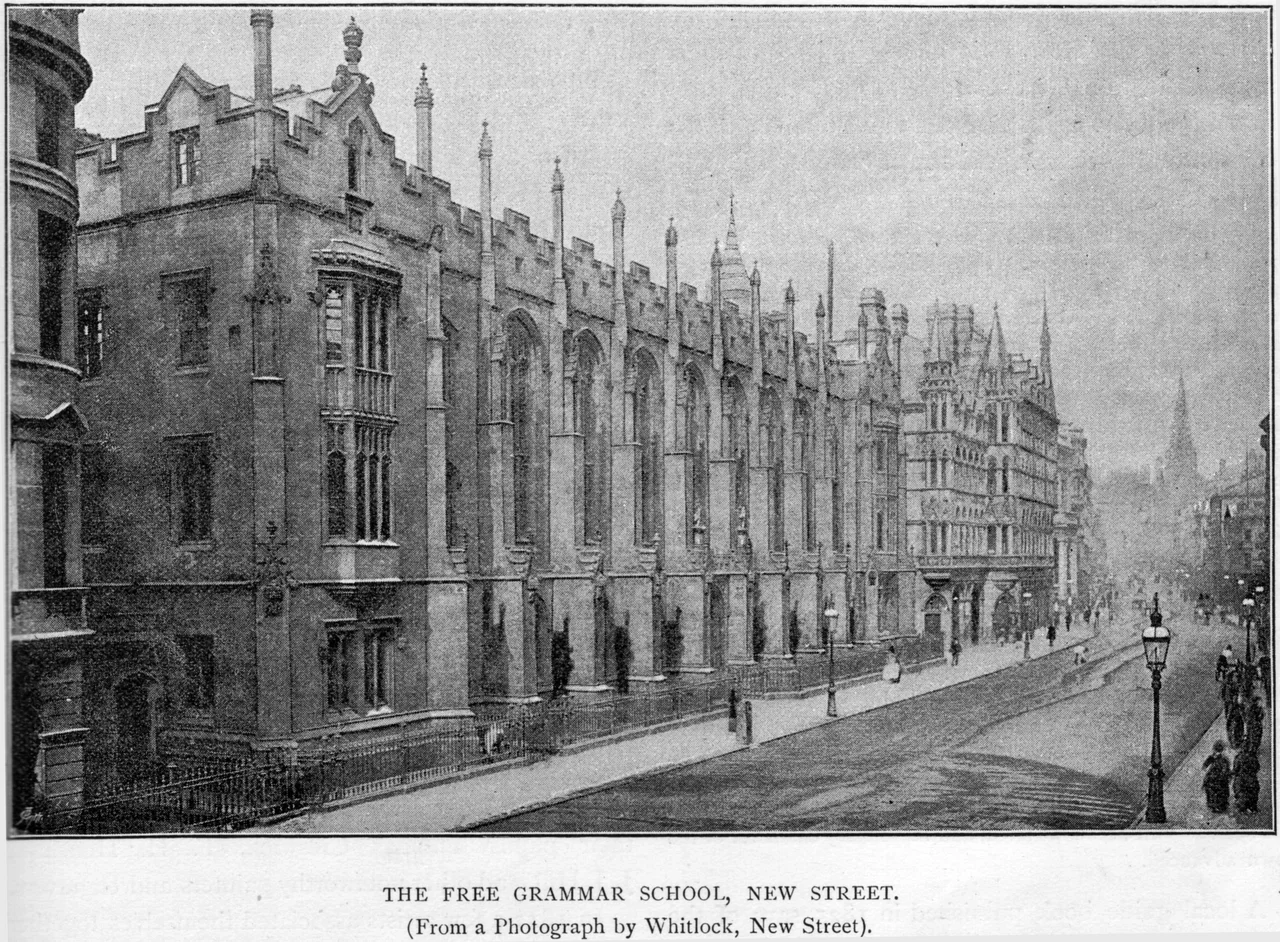
In an 1840s guide written shortly after the completion of Birmingham Town Hall, a visitor called New Street the Bond Street of Birmingham, citing its glittering array of shops, its inns, its fine Elizabethan school, its theatre, and its post office. The phrase stuck. The school was King Edward's Free Grammar School, originally the Guild of the Holy Cross, rebuilt twice on this site by Charles Barry no less, and finally moved out to Edgbaston in 1939. The Theatre Royal stood here from 1774 until 1956, with a portico designed by Samuel Wyatt in 1780 on Matthew Boulton's recommendation. Horatio Nelson visited James Bisset's Museum on New Street in 1802, two years before Trafalgar. Almost nothing of this is visible. The Theatre Royal, the Grammar School, the Hen and Chickens Inn, the Birmingham Society of Artists with its protruding Doric portico, Christ Church, the Exchange, all gone.
21 November 1974
Two pubs on New Street were full on a Thursday evening, the Mulberry Bush inside King Edward House and the Tavern in the Town under the Rotunda. The Provisional IRA detonated bombs in both. Twenty-one people died and 182 were injured, most of them young men and women out for a drink at the end of the week. The bombings shocked Britain into the Prevention of Terrorism Act, passed within days, and led to the wrongful conviction of six men who became known as the Birmingham Six and spent sixteen years in prison before being released. No one has ever been convicted of the murders. A memorial inside Birmingham Cathedral, a few minutes' walk from the bomb sites, lists the names. The Rotunda still rises above the eastern end of New Street, refurbished and full of apartments now.
Rivers of Blood
At the corner of New Street and Stephenson Street stands a Victorian building that for decades was the Midland Bank, designed by Edward Holmes between 1867 and 1869. It is now an Apple Store. On 20 April 1968, in an upstairs room of what was then the Midland Hotel, the Conservative MP Enoch Powell delivered a speech to a Birmingham Conservative Political Centre audience that became known by the line he borrowed from Virgil. Powell warned of what he called rivers of blood, predicting violent conflict if Commonwealth immigration continued. He was dismissed from the Shadow Cabinet within twenty-four hours. The speech became the gravitational centre around which postwar British arguments about race, migration, and belonging have orbited ever since. Speakers and historians return to the address on the anniversary, walking down New Street, past the Apple logo, to the building where the words were spoken.
What the Street Looks Like Now
Antony Gormley's Iron: Man stands at the western end, a six-metre cast-iron figure leaning at a slight tilt, installed in 1993 in Victoria Square. The Town Hall behind it is a Hellenistic temple in Anglesey limestone, opened in 1834. At the eastern end, the Bull Ring shopping centre and the curved Selfridges with its 15,000 spun aluminium discs marks the modern city. Between them, New Street runs pedestrianised, busy with shoppers, with farmers' markets on the first and third Wednesday of each month, and the famous Frankfurt Christmas market filling the street and Victoria Square every December. Bennetts Hill, the side street where the Pre-Raphaelite painter Edward Burne-Jones was born in 1833, runs off towards St Philip's Cathedral. The street holds its layers loosely. Most shoppers walk past Powell's window without looking up. The Theatre Royal's ghost takes its bow with no audience.
The Station Below
Birmingham New Street is the name of one of Britain's busiest railway stations, but the station has never had direct access to the street that named it. Passengers reach it via Stephenson Place or, since 2015, through the new Grand Central shopping complex built above the redeveloped concourse. It is a peculiar piece of urban etymology. The street gave its name to the station, the station gave its name to the city's principal point of arrival, and a traveller stepping off a Pendolino from London emerges into a structure that owes its address to a thirteenth-century shortcut from a medieval market to a Norman castle.
From the Air
Coordinates 52.4782 N, 1.89984 W. The principal shopping street of central Birmingham, running roughly east to west from Victoria Square to the Bullring. Recommended viewing altitude 1,500 to 2,500 feet AGL. Look for the cluster of Victorian municipal buildings around Victoria Square, the curved silver scales of Selfridges in the Bull Ring at the east end, and the cathedral of St Philip's just to the north. Nearest airports: Birmingham International (EGBB) 7 nm east-southeast; Wolverhampton Halfpenny Green (EGBO) 12 nm west; Coventry (EGBE) 14 nm east. Urban haze in summer; low cloud and drizzle dominate October through March.
Nearby Stories
- Shepshed 8.5 km away
- Battle of Evesham 11 km away
- Hixon rail crash 12 km away
- Battle of Cropredy Bridge 12 km away
- Wenlock Priory 15 km away
- RAF Shawbury 16 km away
- Market Bosworth 17 km away