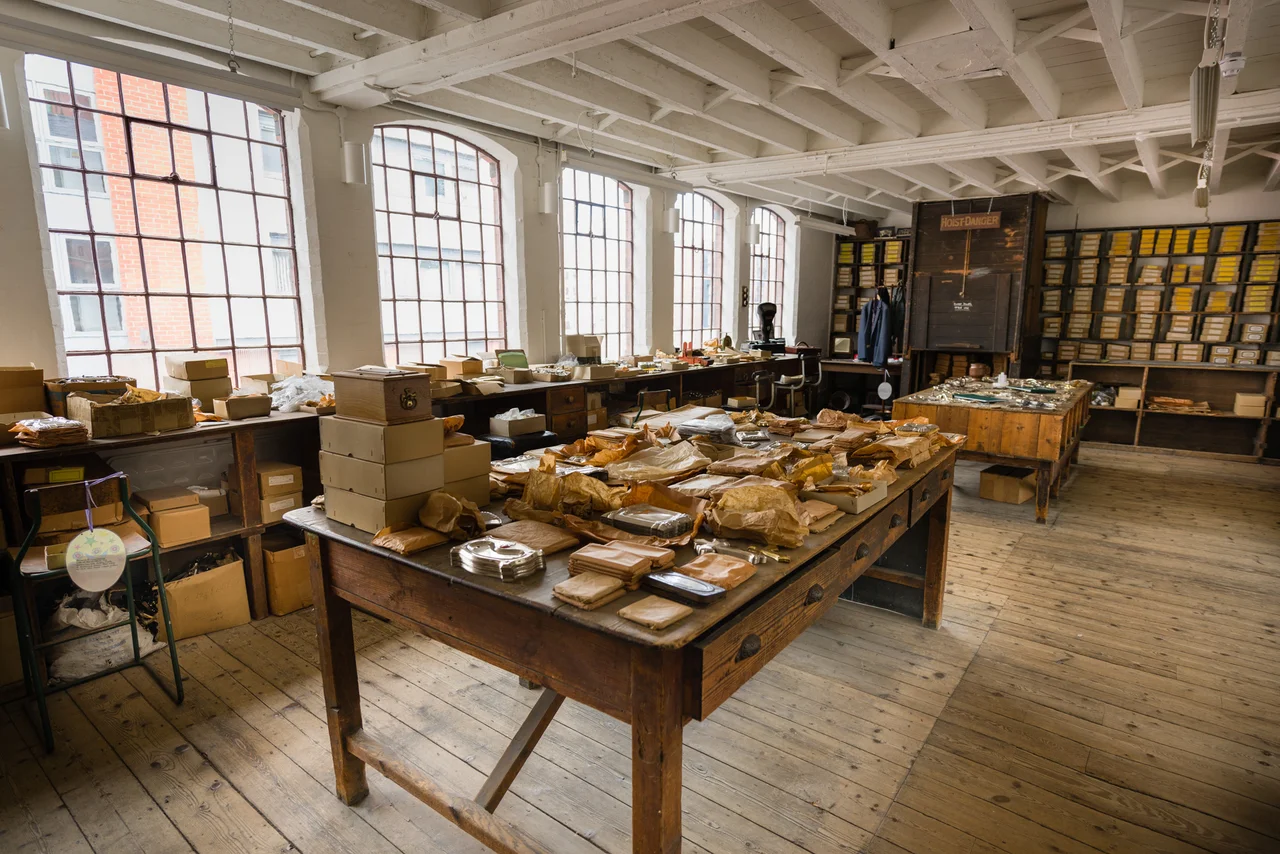

Newman Brothers Coffin Furniture Factory
When Princess Diana's coffin was carried into Westminster Abbey on 6 September 1997, the brass handles holding her body were made on a quiet street in Birmingham's Jewellery Quarter. So were the fittings on Winston Churchill's coffin, Joseph Chamberlain's, and Neville Chamberlain's. Newman Brothers had been doing this kind of work since 1894. The factory at 13 to 15 Fleet Street closed in 1998, and rather than gut it for flats, the Birmingham Conservation Trust did something unusual. They left it. The brass dust on the workbenches, the half-finished breastplates, the tea-stained mugs, the timecards on the wall. The Coffin Works museum that opened here in October 2014 is not a recreation. It is the factory exactly as the last worker found it when she locked the door.
A Brass Foundry That Became a Funeral Empire
Alfred and Edwin Newman started the company in 1882 as a general brass foundry. Twelve years later, they moved into a purpose-built factory designed by Roger Harley in 1892 at the heart of Birmingham's Jewellery Quarter, the dense network of small workshops where the city's jewellers and metalworkers had clustered for two centuries. Newman Brothers specialised in coffin furniture, the handles, breastplates, lid motifs, and trim that turned a wooden box into a sendoff fit for the Victorian middle class. By the 1950s and 1960s, the firm employed around a hundred people and exported to West Africa, India, Sri Lanka, South Africa, the Caribbean, Canada, and Malta. Death, as a trade, travelled.
The Trade That Cremation Killed
Cremation was rare in Edwardian Britain. By the 1960s it accounted for more than half of all funerals, and rising. Legislation began appearing across the country that prohibited metal coffin fittings in cremators, because the metal would not burn cleanly and contaminated the ashes. Injection-moulded plastic replaced cast brass almost overnight. Newman Brothers produced a single range of plastic handles and breastplates but refused to compromise their reputation as makers of the finest. The firm carried on producing high-quality cast-brass fittings into the 1990s, by which point only three coffin furniture manufacturers were still operational in the United Kingdom. The doors finally closed in 1998. The company was officially dissolved the next year. The looms of grief had moved elsewhere.
Joyce Green Refuses to Let It Go
Joyce Green had worked at Newman Brothers. When the firm collapsed, she would not accept that the building would be redeveloped and the social history of the trade forgotten. She led the campaign to save it. In March 2001, the Birmingham Conservation Trust carried out a feasibility study, then approached the regional development agency Advantage West Midlands, which purchased the building in 2003. Funding came in fits and starts. A business plan was finally drawn up in 2005. A £1.5 million grant secured in 2006 put the project back on track. Birmingham Conservation Trust appointed a full professional team in 2007. The total restoration took fifteen years from Green's first appeal.
A Building That Was Allowed to Be Itself
The restoration was deliberately light-handed. The nineteenth-century brickwork was not altered. The slate roof was stripped and replaced with Welsh slates, the type the building had always worn. Plastic rainwater guttering was swapped out for cast iron. The modern company sign was removed and replaced with Victorian-style signage matching the lettering visible in old photographs. Inside, the workshops were left as a working factory mid-pause. Visitors walk past the stamp room where breastplates were impressed with names, the polishing room where brass was buffed to mirror finish, the shroud room where linen interiors were hand-sewn. Each workbench still holds the tools and unfinished pieces left at the close of the last shift. The factory feels haunted in the literal sense. Its workers have only just gone home.
The Quiet Trade Beneath
Coffin furniture was made by people whose names do not appear on the brass. The polishers were mostly women, often working with toxic finishing compounds and breathing brass dust for forty years. The shroud-makers stitched linen interiors at piecework rates. The men who operated the drop-stamps did so by hand and shoulder, repeating the same movement thousands of times a day. The Coffin Works does not romanticise this. The guides talk about the working conditions, the long hours, the lung complaints, and the women who married, left for childcare, and came back twenty years later to find their old machines still running. The factory's Grade II* listing protects the building. The museum protects the labour. When you next see a brass handle on a coffin in a film or on a news bulletin, the chances are it was made here, by people who knew exactly what their handiwork was for.
From the Air
Coordinates 52.482 N, 1.90742 W. Located on Fleet Street in the dense grid of Birmingham's Jewellery Quarter, immediately north-west of the city centre. Recommended viewing altitude 1,000 to 2,000 feet AGL. Look for the warren of small-roofed Victorian workshops bounded by Vyse Street, Frederick Street, and the Birmingham and Fazeley Canal. The Jewellery Quarter is the densest concentration of small heritage industrial buildings in Britain. Nearest airports: Birmingham International (EGBB) 8 nm east-southeast; Wolverhampton Halfpenny Green (EGBO) 12 nm west-northwest; Coventry (EGBE) 15 nm east-southeast. Urban haze typical; mornings clearest.
Nearby Stories
- Shepshed 8.5 km away
- Battle of Evesham 11 km away
- Hixon rail crash 12 km away
- Battle of Cropredy Bridge 12 km away
- Wenlock Priory 15 km away
- RAF Shawbury 16 km away
- Market Bosworth 17 km away