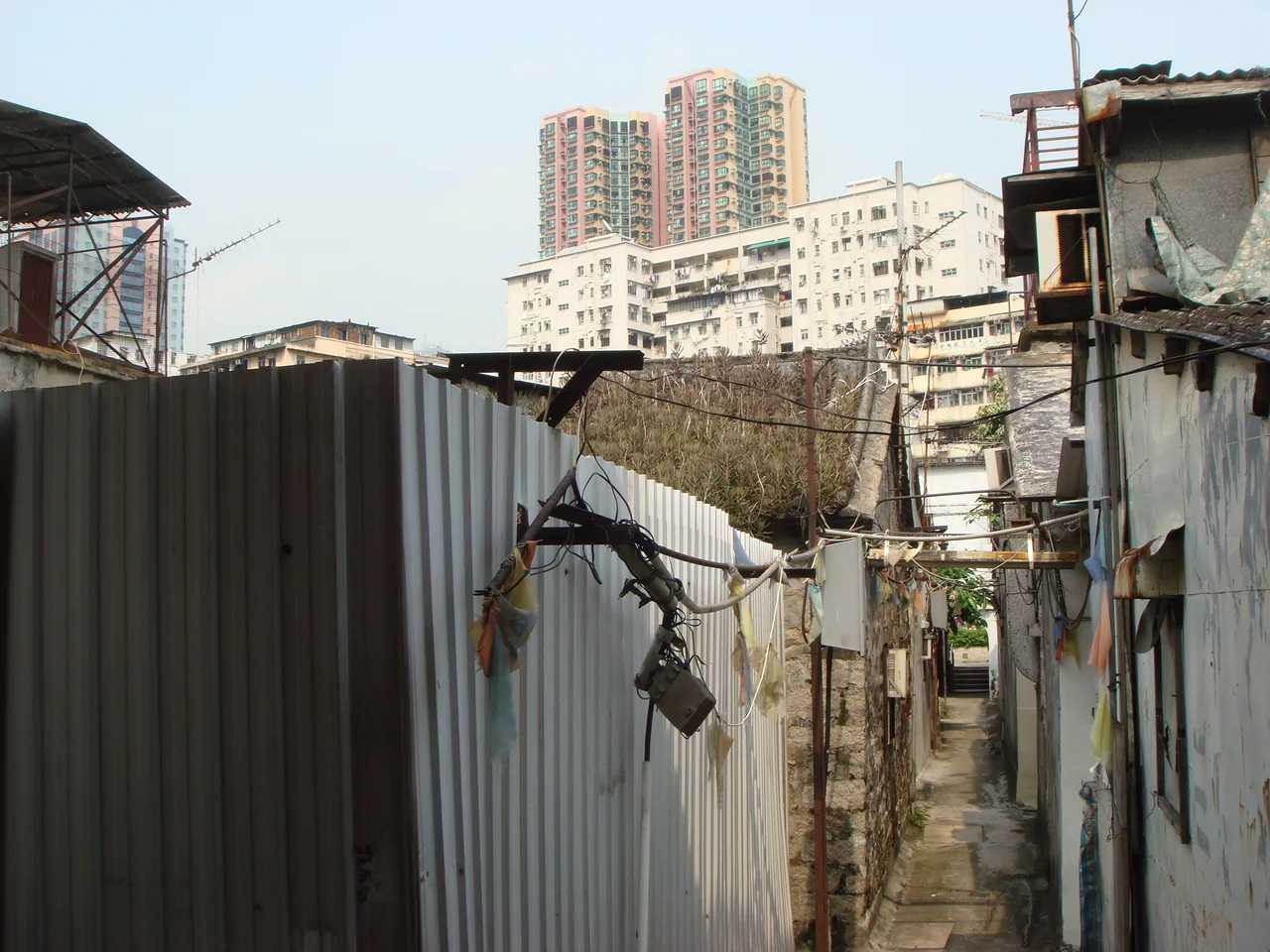

Nga Tsin Wai Tsuen
The characters carved above the entrance gate read 慶有餘 — 'overflowing prosperity' — said to be in the handwriting of Emperor Duanzong of the Song dynasty, a boy-emperor who fled south with his court in the thirteenth century and may have sheltered here. Whether the attribution is strictly accurate matters less than what it signals: this village understood itself to be ancient, to carry the weight of deep time. Nga Tsin Wai Tsuen stood in Kowloon for more than six hundred years. In January 2016, the last two holdout families walked out under threat of fines of up to HK$1 million and six months imprisonment. The village is gone now, replaced by towers.
Walls Built for Protection
The Ng, Chan, and Lee clans — the three founding lineages, with the Ng Clan Hall still standing inside the village — built a Tin Hau temple here around 1352. The fortified walls that gave the village its distinctive rectangular enclosure came later, erected around 1724. By that point, walled villages were a practical response to the realities of life in the New Territories: piracy, clan warfare, and the general insecurity of the premodern Pearl River Delta. The walls were not decorative.
Inside the 0.4-hectare enclosure, about 100 houses were arranged along three narrow streets and six side lanes — a tight, efficient layout that made the most of the protected space. The Ng Clan Hall provided the community's social and ceremonial centre. The Tin Hau Temple — dedicated to the goddess of the sea, protector of fishermen and sailors — occupied a place of honour within the walls, reinforcing the village's spiritual geography. For centuries, this was an internally coherent world.
Kowloon's Last Walled Village
Urban development swallowed most of Hong Kong's traditional walled villages long before the twentieth century ended. Nga Tsin Wai Tsuen survived longer than most, partly because its location in Wong Tai Sin district was enclosed by the expanding city rather than overrun by it. But survival in an urban context carries its own pressures.
The Urban Renewal Authority, a statutory body with significant compulsory acquisition powers, identified the site for redevelopment. The plan: demolish the village and replace it with two high-rise towers housing 750 flats, in partnership with Cheung Kong Property Holdings. For the families who still lived and ran businesses within the walls, the terms on offer were inadequate — public housing was not guaranteed, and any reduced rents offered to small shop owners were time-limited, after which market rates would apply. Grassroots entrepreneurs who had owned their shops within the village would find themselves priced out after redevelopment.
The End of Six Centuries
The resistance was organized and documented. The Nga Tsin Wai Village Concern Group formed to coordinate opposition and keep a public record of what was happening. By December 2015, only 15 families remained. They were not simply dealing with the loss of homes; they were watching the end of a settlement older than the colonial history of Hong Kong itself, older than the British lease of the New Territories, older than the Qing dynasty that signed that lease.
In late January 2016, the last occupants left. Some described the Urban Renewal Authority's approach as prioritising profit over heritage. Private developers, they noted, had been eyeing the site for thirty years and had succeeded only when the URA stepped in and deployed the Land Resumption Ordinance. The timeline of a six-hundred-year village ended not with a dramatic collapse but with paperwork and legal deadlines.
What Was Left Standing
Archaeological excavations in 2018 found Ming dynasty relics on the site, prompting a temporary suspension of redevelopment work. The finds complicated the clean narrative that development inevitably replaces heritage. 'Some conservation elements,' the authorities said, would be incorporated into the new development as a result.
The Entrance Gate, the Ng Ancestral Hall, and the Tin Hau Temple had been listed as Grade III historic buildings since March 2014 — a designation that acknowledges heritage value without necessarily preventing demolition. What becomes of those three structures within or alongside the new high-rise complex remains uncertain. The inscription above the gate — 'overflowing prosperity' — will need somewhere to go.
From the Air
Nga Tsin Wai Tsuen was located at approximately 22.335°N, 114.193°E in the Wong Tai Sin district of Kowloon, now in the dense urban fabric of the city. At 1,500–2,500 feet, the redevelopment site is visible within the tight urban grid southeast of the Lion Rock ridgeline. Lion Rock (495 m) provides the dominant visual reference to the north. The nearest airport is Hong Kong International (VHHH), approximately 25 km to the west on Lantau Island. Kai Tak development area lies to the southeast.
Nearby Stories
- Chapel of St. Francis Xavier 3.5 km away
- Cuiheng 4.1 km away
- 2015 Shenzhen Landslide 16 km away
- Shunde 31 km away
- Wanshan Archipelago 37 km away
- Nanxiong Formation 96 km away
- Heyuan 149 km away
- Checheng Fu'an Temple 629 km away