
Nitro, West Virginia
The town of Nitro, West Virginia, was built on purpose, in a hurry, to make gunpowder. In 1918, the U.S. War Department needed an enormous quantity of smokeless powder to feed American artillery on the Western Front. Eighteen hundred acres of cow pasture along the Kanawha River were chosen for the site. The federal government spent $80 million to construct what was called Explosive Plant C - an entire industrial city of barracks, factories, magazines, rail spurs, and worker housing rising out of the farmland in months. The first shipment of powder left the plant in November 1918. The armistice was signed on November 11. The first shipment was also the last. Nitro had been built to feed a war that was over.
An Instant City for the War
Daniel C. Jackling, the copper magnate who had pioneered open-pit mining in Utah, supervised the construction and operation of the Nitro plant. By the armistice, the facility was producing three hundred fifty thousand pounds of smokeless gunpowder per day. The town that supported the plant included housing for thousands of workers, schools, a YMCA, mess halls, infirmaries, and recreation facilities. Among the workers in 1918 was a young Ohio kid named Clark Gable, employed at Explosive Plant C before he would head to Hollywood and become one of the biggest movie stars of his era. The U.S. Board on Geographic Names selected the name Nitro for the new municipality - a straightforward acknowledgment of what the place existed to do. When the war ended, the town remained. The plant did not. The federal government handed the infrastructure to private chemical companies, and Nitro - 'a Living Memorial to World War I,' as the city motto now reads - became part of the Kanawha Valley's emerging chemical industry.
Chemical Valley
The forty-mile stretch of the Kanawha River between Belle and Nitro became known locally and nationally as Chemical Valley. At its peak in the late 1950s and early 1960s, this corridor was the leading chemical-producing region in the world. Union Carbide, Monsanto, FMC, Great Lakes Chemicals, and many smaller companies operated plants along the river, taking advantage of the postwar petrochemical boom, ready access to natural gas and coal feedstocks, and the existing industrial infrastructure that had grown out of the World War One munitions effort. Nitro itself hosted Monsanto's herbicide manufacturing operation, which during the Vietnam War produced the defoliant known as Agent Orange. The town also produced rubber, dyes, and a long list of intermediate chemicals. The smell of the manufacturing was distinctive - especially near the I-64 bridge - and gave Nitro a reputation that lingered in the regional consciousness long after most of the heavy industry had closed.
The Long Bill
The chemical industry left a substantial environmental and public health legacy. The Fike/Artel Chemical Site, on the grounds of the original World War One munitions plant, was placed on the EPA's National Priorities List as a Superfund site in 1983 after decades of unregulated waste storage. Solutia Inc., Great Lakes Chemicals, and Union Carbide's PTO facility have all been subject to RCRA corrective action investigations. The most consequential single legacy may be dioxin contamination linked to the Monsanto plant that produced 2,4,5-T, the herbicide that was a key Agent Orange precursor. In February 2012, Monsanto agreed to settle a class-action case covering dioxin contamination around the Nitro plant. The settlement committed up to $9 million for cleanup of affected homes and $84 million for medical monitoring of people exposed - plus the community's legal fees. Researchers have documented elevated cancer rates in the Nitro and St. Albans areas. Establishing the precise epidemiological linkage requires further study, but the clustering effect is well documented.
Nitro Today
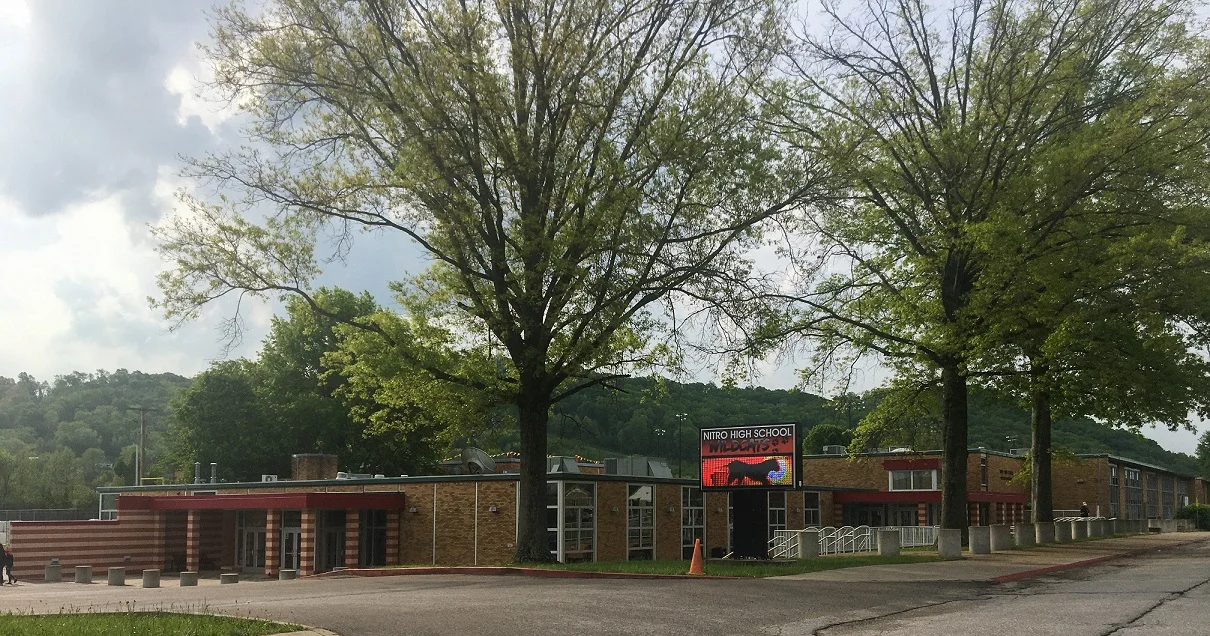
The 2020 census recorded a population of 6,618 - down from the 7,178 of 2010 and from the somewhat larger populations of earlier decades. The town now belongs to the Huntington-Ashland metropolitan area. Most of the heavy chemical manufacturing has wound down. The distinctive smell has substantially faded. Nitro High School graduates have included some figures whose names traveled well beyond the town: Major League Baseball pitcher Lew Burdette, born in Nitro in 1926, who won the 1957 World Series MVP for the Milwaukee Braves; country singer Kathy Mattea, who graduated from Nitro High after growing up in Cross Lanes; and MLB umpire Larry Barnett, born in Nitro in 1945. In 2001, in a strange small chapter of the town's history, the Raelian-affiliated company Clonaid briefly operated a laboratory in a rented room of a former Nitro high school. The town's main industries today are services, retail, and the diminished but still real chemical activity in the surrounding valley. The river still runs. The town still bears the name.
From the Air
Nitro sits on the north bank of the Kanawha River in Kanawha and Putnam Counties, West Virginia at 38.42 degrees north, 81.83 degrees west, about fifteen miles west of Charleston. Best viewed at 3,000 to 6,000 feet AGL: look for the industrial corridor along the Kanawha River with the town grid spread across the floodplain. Yeager Airport (KCRW) is fifteen miles east in Charleston. The I-64 bridge across the Kanawha at Nitro and the wide bend of the river are reliable orientation landmarks. The John E. Amos Power Plant cooling towers are visible just downstream.
Nearby Stories
- Mystery Hole 6.5 km away
- West Virginia Colored Children's Home 9.4 km away
- Clay, West Virginia 13 km away
- Staats Mill Covered Bridge 14 km away
- Hobet Coal Mine 23 km away
- Appalachia 23 km away
- Fred M. Vinson Museum and Welcome Center 30 km away
- Ponn Humpback Covered Bridge 43 km away