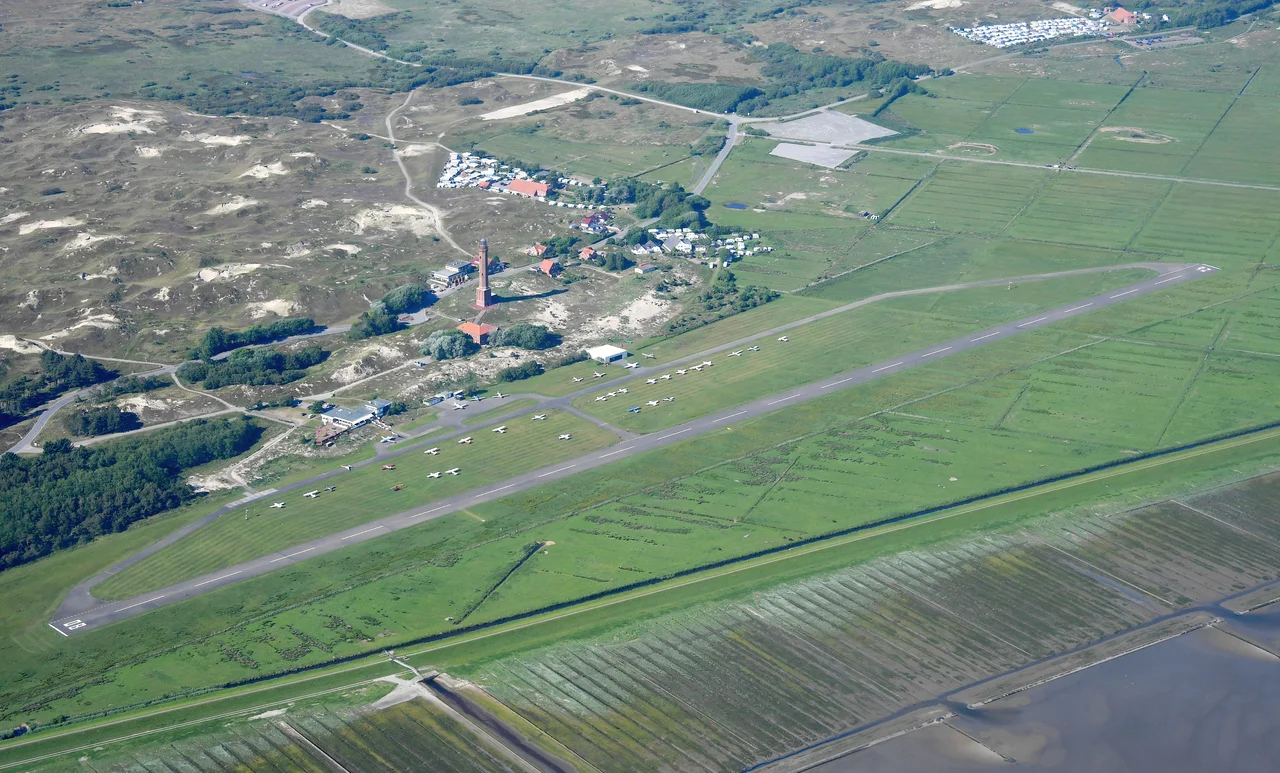

Norderney Airport
On a hard winter, when pack ice closes the channel between the East Frisian coast and the island of Norderney, the ferries stop running. The watt freezes over in patches; the seals haul out on broken floes; and a 1,000-meter strip of asphalt near the lighthouse becomes the only practical way on or off the island. Norderney Airport opened in 1970 specifically because the previous airfield had been built badly and the one before that had been turned into vegetable gardens after the war. The current strip has had its bad moments, but it has kept the lights on through forty-five winters.
Three Airfields, One Lesson
The island's original airfield is now a memory. After the Second World War, it was parceled out as allotments - small gardening plots for residents needing food in lean years. By 1954, a makeshift replacement was put down, but it had problems from the start: wrong wind exposure, prone to flooding, and no room to grow. In 1963, planners began looking for a better site. By 1965 they had picked one - agricultural land near the lighthouse, on the more sheltered south-central part of the island. Construction began in 1968 and finished in 1970. The terminal building opened the same year. In its first full year, the new airport saw thirty daily connections and long-distance routes to Bielefeld, Bremen, Düsseldorf, and Hannover. Twenty-four thousand passengers passed through. For a grass strip on a barrier island, those numbers were not modest.
Asphalt, Lights, and a Citation
In 1974, the runway and taxiways were asphalted - a project that cost 1.8 million Deutschmarks, roughly 700,000 US dollars at the time. The pavement opened the airport to heavier aircraft and forty-eight thousand passengers that year. In 1976, airport lighting went in, and night operations became possible. The same year, a Cessna 500 Citation operated by Ostfriesische Lufttransport made the first jet landing on the island. A Citation is not a long-haul aircraft, but it was a step change in what could routinely fly to Norderney. By 1985 the airport was handling about 30,000 passengers and 152,000 kilograms of freight a year. In 1990, after a terminal overhaul, those numbers climbed to 39,000 passengers and 240,000 kilograms of freight. Then they began to drift down. In 1995 it was 38,948 passengers, and the long slide toward today's reality had begun.
The Quiet Strip
As of 1 March 2025, there are no regular commercial passenger flights to or from Norderney Airport. The strip has not closed - it remains an essential piece of island infrastructure, used by general aviation, air taxi services, and medical flights - but the scheduled carriers have moved on. The economics of a 1,000-meter island runway in an era of high fuel costs and intense competition from the ferry are unforgiving. The ferry from Norddeich takes about an hour and costs less than a quarter of what a seat in a light twin used to cost. So the runway sits, lit at night, mowed in the summer, ready for the next medevac or the next charter group of golfers, and waiting for the next hard winter when the seas freeze and the asphalt becomes once again the only way home.
Why an Island Needs an Airport
Norderney has about 5,850 year-round residents and tens of thousands of summer visitors. The ferry handles most of them most of the time. But islands are islands. When the North Sea throws weather at the East Frisian coast - which it does several times each winter - small craft do not sail and big ferries stay tied up at Norddeich. People still need to leave for hospitals on the mainland. Goods still need to arrive. Emergencies do not check the tide tables. The 1,000 meters of paved runway near the lighthouse exist for those moments. They are not glamorous. They are essential.
From the Air
Norderney Airport (EDWY) sits at 53.71°N, 7.23°E on the south-central part of Norderney island, near the lighthouse and just inland of the dunes. The runway is 1,000 meters long, oriented roughly 08/26, paved and lit. Recommended pattern altitude per local AIP. The airfield is the nearest paved runway for the central East Frisian Islands and handles general aviation, air taxi, and medevac traffic. Watch for migratory birds during seasonal passages - the Wadden Sea is one of Europe's busiest flyways and the airport sits on the southern edge of the protected zone. Best visual reference on approach: the Norderney lighthouse just north of the strip.
Nearby Stories
- Leaning Tower of Suurhusen 2.9 km away
- Organ in the Jacobikerk at Uithuizen 3.4 km away
- Alpha Ventus Offshore Wind Farm 7 km away
- Harle (gat) 11 km away
- Battle of Heligoland (1864) 12 km away
- Borkum 13 km away
- Gode Wind Farm 15 km away
- Varel 27 km away