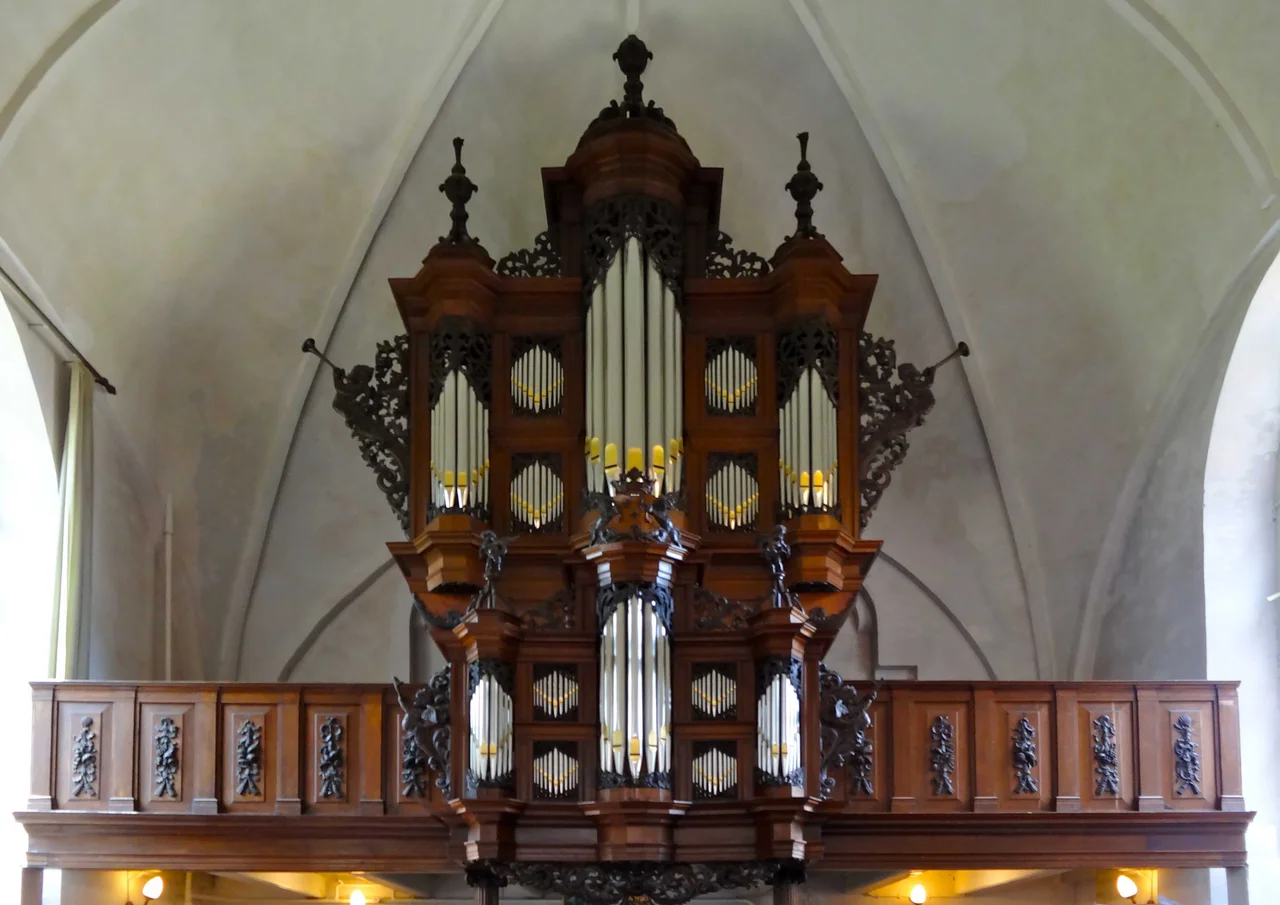

Organ in the Jacobikerk at Uithuizen
'I do not deserve anything from these two works,' Arp Schnitger wrote about his organs at Uithuizen and the Academiekerk in Groningen, 'because I had two rogues and idlers in those places who probably consumed a lot, but have not earned anything for me. God will give them their reward.' It is one of the great backhanded compliments in the history of organ building - the master himself dismissing one of his masterpieces because the local crew drank too much and worked too little. Three hundred and twenty-five years later, the organ at Uithuizen is still here, still playable, still considered one of the finest surviving Schnitger instruments in the world. The rogues, presumably, got whatever reward God decided on.
A Village Organ, Oversized
The congregation of the Jacobikerk in Uithuizen - a market village on the Groningen coast - signed their contract with Arp Schnitger on 26 April 1699. They were buying twenty-seven stops on two manuals and pedal, for 1,600 Caroli guilders, plus another 900 to the furniture maker Allert Meijer for the case and gallery. Schnitger threw in a twenty-eighth stop at his own expense and delivered the finished instrument in 1701. When he was done, the organ at Uithuizen was the largest village organ in the Netherlands. The villagers, who knew their parish was not a city, must have looked at the soaring case in their small whitewashed church and felt the slight vertigo of acquiring something out of scale with the building around it.
Lions and Angels
Look up at the Rückpositiv - the smaller chest of pipes that hangs over the gallery rail - and the central tower is crowned by the coat of arms of the Alberda van Menkema family, the patrons whose nearby borg still stands. Two upright lions hold the shield. The carvings on either side, attributed to Jan de Rijk, show openwork acanthus tendrils that twist upward and resolve into musical angels playing baroque instruments. Acanthus foliage runs above and below every pipe field, enclosing the whole assembly in a sculpted frame. This was a parish church spending serious money to make sure the visiting nobility saw their name carved in oak the moment they walked through the door.
The Hinsz Repairs
Schnitger's workshop did the original build, but the man whose name is most associated with later northern Dutch organ work is Albertus Antonius Hinsz, his successor's successor. Hinsz repaired the Uithuizen organ in 1747 and restored it more thoroughly in 1785, renewing both the manual and pedal keyboards and adding semitones in the bass octave that the original keyboard lacked. The sound, by all accounts, did not change. Hinsz understood what he was working with. Two centuries later, his keyboards are still the ones organists touch when they play the instrument today - a quiet piece of continuity hiding inside an instrument that has otherwise been taken apart and reassembled more than once.
What Was Lost, and Found Again
The nineteenth century was rough on the Uithuizen organ. Between 1854 and 1856 the workshop of Petrus van Oeckelen replaced ten of Schnitger's stops in whole or in part, widened the case, and broadened the pedal division to suit nineteenth-century tastes. In 1891 the same workshop swapped out Schnitger's original wedge bellows for vertical reservoir bellows - mechanically more reliable, sonically less interesting. The restoration of the original Schnitger sound waited almost a century. Beginning in 1987, the Swiss organ builder Bernhardt Edskes set out to undo what the nineteenth century had done. He returned the Rückpositiv to its 1701 state first, reconstructing five stops from surviving fragments. Between 1999 and 2000 he completed the work on the main manual and pedal. The wedge bellows came back. The lost stops were rebuilt, including the façade pipes with their gilded labia.
A Template for the World
What makes the Uithuizen organ extraordinary today is not just that it survived - many baroque organs survived in some form - but that what survived is so largely original. Schnitger's pipework, Schnitger's windchests for the Rückpositiv and pedal, Hinsz's keyboards from 1785, and Edskes's careful reconstructions sit together as one continuous instrument. Modern organ builders use it as a reference: when someone wants to rebuild a lost Schnitger organ elsewhere in northern Europe, the Uithuizen instrument is one of the templates they study. The 28 stops and 39 ranks of pipes are tuned in Vallotti temperament, a semitone above modern pitch. To hear it played is to hear, as closely as anyone alive can, what a village congregation on the Groningen coast heard in 1701 - the year Arp Schnitger handed them his work and quietly cursed the men who had helped him build it.
From the Air
The Jacobikerk in Uithuizen stands at 53.41°N, 6.67°E in the village center of Uithuizen, about 25 km north of Groningen city. The church and its slim brick tower are visible above the flat polder landscape. Nearest airport is Groningen Airport Eelde (EHGG), 40 km south. From cruising altitude, Uithuizen reads as a wierde-village rise on the otherwise level Hogeland plain.
Nearby Stories
- Spinnenkop Wedderveer 2.5 km away
- Rysum Organ 3.3 km away
- Miedenmolen, Holwerd 3.9 km away
- Tynaarlo 6.4 km away
- Prinses Margriet Canal 10 km away
- Norderney 13 km away
- Schule am Meer 31 km away
- Gemini Wind Farm 47 km away