_D-AOLH_(23390271522).jpg)
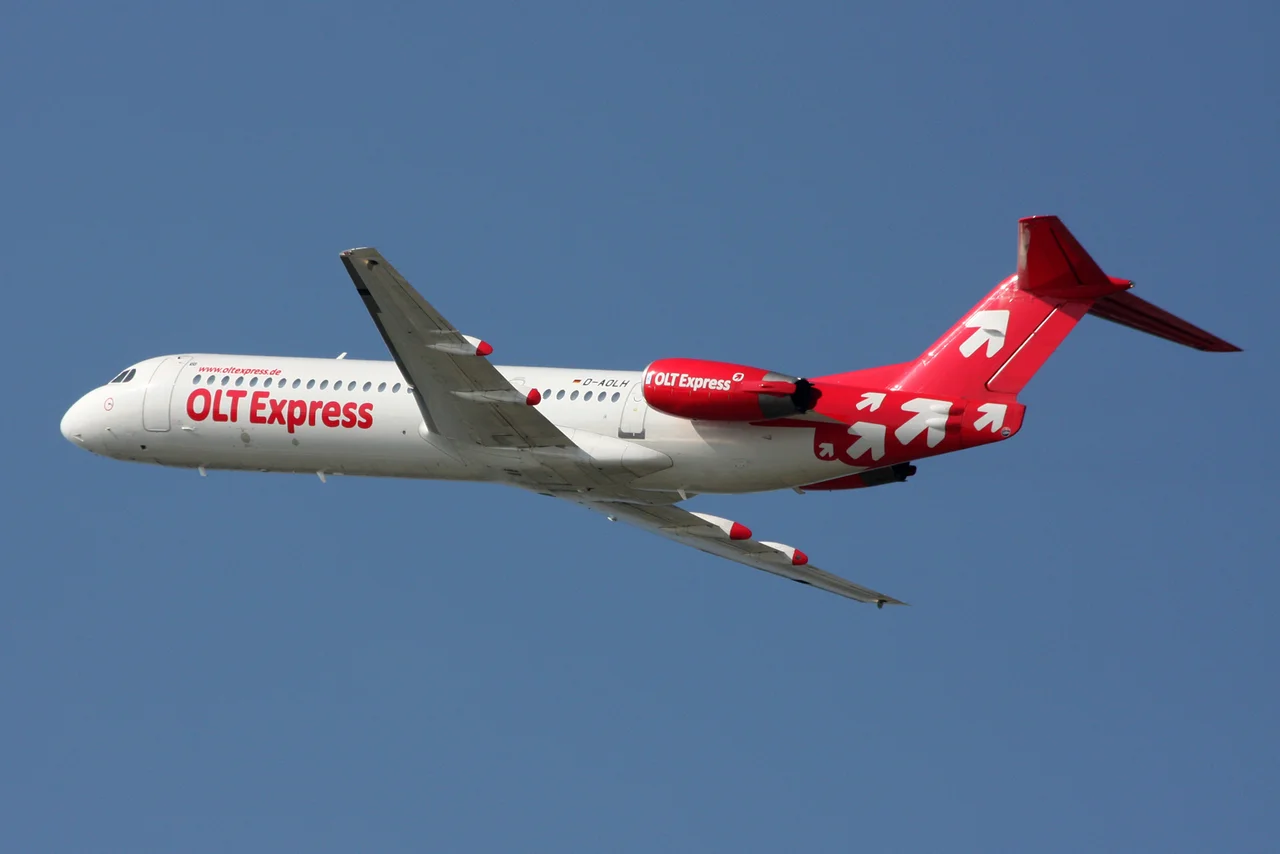
OLT Express Germany
On 27 January 2013 the airline known as OLT Express Germany shut down without warning. The closure surprised almost no one in the European aviation industry, because by that point the Bremen-based regional carrier had been visibly dying for at least six months, ever since its Polish parent company collapsed in one of the largest Ponzi-scheme implosions in modern European financial history. The story of how a small, profitable, fifty-year-old East Frisian island-hopper ended up owned by a Polish shadow-banking fraud — and was destroyed by it within eighteen months — is one of the stranger sagas in commercial aviation. The original company had begun in 1958 with a single Danish-built four-seat plane flying air-taxi runs to Borkum and Heligoland from Emden's small airfield. The pilots in the early years carried the mail in their flight bags. By 2012 the same airline was flying Fokker 100 jets between Vienna, Toulouse and Saarbrücken on routes its founders would not have recognized.
Dekker and Janssen
On 1 November 1958, Martin Dekker and Jan Janssen registered a company in Emden called Ostfriesische Lufttaxi - Dekker und Janssen OHG. Their first aircraft was a KZ VII, a single-engine wood-and-canvas four-seater built by Skandinavisk Aero Industri in Copenhagen. The business plan was simple: fly people and cargo from the East Frisian coast to the North Sea islands, which were otherwise reachable only by tide-dependent ferries that ran a few times a day in summer and barely at all in winter. In 1961 they hired their first employee, a pilot. The same year they hired what their own corporate history calls a Bodenstewardess — a ground stewardess. By 1968 the airline had five aircraft and was operating 13,174 flights a year, almost all of them under twenty minutes long.
Going Up-Market
By 1991, with its island operation profitable and stable, OLT expanded into mainland scheduled service from Bremen. The fleet grew to include Saab 2000 turboprops and Fokker 100 regional jets. In 1996 the smaller competitor OFD — Ostfriesischer-Flug-Dienst — was absorbed into OLT under the control of AG EMS, the local ferry conglomerate. By the late 2000s the airline was flying contract shuttle services for Airbus, ferrying engineers and managers between the Airbus assembly sites in Toulouse and Hamburg. The Airbus contract represented a substantial share of OLT's revenue. In August 2011, Airbus declined to renew it.
The Polish Buyer
Losing the Airbus contract meant losing one hundred of OLT's one hundred and twenty employees. The Fokker and Saab operations were to be wound down. Only the original island routes from Emden to Borkum and Heligoland would survive, and even those were transferred to a new independent company called OFD Ostfriesischer-Flug-Dienst. Then, in the middle of the restructuring, a buyer appeared. Amber Gold, a Polish financial-services company that had spent several years offering implausibly high returns on gold-backed investment products, announced it was acquiring OLT along with two Polish carriers — Jet Air and the charter airline Yes Airways. The three were rebranded under the umbrella OLT Express, with the German operation renamed OLT Express Germany. Amber Gold's founder, Marcin P., projected a vision of a low-cost regional network competing with Lufthansa across central Europe. The aviation press was skeptical. The skepticism was warranted.
Collapse
Amber Gold was not a financial-services company. It was a Ponzi scheme, paying old investors with new investors' money, and by July 2012 it was running out of new investors. On 27 July 2012 the Polish OLT Express suspended all flights without notice, stranding passengers across Eastern Europe. Within days Amber Gold itself was placed under regulatory investigation in Poland. Marcin P. was eventually convicted of fraud and sentenced to fifteen years in prison; his wife received the same sentence. The total losses to Polish investors ran into the hundreds of millions of euros. The German subsidiary kept flying, briefly. In August 2012 a Dutch holding company called Panta Holdings — owner of Denim Air and Maas Air Leasing — bought OLT Germany out of the wreckage and tried to keep its routes running. The math did not work. On 27 January 2013, OLT Express Germany ceased all operations.
What Remained
The independent OFD Ostfriesischer-Flug-Dienst — the company that had spun off the original island routes in 2011 — survived everything. It still flies BN-2 Islanders and other small piston aircraft from Emden to Borkum, Juist, Norderney, Langeoog and Heligoland, operating essentially the same business model that Dekker and Janssen registered in 1958. The mainland scheduled network is gone. The Fokker 100s flew to other airlines or to the desert. The Polish parent company exists only in court documents and in a series of Polish-language true-crime podcasts. From the air, a clear day over the East Frisian islands will still show you a small white twin-engine plane making one of the shortest scheduled flights in Europe — Emden to Borkum is fewer than twenty minutes wheels-up to wheels-down. It is the last piece of OLT still in the sky.
From the Air
OLT Express Germany operated principally from Bremen Airport (EDDW, 53.05°N, 8.79°E) and Saarbrücken Airport (EDDR). Its predecessor and successor operations are anchored at Emden Airfield (EDWE, 53.39°N, 7.23°E), a small regional aerodrome on the eastern edge of Emden that today serves the East Frisian island shuttle network. The historic island routes connect Emden to Borkum (EDWR, ~30 km west), Juist, Norderney, Langeoog and Heligoland (EDXH, ~75 km north in the German Bight). The flight from Emden to Borkum is one of the shortest scheduled airline operations in Europe — fewer than 20 minutes including taxi. Recommended viewing altitude: 1,500–3,000 ft AGL over the East Frisian island chain to see the multiple short hops simultaneously.
Nearby Stories
- Tynaarlo 5.3 km away
- Organ in the Jacobikerk at Uithuizen 6.4 km away
- Bourtange 8.9 km away
- Norderney Airport 11 km away
- Razing of Friesoythe 11 km away
- Harle (gat) 19 km away
- Lordship of Gödens 22 km away
- Alpha Ventus Offshore Wind Farm 45 km away