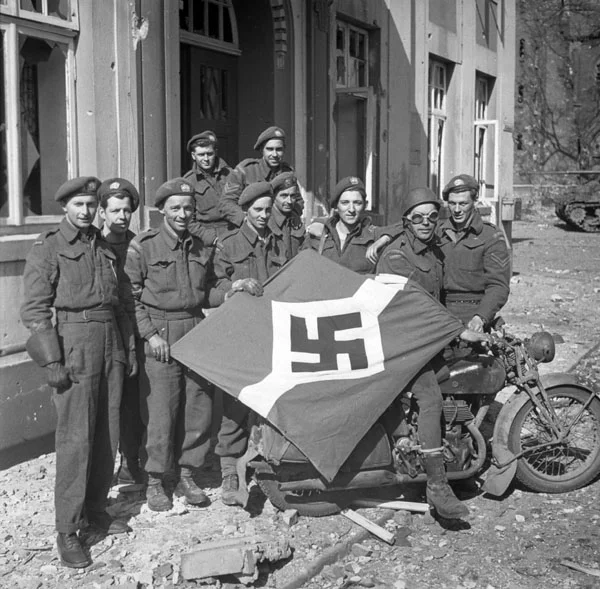

Razing of Friesoythe
Lieutenant-Colonel Frederick Wigle died on the morning of 14 April 1945, in a small Lower Saxon town that almost no one outside Germany had ever heard of. A German soldier, not a civilian, fired the shot. By the time anyone established that for certain, Friesoythe was gone. What happened over the next eight hours sits in an uncomfortable corner of the Allied war: a deliberate, methodical burning of a town by troops who had spent the morning capturing it, ordered by a general who later wrote that he felt 'no great remorse.' The war in Europe ended twenty-four days later.
The Final Spring
By April 1945 the British and Canadians were pushing across northwest Germany behind the success of Operation Plunder, the Rhine crossing. Everyone in uniform understood the war was almost over. The historian Max Hastings later called this period 'many foolish little battles which wasted men's lives.' One British corporal put it bluntly: 'Why don't the silly bastards give up?' A British pilot wrote home that it seemed 'a stupid time to die.' But the Germans did not give up. Paratroopers, Volkssturm units, teenagers with eight weeks of training and old men with Panzerfausts kept fighting from village to village across the sodden Westphalian Lowland - and Allied frustration was hardening into something colder. On 15 April British troops would reach Bergen-Belsen. The mood was already turning before they did.
The Sod of Sögel
Five days before Friesoythe, the 4th Canadian (Armoured) Division had done something similar at Sögel, 25 km to the west. German civilians had reportedly joined the fighting there and killed several Canadians. Major-General Christopher Vokes, the division's commander, decided the town centre needed to be destroyed as a lesson. It was, with truckloads of dynamite. Vokes knew this violated the Hague Conventions and was careful never to put the order in writing. His own soldiers started calling him 'the Sod of Sögel.' Then came Friesoythe. The Argyll and Sutherland Highlanders, led by Lieutenant-Colonel Frederick Wigle, took the town at dawn on 14 April after a flanking night march. At around 08:30, about fifty German soldiers stumbled into Wigle's tactical headquarters and a firefight broke out. Wigle was killed. The town was fully in Canadian hands by 10:30. Within minutes of the firefight, the rumour was running through the battalion that a civilian had shot him in the back.
The Order Nobody Wrote Down
Vokes was furious. He wrote in his memoir, decades later, that he had had a 'special regard and affection' for Wigle - a first-rate officer killed, he believed at the time, by a sniper from the back. He summoned his operations chief and roared at him: 'Mac, I'm going to raze that goddam town. Tell 'em we're going to level the fucking place. Get the people the hell out of their houses first.' Lieutenant-Colonel Mackenzie Robinson obeyed, but talked Vokes out of putting the order in writing or proclaiming it to the civilians. The Argylls, on their own initiative, had already started burning houses in revenge for Wigle. Then the order made it official. Universal Carriers fitted with flamethrowers - Wasp carriers - moved through the streets. Soldiers in the side streets threw petrol containers into houses and lit them with white phosphorus grenades. The burning continued for over eight hours.
The People Who Did Not Get Out
Most of Friesoythe's four thousand residents had already evacuated to the countryside on 11 and 12 April. But not everyone left. Twenty civilians from the town and the surrounding villages were killed during the two days of fighting and what followed - elderly people, families that had stayed in their cellars, residents who, according to the accounts, were dragged from their houses before the houses came down. There were reports of civilians lying dead in the streets. The German assessments afterwards put the destruction at 85 to 90 per cent of the town. Of 381 houses in the centre, 231 were destroyed and 30 more badly damaged. The convent on the edge of town was, a Canadian nurse wrote home, the only building left standing. In the suburb of Altenoythe, 120 houses and 110 other buildings were gone. The rubble was bulldozed into the craters in the local roads so the Canadian tanks could continue east toward Oldenburg.
The Silence That Followed
The official record went quiet almost immediately. The Argylls' war diary noted only that 'many fires were raging.' Nothing about a deliberate burning appeared in the division, corps or army war diaries. The 1st Battalion of the Argylls was awarded the battle honour 'Friesoythe' for the morning's combat. When the Canadian Army's official historian, Colonel Charles Stacey, visited Friesoythe the following day and later wrote it up in the 1960 official history, he simply said 'there is no record of how this came about.' Vokes, in 1946, sat on a panel that heard the appeal of the convicted German war criminal Kurt Meyer and commuted his death sentence to life imprisonment, citing what his own troops had done in Italy and Northwest Europe. Forty years on, he was still defending the decision. Friesoythe, meanwhile, did what bombed and burned German towns did: it picked up the bricks that were left and built itself again.
From the Air
The razing took place at 53.02 degrees north, 7.86 degrees east, in what is today the centre of Friesoythe, Lower Saxony. The town sits on the River Soeste about 32 km west of Oldenburg. The flat, often boggy terrain of the Westphalian Lowland is the same ground that channelled the Canadian advance in April 1945. Nearest airports today are Bremen (EDDW) to the northeast and Münster-Osnabrück (EDDG) to the southwest; the small Cloppenburg-Varrelbusch field (EDWV) lies 20 km south. From the air, the rebuilt town centre and the convent on the edge of town are the only physical reminders of the event.
Nearby Stories
- Nienhaus 5.8 km away
- Quakenbrück 7.1 km away
- Meppen 7.9 km away
- Ems 12 km away
- Wiesmoor 19 km away
- Valentin submarine pens 25 km away
- Teufelsmoor 31 km away
- Minden 59 km away