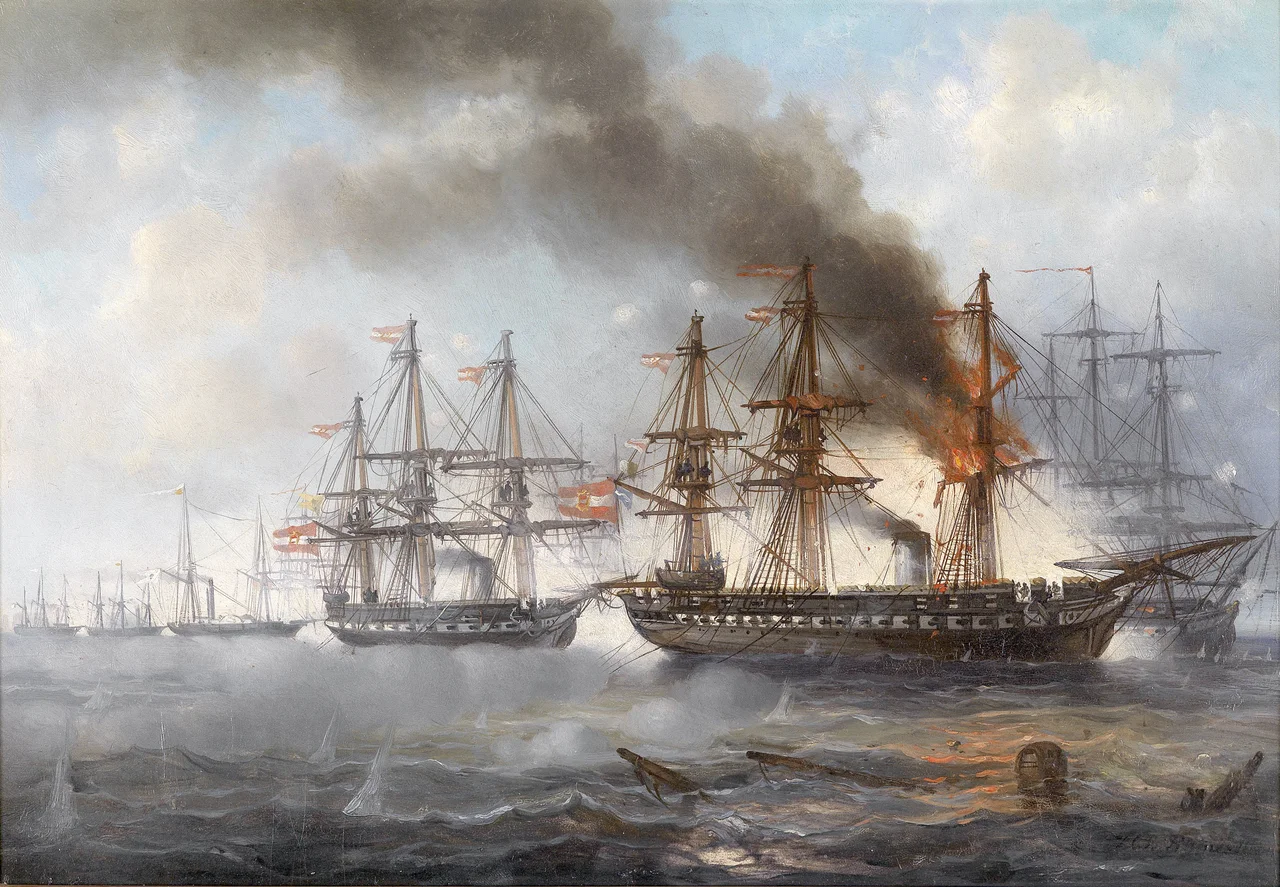

Battle of Heligoland (1864)
Both sides claimed to have won. Denmark insisted on it; the Austrians and Prussians said it was a draw, though their commander quietly accepted a promotion to rear admiral as if he'd done rather better than that. Historians have argued about it ever since. What is certain is that on the afternoon of 9 May 1864, in the southern North Sea off a tiny British-held island called Heligoland, four wooden warships passed each other at two thousand yards and unleashed broadsides into each other's flanks - and that this was the last time on Earth that squadrons of wooden ships ever fought a battle. Within a generation, iron and steel would make the entire scene impossible. The Battle of Heligoland was a closing door.
Why the North Sea Filled With Ships
The trigger was a constitutional fight over three small duchies. In November 1863, Denmark passed a constitution integrating Schleswig, Holstein, and Lauenburg into the Danish state, which violated a London treaty signed eleven years earlier. Prussia and Austria delivered an ultimatum. Denmark refused. War began on 1 February 1864, and almost immediately the Danish fleet, far stronger than the Prussian one, slapped a blockade on the German North Sea coast. By early May, fifteen German prizes had been captured. Hamburg and Bremen were effectively closed. The Austrians decided to fix this by ordering their Levant Squadron, anchored in the Mediterranean, to steam to the German Bight. Commodore Wilhelm von Tegetthoff led them north.
Two Frigates, Two Frigates, and a Burning Foretopsail
The fight itself was strange. The Austro-Prussian flotilla had more ships, but the Prussian gunboats and aviso were slow and underpowered, and they lagged hopelessly behind during the action. Effectively this was two Austrian steam frigates - Schwarzenberg and Radetzky - against three Danish vessels under Commodore Edouard Suenson. The squadrons sighted each other in mid-morning. At 13:57 Schwarzenberg opened fire at 3,750 yards. The line of battle closed to 2,000 yards, then to 400, ships passing in opposite directions and pouring broadsides across the gap. A Danish shell from Niels Juel killed or wounded most of one Austrian gun crew. Then Schwarzenberg's foretopsail caught fire - the third blaze of the day, and the one her crew could not extinguish. By 16:00 she was burning badly enough that Tegetthoff broke off and ran for the neutral three-mile zone around Heligoland.
A British Frigate Holds the Line
Heligoland in 1864 was a British possession, ceded to Britain by Denmark fifty years earlier. The British frigate Aurora, commanded by the Arctic explorer Francis Leopold McClintock, had spent the previous days shadowing both squadrons to mark the limits of British neutral waters. When Tegetthoff fled, Suenson tried to pursue - and McClintock, in a remarkable bit of small-ship diplomacy, simply steamed Aurora between the two retreating Austrians and the chasing Danes, daring Suenson to violate British neutrality by firing through her. Suenson held off. A Danish hit on Jylland's rudder also helped, leaving her unable to maneuver. Tegetthoff's burning ships limped to Cuxhaven through the night. The Danes had inflicted more damage; the Austrians had broken the blockade. Three days later an armistice took effect.
What Survived
Politically, the battle changed nothing about the larger war. Denmark lost. The duchies went to Austro-Prussian control, and by the following year the Danes had ceded Schleswig-Holstein outright. Tegetthoff went on to win the much bigger Battle of Lissa in 1866 and is remembered today as one of the great naval commanders of the nineteenth century. Suenson got a monument at Nyboder in Copenhagen. A German memorial to the Austrian dead stands in Ritzebuttel, Cuxhaven. And one of the Danish frigates, Jylland - the wooden-hulled, screw-driven ship whose rudder failed at exactly the wrong moment - still exists, preserved at Ebeltoft on the Danish coast. She is the last surviving wooden screw-driven warship in the world. The era she fought in ended that afternoon off Heligoland.
From the Air
The battle was fought roughly 54.05°N, 7.85°E, in open North Sea water just outside the British neutral zone around Heligoland (Helgoland). Today the position is Bundesrepublik German waters in the German Bight, southwest of the modern Helgoland archipelago. The nearest aviation reference is Helgoland-Dune airport (EDXH), the small island airfield east of Heligoland itself. Cuxhaven, where the burning Austrian flagship Schwarzenberg sheltered, is roughly 30 nm southeast; Wilhelmshaven and Bremerhaven lie further south along the German coast. Open water with no fixed feature marks the engagement zone - the memorial markers are on land at Ritzebuttel (Cuxhaven) and Nyboder in Copenhagen.
Nearby Stories
- Blaue Balje 5 km away
- Baltrum 6.8 km away
- German Bight 19 km away
- SMS Ariadne 20 km away
- Amrumbank West 27 km away
- Stalag X-B 62 km away
- Teufelsmoor 91 km away
- Lilleø 207 km away